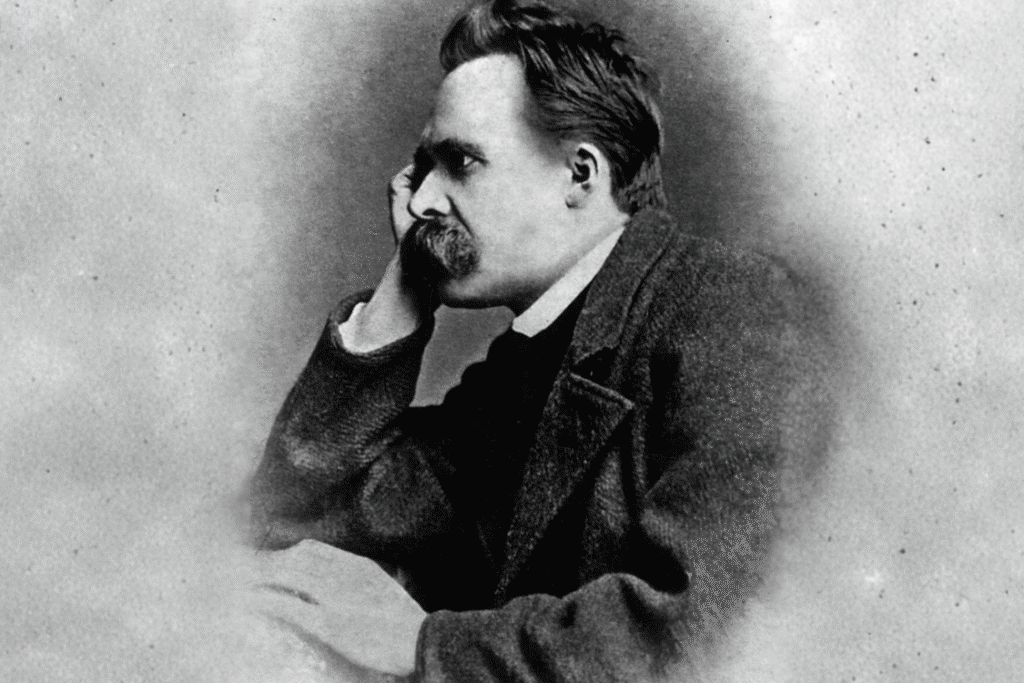
What happens when the beliefs that once gave life meaning no longer feel convincing? Nietzsche nihilism quotes are often shared as if the German philosopher simply looked at existence, declared everything meaningless, and called it a day. His actual position was more complicated.
Friedrich Nietzsche saw nihilism as a crisis that appears when old sources of meaning and morality lose their authority. Yet much of his philosophy asks what comes next: how people might face uncertainty, create values, endure suffering, and affirm life without retreating into comforting answers they no longer believe.
The quotes below capture both sides of that struggle, from the death of God and the abyss to self-overcoming, purpose, freedom, and amor fati.
WHAT’S INCLUDED IN THIS CONTENT:
- Nietzsche Quotes That Explain Nihilism
- Nietzsche Quotes About Truth, Belief & the Crowd
- Nietzsche Quotes About Meaning and Endurance
- Nietzsche Quotes About Self-Overcoming
- Nietzsche Quotes About Affirming Life
- Was Nietzsche Actually a Nihilist?
- A Note on “There Are No Facts, Only Interpretations”
- Final Thoughts on Nietzsche and Nihilism
Nietzsche Quotes That Explain Nihilism
Nietzsche did not use nihilism as a fashionable synonym for being gloomy. He was describing a deeper collapse of values, especially when the beliefs that once supplied purpose no longer seemed convincing.
1. When the “Why” Disappears
What does nihilism mean? That the highest values devaluate themselves. The aim is lacking; ‘why?’ finds no answer.
Friedrich Nietzsche, 1887 notebook entry, later published in The Will to Power
This is one of Nietzsche’s clearest descriptions of nihilism. The problem is not merely sadness or disbelief. It begins when the values a culture considered highest no longer seem capable of explaining why people should live, suffer, sacrifice, or choose one path over another.
There is also an important source distinction here. The Will to Power was assembled after Nietzsche’s death from his notebooks; he did not publish it as a finished book. Treating every line in it as though Nietzsche personally prepared the collection for publication erases a rather important part of its history.
2. God Is Dead
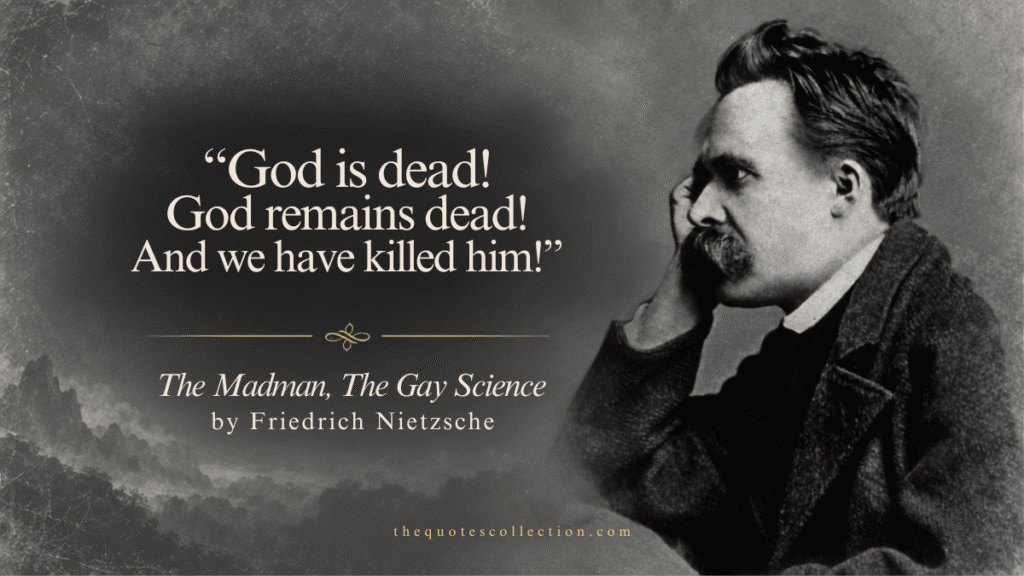
God is dead! God remains dead! And we have killed him!
The Madman, The Gay Science, Book III
Few Nietzsche quotes have escaped philosophy books quite as successfully as “God is dead.” It is also one of the easiest to flatten into something Nietzsche was not saying.
In The Gay Science, the words come from the madman, who announces the death of God to people who already do not believe. He is not triumphantly celebrating atheism. Instead, he is horrified by what the disappearance of the Christian-metaphysical worldview may mean for morality, purpose, and the foundations Western culture had relied on for centuries.
The harder question is not simply whether God exists. Nietzsche wants to know what happens when people abandon the old foundation while continuing to live as though all the values built upon it remain untouched.
For a different take on belief and meaning, see our We Who Wrestle With God quotes.
3. God or Human Error?
What is it: is man only a blunder of God, or God only a blunder of man?
Friedrich Nietzsche, Twilight of the Idols, “Maxims and Arrows”
Nietzsche manages to turn an enormous theological question into a wonderfully sharp reversal. Instead of asking only whether humanity has failed God, he asks whether humanity created the concept in the first place.
The joke has teeth. Nietzsche repeatedly questioned whether supposedly eternal truths were discoveries or human constructions that had become so familiar we stopped noticing who built them.
4. Morality Is an Interpretation
There are no moral phenomena at all, but only a moral interpretation of phenomena.
Friedrich Nietzsche, Beyond Good and Evil
Nietzsche is not saying actions have no consequences. He is attacking the assumption that moral labels such as good and evil exist inside events like permanent tags attached by the universe.
For him, people interpret actions through inherited systems of values. Once those systems come under suspicion, morality itself becomes something philosophy must investigate rather than simply accept.
Nietzsche Quotes About Truth, Belief & the Crowd
Nihilism becomes especially uncomfortable when certainty starts looking less certain. Nietzsche distrusted ideas simply because everyone agreed with them, which probably made him exhausting at dinner parties but rather useful as a philosopher.
5. The Danger of Convictions
Convictions are more dangerous enemies of truth than lies.
Friedrich Nietzsche, Human, All Too Human
A lie can be questioned because we already recognize the possibility that it is false. A conviction is harder to examine because certainty tends to close the door before doubt has even knocked.
Nietzsche’s suspicion is directed at beliefs held so tightly that evidence no longer gets a vote.
6. Madness in the Crowd
Insanity in individuals is something rare—but in groups, parties, nations, and epochs it is the rule.
Friedrich Nietzsche, Beyond Good and Evil
Nietzsche had little confidence in the wisdom of crowds. Groups can strengthen belonging and cooperation, but they can also make beliefs feel true simply because enough people repeat them.
The line remains popular because it travels remarkably well beyond nineteenth-century philosophy. Parties, movements, online mobs, ideological bubbles and very enthusiastic group chats all demonstrate how quickly individual doubt can disappear inside collective certainty.
7. Looking Into the Abyss
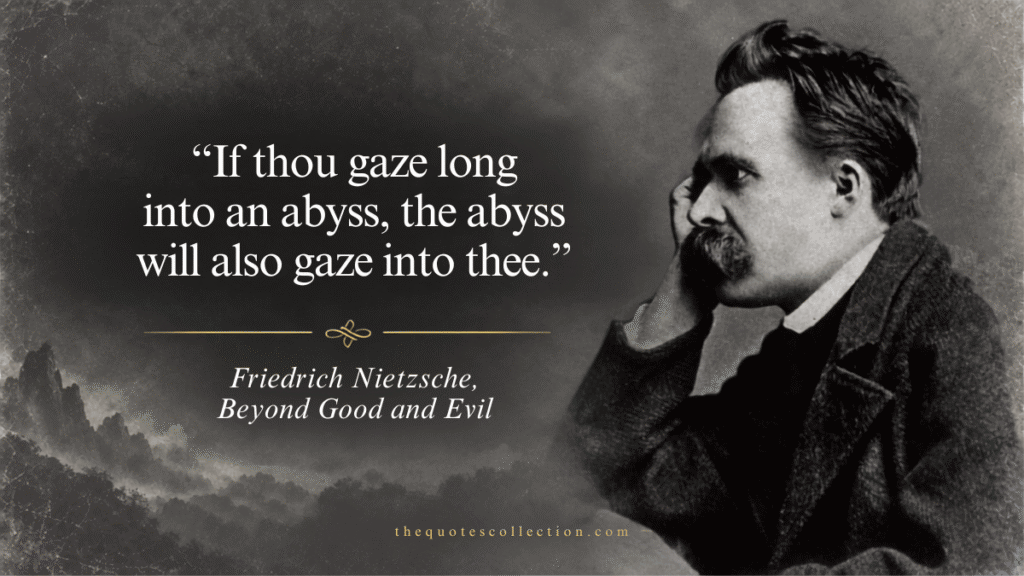
If thou gaze long into an abyss, the abyss will also gaze into thee.
Friedrich Nietzsche, Beyond Good and Evil
The abyss quote is usually shared alone, but its surrounding aphorism warns about people fighting monsters without noticing what the fight is doing to them. Nietzsche’s point is not simply that darkness is spooky and stares back.
Prolonged confrontation with hatred, cruelty or corruption can change the person doing the confronting. A cause may begin with resistance to something terrible, yet the methods used in that struggle can slowly reproduce the very qualities being opposed.
That is why the quote works so well beyond its original philosophical setting. What we repeatedly study, fight, resent or obsess over can shape us in return.
Nietzsche Quotes About Meaning and Endurance
Nietzsche is often remembered for dismantling old answers, but he was equally interested in what allows a person to keep moving when easy answers disappear.
8. Find Your Why
He who has a why to live can bear almost any how.
Friedrich Nietzsche, Twilight of the Idols, “Maxims and Arrows”
Viktor Frankl later helped make this Nietzsche line famous through Man’s Search for Meaning, but the idea originates in Twilight of the Idols.
Purpose does not remove pain. It changes a person’s relationship to it. When someone knows what they are enduring something for, hardship can feel less like meaningless punishment and more like part of a direction they have chosen.
That distinction sits close to the heart of Nietzsche’s response to nihilism. Losing an inherited “why” does not necessarily mean living forever without one.
9. Strength Through Hardship
What does not kill me makes me stronger.
Friedrich Nietzsche, Twilight of the Idols, “Maxims and Arrows”
This may be Nietzsche’s most famous contribution to gym walls, breakup captions, and motivational playlists.
The original aphorism frames the idea as something learned from the “school of life.” Nietzsche is not promising that every painful experience automatically improves us. Rather, his broader philosophy values the capacity to take difficulty and turn it into greater strength instead of allowing suffering to have the final word.
10. Suffering and Hope
What makes one heroic? To approach at the same time one’s highest suffering and one’s highest hope.
Friedrich Nietzsche, The Gay Science
Heroism here does not require eliminating suffering or the pain of grief before pursuing something meaningful. Nietzsche brings suffering and hope into the same movement.
The highest goal may expose a person to the greatest risk, disappointment or sacrifice. Choosing it anyway is where he locates the heroic part.
11. Live Dangerously
The secret for harvesting from existence the greatest fruitfulness and greatest enjoyment is—to live dangerously.
Friedrich Nietzsche, The Gay Science
Nietzsche was not handing out instructions to ignore seat belts.
“Live dangerously” is an argument against arranging life entirely around safety, familiarity and intellectual comfort. Discovery requires uncertainty, while independent thought sometimes means stepping beyond the boundaries that made everything feel conveniently settled.
Nietzsche Quotes About Self-Overcoming
Once old values lose their authority, Nietzsche does not suggest sitting peacefully in the wreckage. His work repeatedly turns toward discipline, independence and the difficult work of shaping a life for yourself.
12. Become Who You Are
What does your conscience say? You shall become who you are.
Friedrich Nietzsche, The Gay Science
The line sounds contradictory at first. If you already are yourself, what exactly is left to become?
Nietzsche treats identity less like a finished object waiting to be discovered and more like something brought into form through choices, discipline and experience. The familiar shortened phrase “become who you are” captures one of the most recognizable themes in his later philosophy.
13. The Mark of Freedom
What is the seal of liberation? No longer being ashamed in front of oneself.
Friedrich Nietzsche, The Gay Science
Freedom is not very impressive if it depends entirely on receiving permission from everyone watching.
Nietzsche links liberation with the ability to face yourself without constantly measuring your worth against inherited expectations. It is a small quote carrying a rather large assignment.
14. Shed the Old Skin
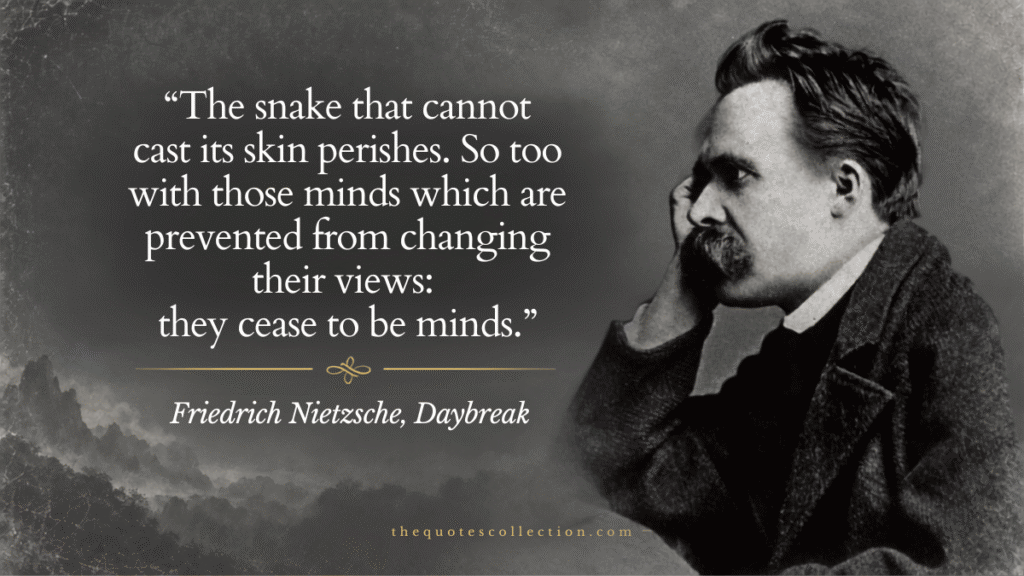
The snake that cannot cast its skin perishes. So too with those minds which are prevented from changing their views: they cease to be minds.
Friedrich Nietzsche, Daybreak
Intellectual growth requires the possibility of being wrong.
Nietzsche compares a mind that cannot revise itself to a snake trapped inside an old skin. Opinions may once have served us well, but keeping them solely because they are familiar eventually turns consistency into stagnation.
15. Command Yourself
Whatever cannot obey itself, is commanded.
Zarathustra, Thus Spoke Zarathustra, “Of Self-Surpassing”
Nietzsche’s language of commanding and obedience can sound severe, but the point here is self-mastery. Without the ability to direct your own impulses, priorities and actions, something else will inevitably do the directing.
Freedom, in this sense, involves more than escaping authority. It also requires enough discipline to govern yourself.
16. Outgrow the Teacher
One repays a teacher badly if one remains only a pupil.Zarathustra, Thus Spoke Zarathustra, Part I, “Of the Bestowing Virtue”
A good teacher should eventually become unnecessary.
Zarathustra does not want disciples who merely memorize his conclusions. He wants people capable of testing what they have learned, leaving him behind, and thinking independently. There is something refreshingly anti-guru about a philosopher telling his followers not to remain followers forever.
17. A Bridge, Not a Goal
“What is great in man is that he is a bridge and not a goal.”Zarathustra, Thus Spoke Zarathustra, Prologue
Nietzsche rejects the idea that humanity has reached some comfortable final form. Zarathustra presents the human being as transitional: capable of crossing beyond inherited habits, values and limitations.
The famous “bridge” metaphor points toward self-overcoming, not a biological upgrade or comic-book superhuman. Human greatness lies partly in refusing to assume that whatever we currently are must also be the endpoint.
18. Chaos and the Dancing Star
“One must still have chaos in oneself to be able to give birth to a dancing star.”Zarathustra, Thus Spoke Zarathustra, Prologue
Not everything valuable begins in perfect order.
Nietzsche turns inner chaos into creative possibility. Confusion, tension and contradiction can become raw material for something new rather than proof that nothing worthwhile can emerge.
The “dancing star” is one of his most memorable images because it refuses the idea that creation requires a perfectly tidy inner life first. If that were true, humanity might still be waiting.
Nietzsche Quotes About Affirming Life
Nietzsche’s answer to nihilism is not a return to comforting certainty. Increasingly, his later work asks whether a person can say yes to life even when life includes pain, accident, loss and circumstances they would never have chosen.
19. Love Your Fate
“My formula for greatness in a human being is amor fati.”Friedrich Nietzsche, Ecce Homo, “Why I Am So Clever”
Amor fati means love of fate, but Nietzsche pushes the idea beyond grudging acceptance.
He does not merely ask whether we can tolerate what has happened. His stronger ideal is to stop wishing reality had been rewritten for us and learn to affirm the life we actually have.
That is a demanding response to nihilism because it refuses both despair and fantasy. Instead of declaring existence worthwhile only if certain painful parts could be removed, amor fati asks whether life can be affirmed as a whole.
20. A God Who Dances
“I would only believe in a God that knows how to dance.”Zarathustra, Thus Spoke Zarathustra, Part I, “Of Reading and Writing”
Nietzsche often contrasts heaviness with dance, laughter and lightness. Here, Zarathustra imagines even divinity as something capable of movement and joy rather than solemn weight.
It is a playful line, but the playfulness is part of the philosophy. Nietzsche’s life-affirming ideal has room for laughter. Endless grim seriousness would be a rather strange way to defeat nihilism.
21. Life Needs Music
“Without music, life would be a mistake.”Friedrich Nietzsche, Twilight of the Idols, “Maxims and Arrows”
Nietzsche was not all abysses, dead gods and existential emergencies.
Music mattered deeply to him, and this tiny aphorism gives art a surprisingly large role. Meaning does not have to arrive only through religion or abstract philosophy; sometimes humans make life richer through beauty, creativity and the strange fact that a collection of sounds can make existence feel different.
Was Nietzsche Actually a Nihilist?
Calling Nietzsche simply “a nihilist” misses the central tension in his work.
He certainly believed Western culture faced a nihilistic crisis. Traditional religious and metaphysical values were losing authority, yet people had not fully confronted what their disappearance would mean. Without those foundations, familiar answers about morality, purpose and truth could no longer be taken for granted.
However, Nietzsche did not stop at “nothing has meaning.” Much of his later philosophy searches for ways to confront nihilism through self-overcoming, value creation, and a stronger affirmation of earthly life. The Stanford Encyclopedia of Philosophy describes Nietzsche’s commitment to life affirmation as closely connected to his attempt to respond to the crisis created when the “highest values” lose their force.
His ideas are not easy optimism. Nietzsche does not promise that suffering secretly exists for our benefit or that the universe will eventually explain itself. Instead, he asks a more uncomfortable question: Can you live fully without requiring existence to provide an externally guaranteed meaning first?
A Note on “There Are No Facts, Only Interpretations”
One famous Nietzsche line deliberately does not appear in the numbered collection:
“There are no facts, only interpretations.”
The idea is genuinely Nietzschean. But the familiar sentence is a shortened version of an unpublished notebook passage, not a standalone aphorism from one of the books he prepared for publication.
In the longer note, Nietzsche is arguing against positivism and questioning whether we can access uninterpreted “facts in themselves.”
Final Thoughts on Nietzsche and Nihilism
Nietzsche’s darkest quotes are often the easiest ones to remember. Dead gods, monsters and abysses have a certain advantage when competing for space on the internet.
Yet stopping there gives us only half of Nietzsche.
Alongside the destruction of old certainties are dancing stars, self-overcoming, purpose, music, freedom and amor fati. Nietzsche saw the danger of a world in which the old “why” no longer provided an answer, but he did not think the only response was to stare into the void indefinitely.
The harder task begins after the old answers fall away: What will you choose to value when nobody can simply hand the answer to you?
Leave a Reply