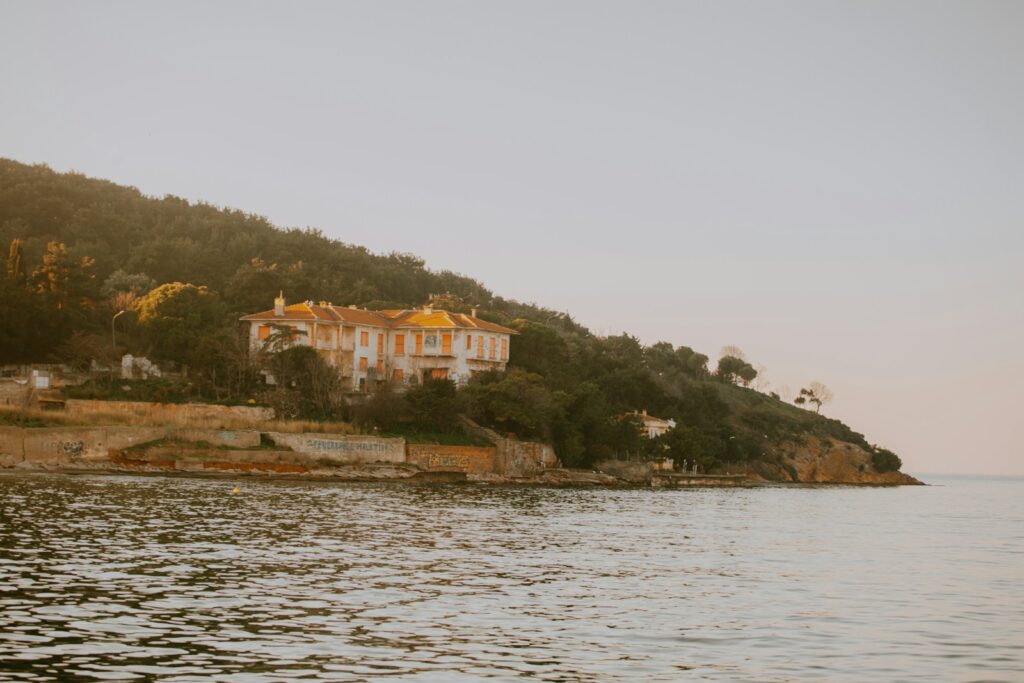
Ten strangers arrive on an island, each carrying a past they would rather leave behind. These And Then There Were None quotes by Agatha Christie capture the unsettling moments when a pleasant visit turns into a struggle for survival, and private guilt becomes impossible to escape.
The passages below explore the novel’s fear, suspicion, and troubling questions about justice, with explanations of who speaks and what their words reveal. Spoilers are included throughout, and the final section discusses the ending and the killer’s identity.
JUMP TO:
Quotes About Isolation and Uncertainty
Featured in our collection of bestselling books of all time, Christie’s mystery makes its setting part of the threat. The island first promises a welcome escape, but its distance from the mainland soon leaves the guests dependent on people they barely know.
These opening And Then There Were None quotes by Agatha Christie capture that uneasy shift. Even before the guests understand their situation, ordinary observations begin to carry a darker meaning.
1. The strange appeal of an island
“There was something magical about an island—the mere word suggested fantasy.”Narrator, reflecting Dr. Armstrong’s perspective, And Then There Were None, Chapter 2, Section VI.
Armstrong arrives hoping for a break from his demanding work, and the island seems to offer the distance he needs. There is something familiar in that wish to leave daily concerns behind, which makes his first impression easy to understand.
Christie gradually turns the promise against him. The separation that makes an island appealing also places help beyond reach, giving the setting a threat that grows with every death.
2. The comfort of not knowing
“Good thing, perhaps, that one can’t foresee the future.”William Blore’s thoughts, And Then There Were None, Chapter 2, Section IX.
Blore remembers knowing the island as a child and reflects on the unexpected work that has brought him back. His thought seems casual, but readers can hear a warning in it.
The line gains force on a second reading, when we know what awaits him. His ignorance allows him a brief moment of ease that knowledge would have taken away.
3. A house that seems to hold no secrets
“There was nothing hidden in this house, nothing concealed.”Narrator, And Then There Were None, Chapter 5, Section II.
The house lacks the gloomy passages and secret corners we might expect in a murder mystery. Its bright, modern rooms seem easy to inspect, yet seeing the surroundings clearly brings the guests no closer to safety.
That contrast makes the setting especially disturbing. The secrets belong to the people inside the house, and those are far harder to uncover.
Quotes About Fear and Mortality
As the deaths continue, uncertainty wears away the guests’ confidence. Familiar language and everyday duties offer little comfort when nobody can explain what is happening or who might be next.
4. The terror of having no explanation
“I don’t know. I don’t know at all. And that’s what’s frightening the life out of me. To have no idea…”Mr. Rogers to William Blore, And Then There Were None, Chapter 10, Section II,
Rogers puts the group’s fear into words without trying to sound brave. Knowing that someone means to harm them is terrifying, but not knowing who that person is makes every encounter dangerous.
His repeated admission gives the passage its force. Someone he serves or passes in the hallway may be responsible, yet he has no firm ground on which to judge them.
This is one of the clearest expressions of helplessness. Rogers wants an answer that will let him act, and his fear deepens because none is available.
5. Death within ordinary life
“In the midst of life we are in death.”Emily Brent, And Then There Were None, Chapter 5, Section I.
Emily responds to sudden death with language that gives it a familiar religious shape. Her solemn certainty contrasts with the alarm around her, though the words offer no explanation for the danger facing the household.
Within the novel, the sentence also captures how quickly ordinary life can be interrupted. A shared evening becomes a scene of accusation and death, leaving the guests unable to return to the ease they briefly enjoyed.
Quotes About Guilt and Mortality Judgment
Some of the most revealing And Then There Were None quotes concern the judgments people make about one another. The guests can be sharp observers of someone else’s wrongdoing while remaining remarkably protective of their own version of the past.
6. The belief that wrongdoing will be discovered
“Be sure thy sin will find thee out.”Emily Brent, And Then There Were None, Chapter 7, Section I.
Emily uses this warning while discussing the accusation against the Rogerses. She finds their behavior suspicious and readily accepts the possibility that guilt has followed them to the island.
Her confidence becomes more troubling when the conversation turns toward her own past. She expects others to answer for their actions while treating her own conduct as justified, revealing how moral certainty can protect a person from uncomfortable self-examination.
7. The equal worth of human lives
“Black or white, they are our brothers.”Emily Brent to Vera Claythorne, And Then There Were None, Chapter 7, Section I.
When Vera minimizes the deaths of the African men Lombard abandoned, Emily insists that their lives deserve equal regard. Her response directly challenges Vera’s prejudice, making it an important moment in their conversation.
Yet Emily’s compassion has limits elsewhere. She can recognize the wrong in dismissing these men’s lives while refusing to reconsider her treatment of Beatrice Taylor. The contradiction gives her character depth and asks readers to notice the distance between a principle someone voices and the choices they make.
8. When guilt makes an ending seem welcome
“That’s peace—real peace. To come to the end—not to have to go on…Yes, peace…”General Macarthur, And Then There Were None, Chapter 6. studylib.net
Macarthur’s words express exhaustion and resignation, rather than a comforting belief about death. His past has weighed on him for so long that an ending begins to seem like release from the burden of remembering.
This makes his response different from the growing panic around him. While other guests search for ways to survive, he appears increasingly willing to stop struggling. The passage reveals the depth of his isolation, even among people facing the same threat.
The Rhyme Behind the Mystery
The counting rhyme gives the novel a pattern that readers and characters can recognize. As its verses take on a deadly meaning, that recognition brings dread rather than reassurance.
9. The final disappearance
“One little soldier boy left all alone;
He went and hanged himself
And then there were None.”Final stanza of the counting rhyme reproduced in And Then There Were None
A counting rhyme usually makes repetition feel safe and predictable, but here every decrease means another life lost. Its rhythm gives the violence an apparent order, making the ending feel closer with each death.
The final stanza is especially bleak because surviving longer than everyone else offers no promise of escape. Being the last person left means facing the island’s silence alone.
The official Agatha Christie page for the novel provides further background on the story and its adaptations. When comparing quotations, use the novel as the reference, since stage and screen versions can change dialogue and plot details.
A Quote That Reveals the Ending
The final selection identifies the killer and discusses the confession that explains the murders. If you have not finished the novel, this is the point to stop reading.
10. The killer’s need for recognition
“But no artist, I now realize, can be satisfied with art alone. There is a natural craving for recognition which cannot be gainsaid.”Justice Lawrence Wargrave, closing manuscript confession following the epilogue of And Then There Were None.
Wargrave describes his murders as an artistic achievement, exposing the vanity beneath his claims of justice. He wants others to recognize the care and cleverness of his design, even though keeping its creator unknown is central to his ambition.
That conflict explains why he leaves an account of his actions. An unsolved crime might preserve his secret, but it would deny him the audience he craves.
His comparison between murder and art also reveals how far his thinking has moved from the lives he destroys. He treats people as parts of a design and expects admiration for arranging their deaths.
Why These Quotes Stay With Us
The strongest And Then There Were None quotes by Agatha Christie draw their power from the gap between what people say and what their words reveal. A wish for rest can carry despair, while a claim to justice can conceal a hunger for control.
Christie’s mystery asks readers to examine those gaps as carefully as any physical clue. Long after the solution is known, the unsettling question remains whether people understand their own motives as clearly as they believe.
Leave a Reply