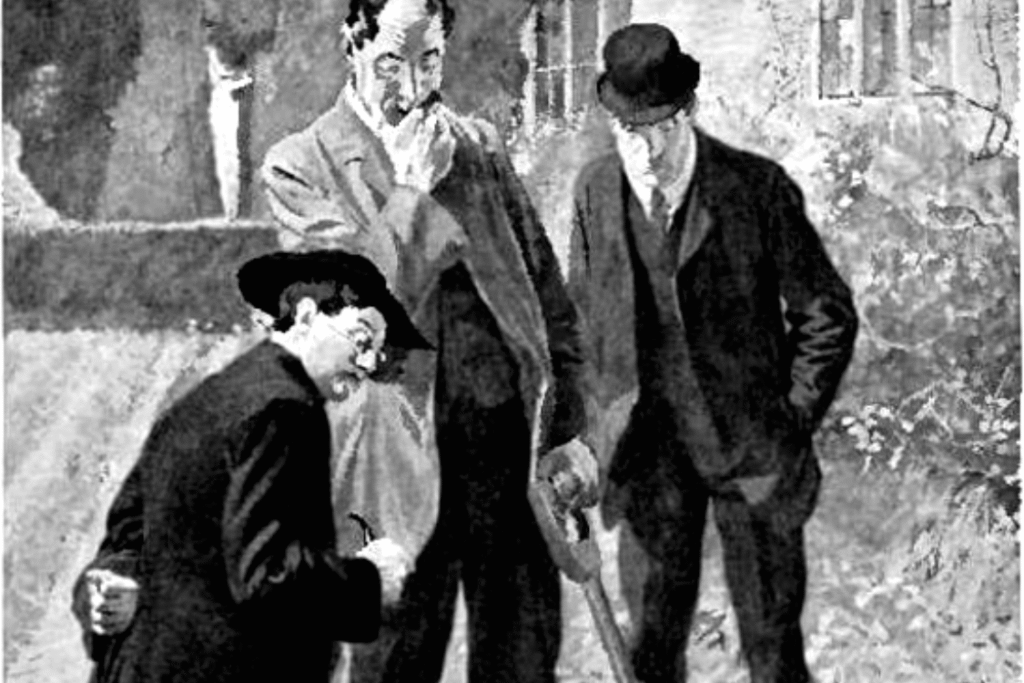
A shabby umbrella and a distracted expression make Father Brown an unlikely match for a master criminal. Yet in The Innocence of Father Brown, G. K. Chesterton gives his quiet priest a rare advantage. He understands the excuses people make for themselves, especially when pride allows them to mistake cruelty for virtue.
First published in 1911, the book collects twelve detective stories about the Catholic priest and amateur investigator. This guide introduces each mystery, explores the book’s main themes, and explains seven verified quotations.
We’ll discuss character development without revealing the culprits or central solutions.
JUMP TO:
- What Is The Innocence of Father Brown?
- Where Can You Read the Book for Free?
- The Innocence of Father Brown Summary
- The Twelve Stories in Order
- Why Is Father Brown Called Innocent?
- Seven Quotes That Explain the Book’s Themes
- How Does Father Brown Solve Mysteries?
- Is The Innocence of Father Brown Worth Reading?
- Understanding the Person Behind the Crime
What Is The Innocence of Father Brown?
The Innocence of Father Brown is Chesterton’s first collection about the priest-detective. It contains separate mysteries rather than one continuous plot. Recurring characters connect the stories, especially Flambeau, whose relationship with Brown develops from rivalry into friendship.
The cases range from clever thefts to violent deaths. Their settings often resemble a stage, with an exclusive dining club or a remote Scottish castle providing a scene rich in mystery. Brown looks past that atmosphere to examine what people have actually seen and heard.
Faith shapes his view of human behavior, but he also relies on careful thought and practical knowledge. Readers interested in how Christian ideas inform literature can explore our guide to CS lewis and his books.
Where Can You Read the Book for Free?
You can read the complete English text through Project Gutenberg. It offers an online edition and several ebook formats for download. The original work is in the public domain in the United States.
Start with “The Blue Cross” to sample Chesterton’s style. A famous detective finds Brown faintly ridiculous, and readers may share his judgment. The story gives both good reason to reconsider.
The Innocence of Father Brown Summary
The collection opens with Aristide Valentin, a French detective pursuing the notorious thief Flambeau in England. During his journey, Valentin notices a priest who seems unable to manage his parcels or protect the valuable object he carries. Brown looks so helpless that the detective offers him advice. He has no idea how much the priest already knows.
Later stories place Brown among crimes that seem to resist ordinary explanation. An intruder appears to enter a guarded building unseen, while a violent death seems to require impossible strength. Other cases depend on what people assume. A witness overlooks someone they consider unimportant, or an admired reputation prevents anyone from asking a difficult question.
Brown brings a confessor’s knowledge to these puzzles. People have admitted things to him they would hide from the police, and he knows how often a decent excuse conceals a selfish motive. Catching the offender is only part of his concern. He also hopes to stop that person from doing further harm.
Flambeau’s changing role gives the collection a loose emotional thread. His encounters with Brown raise a question about the use of talent. Can someone who has spent years deceiving others put the same gifts to a better purpose? Their growing friendship allows Chesterton to explore that possibility across several stories.
The Twelve Stories in Order
These summaries introduce each mystery without revealing its solution. The cases largely stand alone, but reading them in order preserves the development of Brown and Flambeau’s relationship.
| Story | Spoiler-light summary |
|---|---|
| 1. The Blue Cross | Valentin follows a trail of strange events while searching for Flambeau. A priest carrying a valuable silver cross appears dangerously easy to deceive. |
| 2. The Secret Garden | A dinner at Valentin’s Paris home ends with the discovery of a headless body in an enclosed garden. How it arrived poses a troubling question. |
| 3. The Queer Feet | While attending a dying waiter at an exclusive hotel, Brown hears an odd pattern of footsteps. A dining club’s valuable silver supplies another part of the puzzle. |
| 4. The Flying Stars | A Christmas party includes a lively pantomime and three valuable diamonds. The performance creates an opening for a daring theft. |
| 5. The Invisible Man | A man receives threats before a crime occurs without anyone seeing the person responsible. Brown questions what the witnesses mean when they say they saw nobody. |
| 6. The Honour of Israel Gow | At a remote Scottish castle, Brown and Flambeau find an unusual servant and a puzzling collection of objects. They must work out what connects them. |
| 7. The Wrong Shape | A writer’s death appears to have a clear explanation, supported by a written message. Brown notices details that cast doubt on the apparent answer. |
| 8. The Sins of Prince Saradine | A boating holiday brings Brown and Flambeau to a prince’s secluded home. An old grievance draws them into a dangerous affair involving revenge and mistaken identity. |
| 9. The Hammer of God | A man dies from a crushing blow apparently struck with a small hammer. The case raises questions about strength, religious pride, and judgment. |
| 10. The Eye of Apollo | A woman falls to her death in a building occupied by an unusual religious sect. Brown examines the people and interests surrounding her. |
| 11. The Sign of the Broken Sword | Brown questions the accepted account of a famous soldier’s death. His findings challenge the heroic story preserved in public memory. |
| 12. The Three Tools of Death | A supposedly cheerful man dies amid a confusing collection of evidence. Brown must untangle conflicting accounts and look beyond the dead man’s public image. |
The range gives the book much of its appeal. Chesterton moves from the comedy of a jewel theft to a dark study of moral pride, while keeping a puzzle at the heart of each story.
Why Is Father Brown Called Innocent?
The title invites readers to confuse innocence with ignorance. Brown’s awkward appearance suggests a man with little knowledge of life outside his parish. Other characters assume that religion has sheltered him from the unpleasant facts they know so well.
His work has often done the opposite. People confess acts to him that they conceal from almost everyone else. Brown can recognize their methods without sharing their motives, and he has no need to appear worldly to prove what he knows.
The title can therefore suggest the difference between understanding evil and accepting it. Brown’s gentleness survives his knowledge of human cruelty. He recognizes guilt, but he rarely treats it as the whole truth about a person.
Chesterton makes the reader’s judgment part of the puzzle. Before Brown exposes a mistake in the case, we may already have mistaken his appearance for a measure of his intelligence.
Seven Quotes That Explain the Book’s Themes
These passages come from the original stories. Most are spoken by Father Brown, while the final selection belongs to the narrator. Each offers a different way into the book’s ideas about crime and human nature.
1. Innocence and Human Evil
“Has it never struck you that a man who does next to nothing but hear men’s real sins is not likely to be wholly unaware of human evil?”Father Brown, “The Blue Cross,” The Innocence of Father Brown
Brown addresses Flambeau, who cannot understand how this quiet priest knows so much about crime. The answer lies in work the thief has dismissed. Hearing confessions has taught Brown what people actually do, beyond what they admit in polite company.
The passage explains much of his method. He listens for the excuse beneath a person’s account and recognizes familiar attempts to justify a bad choice. That knowledge comes from paying attention, including to people whom others prefer to ignore.
2. The Simplicity Behind Mystery
“But every clever crime is founded ultimately on some one quite simple fact—some fact that is not itself mysterious. The mystification comes in covering it up, in leading men’s thoughts away from it.”Father Brown, “The Queer Feet,” The Innocence of Father Brown
A complex crime can depend on a plain fact that nobody thinks to examine. In “The Queer Feet,” Brown connects the puzzle to the judgments people make from someone’s appearance and social role.
Chesterton builds the story in much the same way. He supplies enough strange detail to distract us, then lets Brown return to the fact we overlooked.
3. What People Really Answer
“Have you ever noticed this—that people never answer what you say? They answer what you mean—or what they think you mean.”Father Brown, “The Invisible Man,” The Innocence of Father Brown
A witness’s answer may sound more precise than it is. Someone who says they saw nobody might mean nobody unusual or nobody they considered important. Brown questions that hidden limit.
In the surrounding passage, he considers how people describe those staying in a house. They may count a guest but overlook a servant who lives there. A doctor asking about illness would receive a different answer because the speaker would understand the question differently.
This gives the mystery its social force. Someone can vanish from an account while remaining in plain sight. Brown asks whom the witnesses have excluded before he accepts their version of events.
4. The Strength of Humility
“Humility is the mother of giants. One sees great things from the valley; only small things from the peak.”Father Brown, “The Hammer of God,” The Innocence of Father Brown
On its own, this passage sounds like advice to remain modest. In the story, it warns against looking down on other people, especially when faith seems to justify that position.
Chesterton connects physical height with moral pride. Seen from above, people look small. Someone who enjoys that view may start to treat their lives as equally slight. Brown is concerned with the point at which hatred of wrongdoing turns into permission for cruelty.
Humility helps preserve a sense of proportion. A person may rightly condemn an act while lacking the right to punish its author however they choose.
5. The Downward Path of Evil
“Men may keep a sort of level of good, but no man has ever been able to keep on one level of evil. That road goes down and down.”Father Brown, “The Flying Stars,” The Innocence of Father Brown
Brown challenges Flambeau’s fondness for the image of the honorable outlaw. The thief admires his own courage and wit, but those gifts cannot protect him from actions he once would have despised.
The appeal is personal. Brown sees good qualities in Flambeau and fears what a criminal life will cost him. One lie creates the need for another, while innocent people suffer in ways the thief would rather dismiss.
Brown wants him to stop while he can recognize something worth saving in himself. Repentance means changing his conduct, rather than finding a clever reason to excuse it.
6. Lives Before Public Reputations
“Private lives are more important than public reputations. I am going to save the living, and let the dead bury their dead.”Father Brown, “The Three Tools of Death,” The Innocence of Father Brown
Brown refuses to protect an admired reputation at the expense of living people. Others have trusted a public image that prevents them from understanding a death.
His words offer no defense of secrecy for its own sake. He is willing to disturb a comforting story because preserving it would cause further harm. In this case, compassion requires an unwelcome truth.
7. Making Room for Surprise
“The most incredible thing about miracles is that they happen.”Narrator, “The Blue Cross,” The Innocence of Father Brown
This sentence belongs to the narrator, not to Brown’s dialogue. It introduces a reflection on strange coincidences as Valentin searches for a clue.
The examples that follow concern real events that sound almost invented. Chesterton suggests that an account of life built only around the expected can miss what actually happens. An odd detail may deserve attention because it breaks the pattern.
The line often circulates as a religious quotation. Here, its immediate purpose is to prepare us for a detective who follows the unexpected when an obvious trail is missing.
How Does Father Brown Solve Mysteries?
Brown combines close observation with an understanding of motive. He notices physical details, then asks why a person would arrange events in a certain way. A sound explanation needs to account for both.
His faith rarely makes him eager to accept a supernatural cause. In “The Blue Cross,” his defense of reason helps him challenge a deception. Elsewhere, a grand theory can make him cautious, especially when it gives people an excuse to stop checking the facts.
He also sees how confidence can distort judgment. An investigator who knows what a criminal should look like may overlook the offender. Respect for a person’s good name can have a similar effect.
Brown has little interest in appearing brilliant. That leaves him free to ask a plain question even when others think the answer is beneath discussion.
Is The Innocence of Father Brown Worth Reading?
The collection is worth trying if you enjoy mysteries that change your view of the people involved. Chesterton makes an ordinary detail seem strange, then reveals the assumption that gave it a false appearance. His humor often targets social vanity, while his descriptions give the settings a vivid, sometimes eerie beauty.
Readers seeking realistic police work may find some solutions hard to accept. Several plots rely on unlikely events, and Brown sometimes reaches an answer before readers have enough evidence to follow him. The pleasure often comes from rethinking a belief rather than winning a fair contest to name the culprit.
Chesterton’s religious views are clear, and his treatment of other beliefs can be dismissive. The stories also contain racial and cultural stereotypes that deserve criticism. Readers can enjoy the invention while questioning the judgments behind it.
Begin with “The Blue Cross” and continue in order if its wit and surprises appeal to you. “The Queer Feet” offers a strong example of Chesterton’s social insight. “The Hammer of God” explores the darker question of what happens when a person’s sense of virtue grants them too much authority.
Understanding the Person Behind the Crime
The lasting interest of The Innocence of Father Brown goes beyond clever thefts and hidden motives. Brown knows how people convince themselves that one more dishonest act will leave their character untouched. He also knows how easily a just grievance can serve as an excuse for cruelty.
That knowledge gives his gentleness weight. When he offers someone a chance to repent, he has usually understood enough to condemn them. He sees the wrong clearly without believing that it has erased every possibility of good.
Leave a Reply