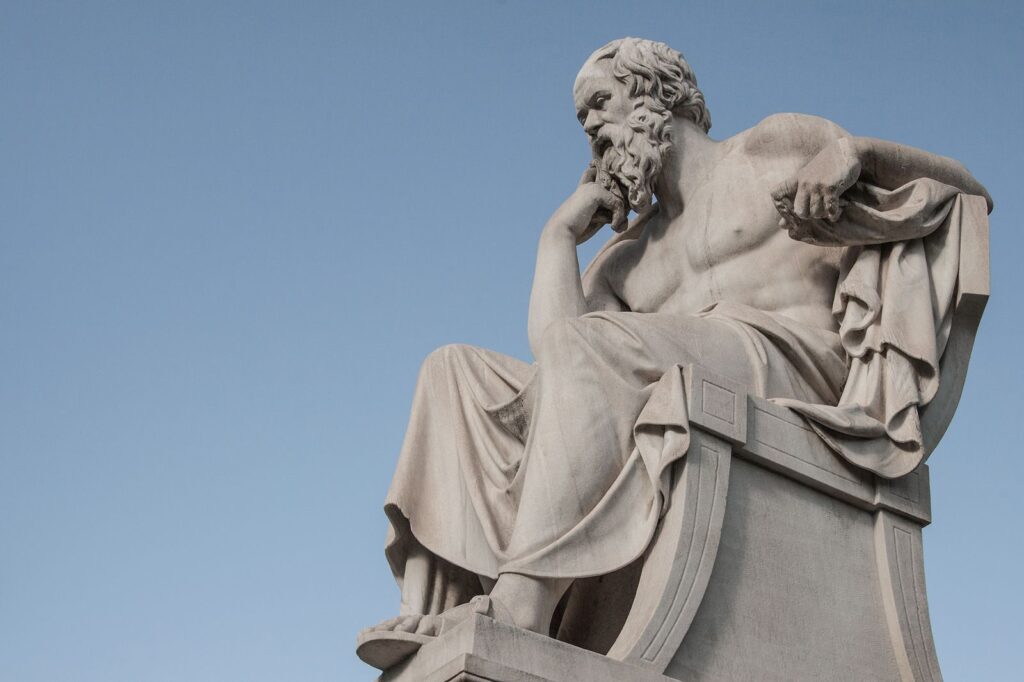
Few admissions feel more uncomfortable than acknowledging that we may be wrong. The saying “the only true wisdom is in knowing you know nothing,” attributed to Socrates, gives that admission a different dignity. It suggests that wisdom begins with recognizing the limits of our understanding, especially where confidence has outrun our reasons.
The familiar sentence is a paraphrase of an idea found in Plato’s Apology. Its underlying challenge remains personal. How much of what we claim to know have we examined, and how willing are we to reconsider it?
JUMP TO:
What Does The Only True Wisdom Mean?
“The only true wisdom is in knowing you know nothing.”Attributed to Socrates, paraphrasing Plato’s Apology, 21d–23b
The saying expresses the value of recognizing what we have yet to understand. A person who mistakes an assumption for knowledge has little reason to investigate further. Acknowledging uncertainty makes inquiry possible because it leaves a question open.
Taken literally, the wording sounds self-defeating. If someone knows nothing, how can they know that? The passage behind the saying offers a more precise distinction. Socrates describes an advantage over someone who believes he possesses knowledge he lacks. Socrates recognizes his own uncertainty about the subject under discussion.
Our guide to the greatest philosophers of all time offers a broader introduction to the thinkers associated with such questions. Here, the challenge concerns how honestly we account for our own beliefs.
Knowing your limits has value because it changes how you proceed. It gives you reason to ask, listen, and investigate. Merely declaring yourself ignorant would accomplish little if you refused the work of learning.
Did Socrates Say These Exact Words?
The popular sentence should be treated as a paraphrase rather than a verified verbatim quotation. The relevant discussion appears in Plato’s Apology, his account of Socrates’ defense at trial.
Benjamin Jowett translates part of the passage at 21d as follows.
“I neither know nor think that I know.”Socrates, in Plato’s Apology, 21d
Socrates has just described a conversation with a man reputed to be wise. He doubts that either of them possesses the understanding being claimed, but the other man remains convinced of his own knowledge. Socrates locates his small advantage in avoiding that error.
The familiar paraphrase compresses this distinction into a memorable line. However, its sweeping wording can obscure the narrower point about pretending to know. Reading the passage restores that precision without taking away the saying’s force.
It also helps to remember whose text we are reading. Socrates left no philosophical writings of his own, and Plato’s portrayal is an ancient literary account, not a surviving transcript of Socrates’ speech.
The Story Behind Socrates’ Wisdom
In the Apology, Socrates explains that his friend Chaerephon asked the oracle at Delphi whether anyone was wiser than Socrates. The answer was that no one was. Socrates found this puzzling because he regarded his own wisdom as slight.
He responded by questioning people who had reputations for knowledge. His conversations took him among politicians, poets, and craftspeople. Again and again, he encountered a gap between what someone understood and what that person felt entitled to claim.
The poets, in his telling, produced admirable work but struggled to explain it. Their achievement also encouraged them to regard themselves as wise about other subjects. Reputation had carried their confidence beyond the grounds for it.
The craftspeople presented a more revealing case. Socrates freely acknowledged that they knew things he did not. Their skill was real, yet some assumed that their competence extended to larger questions outside their craft.
That detail prevents a careless reading of the only true wisdom saying. Socrates could recognize another person’s superior knowledge. His objection concerned the unwarranted authority that sometimes accompanied it.
His questioning also had a cost. People resented having their claims examined, and he connected these encounters with the hostility surrounding him. Admitting uncertainty may sound like a gentle virtue, but asking others to account for their certainty can be deeply unwelcome.
Why Knowing Your Limits Takes Wisdom
The hardest beliefs to examine are often those we have come to associate with our own worth. A challenge to an opinion can feel like a judgment on our intelligence. Socrates’ example asks us to endure that discomfort long enough to consider whether the challenge is justified.
Confidence Needs Good Reasons
Confidence can accompany knowledge, but the feeling itself supplies no proof. Familiarity with an idea may make it easy to repeat without making it easy to defend.
A useful question is whether we can explain why we believe something. What supports the claim, and what would count against it? If we can only repeat the conclusion more firmly, we may have found a limit worth investigating.
This need not lead to endless hesitation. We regularly make reasonable judgments with incomplete information. The discipline lies in allowing our confidence to reflect the strength of our reasons, while remaining willing to revise the judgment when those reasons change.
Expertise Has Its Boundaries
Socrates’ encounter with the craftspeople gives genuine knowledge its due. Years of learning can produce an understanding that a newcomer simply lacks. Recognizing our limits should make us more attentive to relevant expertise.
At the same time, expertise has a scope. Knowledge earned in one field cannot automatically settle questions in every other field. Respect for an accomplished person and scrutiny of a particular claim can coexist.
This distinction also protects us from treating every disagreement as a contest between equally informed opinions. Some explanations are better supported than others. Intellectual humility asks us to notice that difference, including when the stronger explanation belongs to someone else.
Revision Requires Some Courage
Changing your mind can involve admitting that you spoke too quickly or overlooked something important. The discomfort grows when other people have heard you defend the earlier view.
Yet refusing correction carries its own cost. We may spend increasing effort protecting a position we no longer have good reason to hold. An honest revision allows attention to return to the question itself.
There is dignity in being able to explain what changed your judgment. It suggests that your conclusions remain answerable to something beyond the wish to appear consistent.
Applying Socratic Wisdom Today
The circumstances of modern life differ greatly from the conversations of ancient Athens. Still, the temptation to sound certain before we have understood a subject is familiar. Two ordinary situations make the principle especially useful.
Before You Share a Claim
Imagine encountering a short video that appears to settle a controversial question. The speaker is confident, and the conclusion agrees with what you already suspect. Sharing it would take only a moment.
A Socratic pause begins with asking what the clip actually establishes. Does it include the full exchange? Can you find the original source, and does that source support the caption? Your first impression may prove sound, but it deserves more than your immediate agreement.
You can withhold a verdict without abandoning the search for an answer. Sometimes the most responsible response is to investigate further before inviting others to believe the claim.
When Experience Meets a Limit
An older man may have spent decades raising a family, earning a living, and finding his way through disappointment. When his grandson faces a difficult career decision, that experience gives him something valuable to offer. He knows how a setback can look different with time.
Yet he may know little about the industry his grandson hopes to enter or the pressures shaping that choice. Before advising him, he can ask what the work involves and what makes the decision difficult. His own past offers perspective, though it cannot answer every question about another person’s future.
There is wisdom in sharing what life has taught him while acknowledging what he still needs to understand. Listening allows his experience to guide the conversation without deciding its conclusion.
Questions About Socrates and Wisdom
Is This the Same as “I Know That I Know Nothing”?
Both sayings summarize the idea commonly called Socratic ignorance. Neither should replace a careful reading of the source. In the Apology, the crucial distinction concerns recognizing a lack of knowledge rather than mistakenly believing that one possesses it.
Was Socrates Saying Knowledge Is Impossible?
That is too broad a conclusion to draw from this passage. He acknowledges the craftspeople’s knowledge and treats the examination of beliefs as worthwhile. His criticism targets unjustified claims to wisdom, leaving room for genuine understanding.
Why Is Admitting Ignorance Wise?
It helps identify where further inquiry is needed. The admission earns its value through what follows, whether that involves asking a better question or taking a correction seriously. Ignorance alone offers no special insight.
The Courage to Keep Learning
The only true wisdom saying endures because it touches a difficult part of learning. We want to understand, yet we also want the reassurance of already knowing. Socrates’ example asks us to bear the uncertainty that honest inquiry sometimes requires.
We can value what we have learned without treating it as complete. A belief examined carefully may emerge stronger; another may need to be abandoned. Either outcome can leave us better able to judge.
There is room to grow wherever we can still admit that we have something to learn.
Leave a Reply