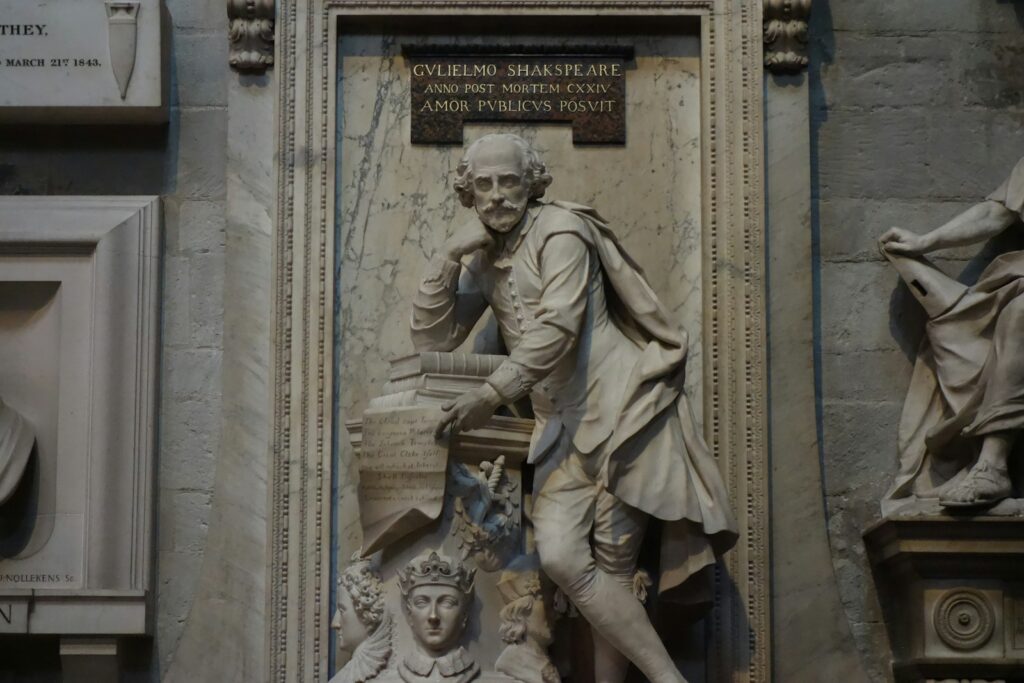
Some lines stay with us because they give familiar feelings an unfamiliar clarity. These famous Shakespeare quotes capture the tenderness of falling in love, the unease of growing older, and the gap between how people appear and what they intend.
Their speakers include devoted lovers and persuasive villains, whose circumstances often complicate the wisdom we hear in their words. Knowing who speaks makes the quotations more interesting, especially when an apparent piece of advice belongs to a deception.
The selections below include their sources and explanations. Some are excerpts from longer speeches, and several discussions reveal plot details.
JUMP TO:
Famous Shakespeare Quotes About Life
Life quotes from Shakespeare range from playful observations to questions with no comfortable answer. His characters consider the roles they inhabit, the time they have left, and the limits of what they understand.
1. The Parts We Play
“All the world’s a stage,
And all the men and women merely players;
They have their exits and their entrances,
And one man in his time plays many parts”Jaques speaking to Duke Senior, As You Like It by William Shakespeare, Act 2, Scene 7
Jaques imagines a lifetime as a succession of roles, each with its familiar gestures and concerns. The speech continues through seven ages, moving from infancy toward the losses of old age.
Its appeal comes partly from recognizing how completely we can inhabit a role that later passes away. Yet Jaques speaks with melancholy, making the comparison more searching than a cheerful invitation to perform confidently.
2. The Question of Existence
“To be, or not to be, that is the question.”Hamlet’s soliloquy, Hamlet by William Shakespeare, Act 3, Scene 1
Hamlet weighs the suffering of existence against death and the uncertainty of what might follow it. The speech gives language to profound distress, rather than ordinary difficulty making a decision.
Its endurance owes much to that unresolved tension. Thought can deepen our understanding while leaving us unable to settle the very question that troubles us.
3. A Life Like Dreaming
“We are such stuff
As dreams are made on: and our little life
Is rounded with a sleep.”Prospero to Ferdinand, The Tempest by William Shakespeare, Act 4, Scene 1
After interrupting a magical performance, Prospero reflects on how everything seemingly solid will eventually vanish. The dream image places human life within that same fragility, inviting wonder at our brief experience without promising that we can preserve it.
4. Good and Ill Together
“The web of our life is of a mingled yarn, good and ill together.”First Lord, All’s Well That Ends Well by William Shakespeare, Act 4, Scene 3
The woven image resists an easy division between wholly good and wholly bad lives. Pleasure and suffering run through the same fabric, much as admirable qualities and serious faults can coexist within one person.
5. Minutes Moving Like Waves
“Like as the waves make towards the pebbled shore,
So do our minutes hasten to their end”The poem’s speaker, “Sonnet 60” by William Shakespeare, lines 1–2
Each wave gives way to another, turning the passage of time into something visible and relentless. The image can sharpen our appreciation of an ordinary hour, precisely because nothing about its passing waits for us to notice.
6. Beyond Our Explanations
“There are more things in heaven and earth, Horatio,
Than are dreamt of in our philosophy.”Hamlet to Horatio, Hamlet by William Shakespeare, Act 1, Scene 5
Following the encounter with his father’s ghost, Hamlet challenges the limits of familiar knowledge. His words leave room for intellectual humility, particularly when an experience refuses to fit the explanations we brought to it.
7. The Weight of Power
“Uneasy lies the head that wears a crown.”King Henry IV, Henry IV, Part 2 by William Shakespeare, Act 3, Scene 1
Unable to sleep, the king envies people whose lives seem less burdened by responsibility. The crown represents an achievement that has brought anxiety with it, giving the line relevance wherever status conceals the private cost of maintaining it.
8. Wisdom Meets a Toothache
“For there was never yet philosopher
That could endure the toothache patiently.”Leonato to Antonio, Much Ado About Nothing by William Shakespeare, Act 5, Scene 1
Leonato rejects easy advice about enduring grief by pointing to a smaller pain that defeats grand theories. The humor carries a fair objection, since understanding patience in principle offers little guarantee of practicing it while suffering.
Love Quotes by William Shakespeare
Love in Shakespeare can be generous, unreasonable, and wonderfully articulate. These passages capture its pleasure while leaving room for the misunderstandings that make his lovers recognizably human.
For more declarations from novels and poetry, explore our romantic quotes from classic literature.
9. An Appetite for Love
“If music be the food of love, play on”Orsino, Twelfth Night by William Shakespeare, Act 1, Scene 1
Orsino asks for music to feed his longing, then imagines such excess that his appetite might disappear. The opening captures someone absorbed in the experience of being in love, including the pleasure he takes in his own unhappiness.
10. Love’s Uneven Course
“The course of true love never did run smooth.”Lysander to Hermia, A Midsummer Night’s Dream by William Shakespeare, Act 1, Scene 1
Facing opposition to their marriage, Lysander places their troubles within a long history of thwarted lovers. The line acknowledges obstacles without making suffering a requirement for genuine affection or proof that a damaging relationship should continue.
11. Affection Without Measure
“My bounty is as boundless as the sea,
My love as deep; the more I give to thee,
The more I have, for both are infinite.”Juliet to Romeo, Romeo and Juliet by William Shakespeare, Act 2, Scene 2
Juliet imagines generosity as something that enlarges her capacity to love. The sea gives her feeling both depth and abundance, expressing the exhilaration of discovering that affection can grow through being offered.
12. The Pleasure in Parting
“Parting is such sweet sorrow,
That I shall say good night till it be morrow.”Juliet to Romeo, Romeo and Juliet by William Shakespeare, Act 2, Scene 2
The lovers keep extending a farewell because even the pain of leaving gives them another reason to speak. Juliet’s contradiction feels familiar whenever saying goodbye confirms how much we want someone to remain.
13. Love Through Changing Circumstances
“Love is not love
Which alters when it alteration finds,
Or bends with the remover to remove”The poem’s speaker, “Sonnet 116” by William Shakespeare, lines 2–4
The speaker defines love through constancy, imagining an attachment that survives change rather than depending on favorable conditions. It is an ambitious ideal, though devotion should never be used to demand that someone accept cruelty or surrender their safety.
14. When Wit Gives Way
“I love you with so much of my heart that none is left to protest.”Beatrice to Benedick, Much Ado About Nothing by William Shakespeare, Act 4, Scene 1
Beatrice briefly gives up the verbal defenses that have shaped her exchanges with Benedick. The admission is especially moving because affection emerges amid distress over Hero, when their relationship must confront something more serious than clever conversation.
15. Love’s Unreliable Judgment
“Love looks not with the eyes, but with the mind,
And therefore is winged Cupid painted blind.”Helena’s soliloquy, A Midsummer Night’s Dream by William Shakespeare, Act 1, Scene 1
Helena reflects on the baffling preferences of someone who loves another woman. Although often read as praise for inner beauty, the passage also concerns love’s faulty judgment and its power to make people value what others cannot understand.
Shakespeare Quotes About Beauty
Shakespeare’s beauty quotes examine what admiration notices and what it overlooks. The sonnets are particularly interested in whether praise can remain truthful while confronting age and change.
16. More Lovely Than Summer
“Shall I compare thee to a summer’s day?
Thou art more lovely and more temperate”The poem’s speaker, “Sonnet 18” by William Shakespeare, lines 1–2
The comparison begins with familiar praise before considering summer’s flaws and short duration. By the ending, poetry offers the beloved a survival beyond the season, turning admiration into an attempt to preserve what time threatens.
17. Beauty Deepened by Truth
“O, how much more doth beauty beauteous seem
By that sweet ornament which truth doth give!”The poem’s speaker, “Sonnet 54” by William Shakespeare, lines 1–2
The poem compares outward beauty with a rose whose fragrance adds something beyond its appearance. Truth gives beauty an inward quality worth preserving, suggesting why admiration often deepens as we come to know someone’s character.
18. Affection Without False Praise
And yet, by heaven, I think my love as rare
As any she belied with false compare.The poem’s speaker, “Sonnet 130” by William Shakespeare, lines 13–14
After rejecting extravagant comparisons between his mistress and idealized beauty, the speaker affirms how highly he values her. She need not resemble a goddess for his affection to be exceptional.
The ending challenges a style of praise that replaces a real person with impossible perfection. Its tenderness lies in allowing the beloved to remain human, although the poem’s deliberately blunt descriptions retain their comic edge.
19. No Stronger Than a Flower
How with this rage shall beauty hold a plea,
Whose action is no stronger than a flower?The poem’s speaker, “Sonnet 65” by William Shakespeare, lines 3–4
If time can overcome stone and steel, the speaker wonders how delicate beauty could withstand it. The flower makes that vulnerability tangible, while the poem’s closing hope in ink gives artistic remembrance a fragile power of its own.
20. A Presence Beyond Youth
Age cannot wither her, nor custom stale
Her infinite varietyEnobarbus describing Cleopatra, Antony and Cleopatra by William Shakespeare, Act 2, Scene 2
Enobarbus presents Cleopatra’s fascination as richer than youthful appearance. Her changing moods and theatrical presence prevent familiarity from exhausting his description of her, suggesting how a compelling personality can continually renew another person’s attention.
Shakespeare Quotes About Courage and Character
Shakespeare’s characters often speak persuasively about how to live, even when their motives deserve scrutiny. Their words reward attention to both the insight and the person offering it.
21. Doubt Before the Attempt
Our doubts are traitors,
And make us lose the good we oft might win
By fearing to attempt.Lucio to Isabella, Measure for Measure by William Shakespeare, Act 1, Scene 4
Lucio urges Isabella to plead for her brother’s life despite her uncertainty. The encouragement recognizes how fear can prevent an effort before its prospects are known, though the danger she later encounters keeps the advice from being an uncomplicated promise.
22. The Choices Within Reach
The fault, dear Brutus, is not in our stars,
But in ourselves, that we are underlings.Cassius to Brutus, Julius Caesar by William Shakespeare, Act 1, Scene 2
Cassius challenges the belief that their political position is fixed by fate. His appeal to personal agency remains powerful, but he is also drawing Brutus toward opposition to Caesar, making the speech an example of persuasion as well as self-determination.
23. Being True to Yourself
This above all: to thine own self be true,
And it must follow, as the night the day,
Thou canst not then be false to any man.Polonius advising Laertes, Hamlet by William Shakespeare, Act 1, Scene 3
Polonius closes his advice with a connection between personal integrity and honest dealings with others. The sentiment gains an ironic edge from a speaker who also practices surveillance and manipulation, leaving readers to consider the distance between wise counsel and consistent conduct.
24. The Trap of Greatness
Some are born great, some achieve greatness and some have greatness thrust upon ’em.Malvolio reading Maria’s forged letter, Twelfth Night by William Shakespeare, Act 2, Scene 5
The familiar saying reaches Malvolio through a letter designed to exploit his ambition. He believes Olivia has written it, allowing the prospect of elevation to make increasingly absurd instructions seem credible.
Read outside the play, the line suggests different routes to distinction. Within it, the comedy asks how easily flattering language can persuade us to believe what we already want to hear.
25. Generosity With Good Judgment
Love all, trust a few, do wrong to none.The Countess, All’s Well That Ends Well by William Shakespeare, Act 1, Scene 1
The Countess combines goodwill with caution as her son prepares to leave. Her advice allows kindness to coexist with discernment, while its final instruction keeps responsibility for one’s own conduct firmly in view.
Shakespeare Quotes About Darkness and Human Nature
Fear and deception give some of Shakespeare’s shortest lines their lasting force. Their darkness comes from recognizable human conduct as often as from ghosts or witches.
26. When Hell Seems Near
Hell is empty
And all the devils are here.Ariel quoting Ferdinand, The Tempest by William Shakespeare, Act 1, Scene 2
Ariel reports these words to Prospero while describing Ferdinand’s terror during the storm. The distinction is important because Ariel speaks the line onstage, but Ferdinand is the person whose frightened cry he repeats.
The apparent catastrophe has been carefully arranged, and Ariel later confirms that nobody has perished. Ferdinand’s experience nevertheless feels infernal, revealing how completely fear can govern the meaning we give a scene.
Modern readers often apply the quotation to human cruelty. That interpretation can resonate, provided it remains distinct from the immediate circumstances aboard the ship. The original scene hosted by MIT preserves Ariel’s account and the reassurance that follows.
27. A Smile Can Conceal
That one may smile and smile and be a villain.Hamlet, Hamlet by William Shakespeare, Act 1, Scene 5
After the ghost’s accusation against Claudius, Hamlet confronts the possibility that a welcoming expression can conceal murder. Repeating “smile” makes the outward ease feel chilling, especially against the betrayal he now believes it disguises.
28. When Appearances Turn Treacherous
Fair is foul, and foul is fair:
Hover through the fog and filthy air.The Three Witches, Macbeth by William Shakespeare, Act 1, Scene 1
The witches introduce a world in which promising appearances and destructive intentions become difficult to separate. Their chant prepares us for the temptation of hearing what sounds fortunate without examining the consequences it may conceal.
29. The Irreversible Past
What’s done cannot be undone.Lady Macbeth, Macbeth by William Shakespeare, Act 5, Scene 1
Spoken during her sleepwalking, the line belongs to someone unable to free herself from guilt. Its apparent practicality collapses beneath the scene, since recognizing that the past is irreversible has brought her no peace with what happened.
30. The Warning That Manipulates
O, beware, my lord, of jealousy:
It is the green-eyed monster which doth mock
The meat it feeds on.Iago to Othello, Othello by William Shakespeare, Act 3, Scene 3
Iago warns against the very jealousy he is encouraging. The image captures how suspicion can torment the person sustaining it, while the speaker’s deception reveals another danger in advice that sounds caring but serves a hidden purpose.
Questions About Famous Shakespeare Quotes
What Are Some of Shakespeare’s Most Famous Quotes?
“To be, or not to be,” “All the world’s a stage,” and “The course of true love never did run smooth” are among his best-known lines. They come from different characters and circumstances, so their meanings extend beyond their familiar wording.
Who Says Hell Is Empty?
Ariel speaks the line while quoting Ferdinand in The Tempest, Act 1, Scene 2. Ferdinand cries out during the terrifying storm, and Ariel later reports the incident to Prospero.
What Did Shakespeare Write About Beauty?
The sonnets explore beauty’s relationship with truth, time, and poetic remembrance. Sonnet 18 imagines preserving beauty in verse, while Sonnet 130 challenges exaggerated praise without denying the beloved’s worth.
Are These Shakespeare’s Personal Beliefs?
Dramatic dialogue belongs to characters with particular motives, while a poem’s speaker should not automatically be treated as its author. A memorable statement can express wisdom, irony, manipulation, or several of these at once.
The Words We Carry Away
These famous Shakespeare quotes endure because they leave room for the contradictions of being human. A lover can speak generously and misjudge completely, while someone capable of cruelty may understand another person’s weakness with frightening precision.
Returning to their scenes gives familiar words fresh meaning. We hear the beauty of the line alongside the hope, fear, or longing of the person who needed to say it.
Leave a Reply