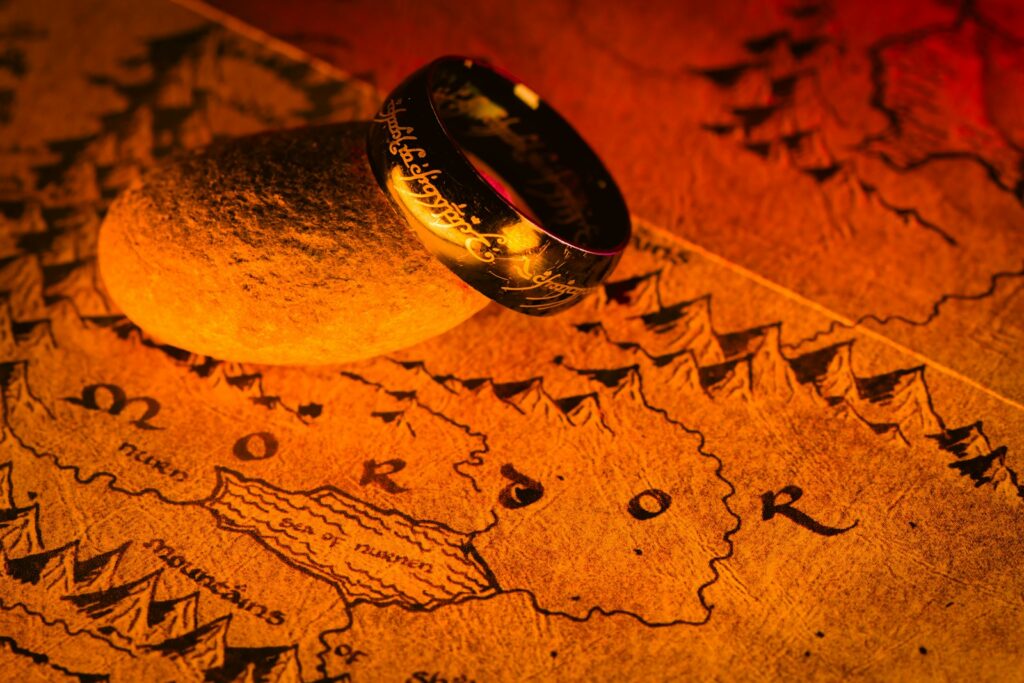
The meaning of “One Ring to rule them all” lies in Sauron’s desire to control the other Rings of Power and, through them, the people who possess them. In J. R. R. Tolkien’s The Lord of the Rings, Sauron creates the One Ring to extend his rule across Middle-earth, leaving no rival beyond his reach.
Yet his plan raises an interesting question. The Nine Men eventually fall under his control, while the Elves resist and the Dwarves prove difficult to enslave.
If the Ring was meant to rule them all, why did some escape its power?
JUMP TO:
What Is Written on the One Ring?
In The Fellowship of the Ring, Gandalf places the ring Frodo inherited from Bilbo into the fire. When he retrieves it, fine letters appear on the gold, revealing an inscription written in the Black Speech of Mordor using Tengwar, an Elvish script.
Gandalf refuses to speak the words aloud in Frodo’s home. Instead, he translates them into the Common Tongue, beginning with the famous phrase:
“One Ring to rule them all”The Ring inscription, translated by Gandalf in J. R. R. Tolkien’s The Fellowship of the Ring, Book I
The inscription contains the final two lines of the Ring Verse, a longer poem describing the Rings given to Elves, Dwarves, and Men. Its words express the One Ring’s purpose of ruling, finding, and binding the others.
The line also opens our collection of Lord of the Rings quotes, but its meaning becomes more troubling when we consider Frodo’s discovery.
Until then, Frodo knows the Ring mainly as an object that grants invisibility. Now he learns that it was created by Sauron himself. What seemed like an unusual inheritance has become a dangerous responsibility.
Who Does “Them All” Refer To?
The words “them all” refer primarily to the other nineteen great Rings of Power. Sauron, however, wanted more than control over magical objects. His real ambition was to command their bearers and extend his influence throughout Middle-earth.
He forged the One Ring in secret, placing much of his own power into it. Through that power, he hoped to bend the other Ring-bearers to his will.
The Nine Rings given to mortal Men reveal how completely his plan could succeed. Their bearers gained power and unnatural longevity but gradually faded into the unseen world. Eventually, they became the Nazgûl, servants bound to Sauron.
The Dwarves resisted more successfully. Their Seven Rings encouraged greed and a fierce hunger for treasure, yet Sauron could not enslave them as he had the Nine. By Frodo’s time, dragons had destroyed four of their Rings, while Sauron had recovered three.
The Elves recognized the danger when Sauron first wore the One Ring. They removed their own Rings before he could master them.
Although the Three Elven Rings were made without Sauron’s direct involvement, they remained subject to the One. While it was lost, the Elves could use them to preserve the places they cherished. If Sauron recovered it, their works would become vulnerable to his power.
These different outcomes reveal the distinction between Sauron’s ambition and his success. He could not control every bearer, but he intended to leave no one beyond his authority.
Why Does Tolkien Repeat “One Ring”?
The Ring Verse begins by describing the different peoples of Middle-earth. The Elves dwell beneath the sky, the Dwarves inhabit their halls of stone, and mortal Men face the certainty of death.
Each people has its own place and destiny. Then the poem turns toward the One Ring, and its language grows more forceful.
The repeated words “One Ring” draw attention away from the many Rings toward a single source of power. Those previously counted and distinguished become simply “them all.”
Tolkien’s choice of verbs strengthens the effect. The Ring is meant to rule, find, and bind, stripping its bearers of independence. Readers can hear the threatening rhythm in Tolkien’s own reading of the Ring Verse.
The repetition captures Sauron’s ambition to bring every other power under his command, regardless of what its bearer desires.
Why Does Gandalf Refuse the Ring?
When Frodo realizes what he possesses, he offers the Ring to Gandalf. The wizard seems an ideal guardian, having spent years opposing Sauron and protecting Middle-earth.
Yet Gandalf understands the temptation better than Frodo realizes.
“The wish to wield it would be too great for my strength.”Gandalf, J. R. R. Tolkien’s The Fellowship of the Ring, Book I
Gandalf fears that his desire to protect others could lead him to misuse the Ring. He might begin with good intentions, believing its power could defeat Sauron and defend the innocent. But the Ring offers power through domination. Even Gandalf’s wisdom could not guarantee that he would resist the temptation to impose his will on others.
His refusal reveals one of Tolkien’s central ideas. Good intentions cannot justify every means used to achieve them, especially when those means require others to surrender their freedom.
The scene also gives the inscription a more personal meaning. Sauron’s ambition threatens entire kingdoms, yet its temptation reaches into the quiet home of an ordinary hobbit.
Rather than taking Frodo’s burden and claiming authority over his choices, Gandalf offers guidance and friendship. His restraint stands in direct contrast to Sauron’s hunger for control.
The Danger of Power Without Restraint
“One Ring to rule them all” expresses Sauron’s ambition to dominate Middle-earth, but Tolkien’s warning reaches beyond the Rings themselves. The desire for absolute power threatens the freedom of everyone who falls under its influence.
Sauron believes power gives him the right to command others. Gandalf recognizes that even noble intentions can turn dangerous when someone assumes the authority to decide everyone else’s fate.
Their opposing choices leave us with a thought worth considering. True wisdom may lie not in possessing the power to control others, but in knowing when to refuse it.
Leave a Reply