Some old books stay useful because human nature has not changed as much as we like to think. We still rush into arguments, make emotional decisions, avoid preparation, and occasionally treat one annoying email like a declaration of war.
From ancient wars to modern life, the Art of War lessons still feel surprisingly practical. Sun Tzu wrote about military strategy, but many of his ideas about timing, self-awareness, patience, and restraint can help us handle work, relationships, competition, and difficult decisions with a little less chaos.
TABLE OF CONTENTS
- What Does The Art of War Teach?
- 1. Know Yourself Before You Study the Competition
- 2. The Best Battle May Be the One You Avoid
- 3. Preparation Makes Confidence Possible
- 4. Stop Attacking Problems at Their Strongest Point
- 5. Adapt When the Ground Changes
- 6. Patience Is Not the Same as Doing Nothing
- 7. Decide What Victory Actually Means
- Which Art of War Lesson Matters Most Today?
- Final Thoughts
What Does The Art of War Teach?
The Art of War teaches us that clear thinking often matters more than force. Sun Tzu emphasizes preparation, self-knowledge, flexibility, careful timing, and the wisdom to avoid conflicts that cost more than they achieve.
Although the book was written about military strategy, its lessons still apply today. You may not be defending an ancient kingdom, but you probably have deadlines, difficult conversations, changing plans, and at least one person who turns every group project into a test of character.
For readers who want to explore Sun Tzu’s ideas in the original public-domain translation, MIT hosts the Lionel Giles version of The Art of War.
Here are seven Sun Tzu lessons that still work in everyday life.
1. Know Yourself Before You Study the Competition
One of Sun Tzu’s most famous teachings is simple: understanding your opponent is not enough. You also need to understand yourself.
“If you know the enemy and know yourself, you need not fear the result of a hundred battles.”
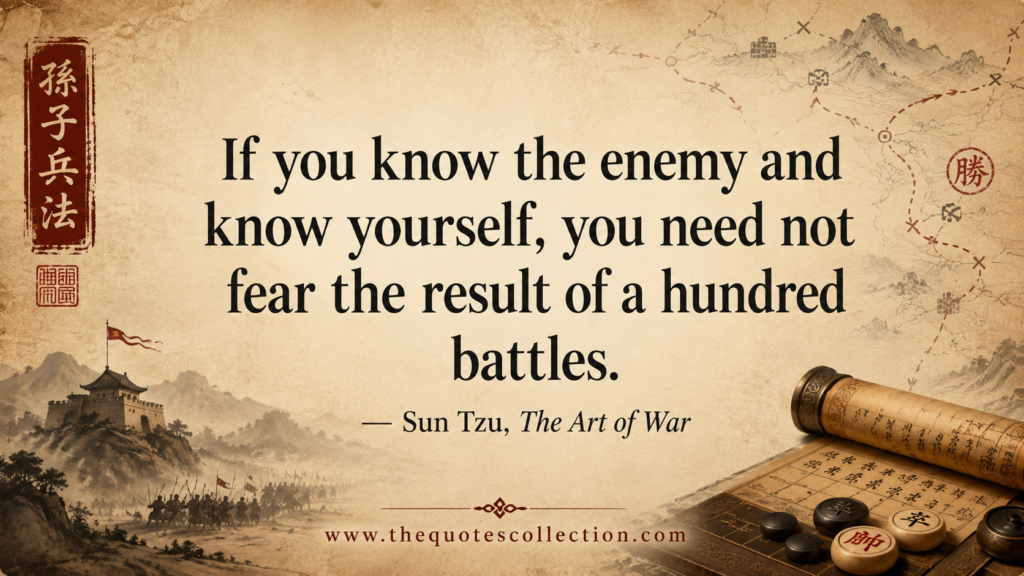
Self-awareness may sound less exciting than strategy, but it is where good strategy begins. You need an honest picture of your strengths, weaknesses, habits, resources, and limits. Otherwise, you can prepare for the wrong problem or chase a victory that does not even suit you.
Think about a job search. It is tempting to apply for every position with an impressive title, especially when the salary looks friendly. A more strategic approach starts with better questions:
- What kind of work do I actually do well?
- Which skills can I prove with real examples?
- What kind of work environment helps me perform my best?
- Which weaknesses do I need to address before applying?
Knowing what another candidate offers can help. Still, knowing what makes you valuable matters more.
The same principle applies to personal goals. If you know you lose focus late at night, building your routine around heroic 11 p.m. productivity may not be ambition. It may just be a weekly appointment with disappointment.
Self-awareness lets you plan for the person you actually are, not the imaginary version of yourself who wakes up at five, drinks green juice, and never checks social media.
2. The Best Battle May Be the One You Avoid
Sun Tzu did not treat constant fighting as proof of strength. In fact, some of his strongest lessons point toward avoiding unnecessary conflict.
“He will win who knows when to fight and when not to fight.”
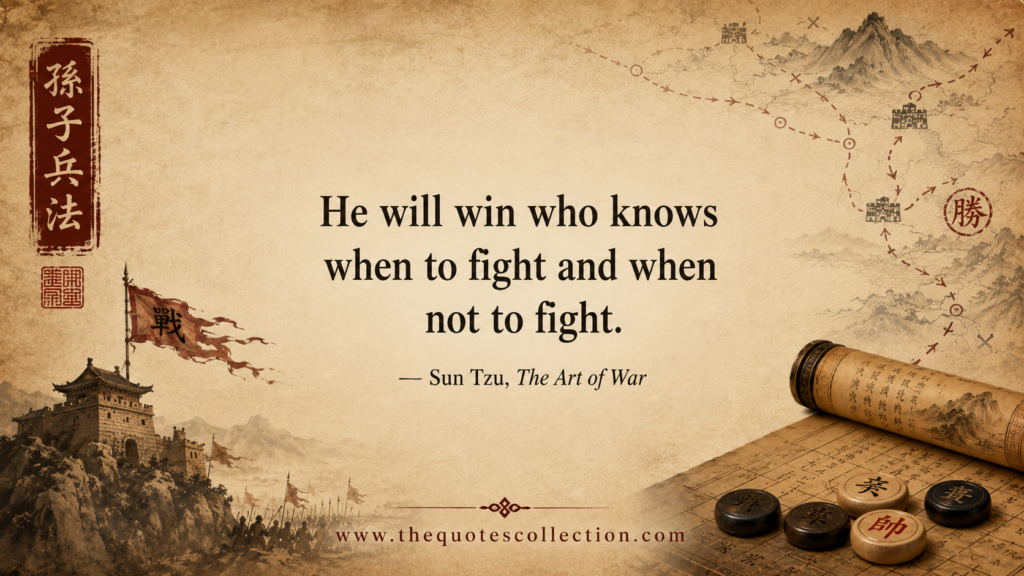
This may be one of the most useful Art of War life lessons because modern life gives us endless chances to enter pointless battles. A rude comment, a sharp message, or a minor disagreement can suddenly feel like a sacred call to defend our honor.
Not every challenge deserves a response.
Imagine receiving an email that feels unnecessarily cold. Your first reply might be passionate, detailed, and capable of damaging three professional relationships before lunch. Waiting twenty minutes does not make you weak. It gives you time to decide whether the message was actually hostile, poorly worded, or simply read while you were already stressed.
Avoiding a fight does not mean tolerating mistreatment. It also does not mean refusing to address serious problems. Instead, it means asking whether confrontation will improve the situation.
Sometimes you need a direct conversation. Sometimes you need firmer boundaries. On other occasions, the wisest response is to close the app, drink some water, and stop giving a stranger in a comment section control of your afternoon.
3. Preparation Makes Confidence Possible
People often admire confidence without noticing the preparation behind it.
The successful presentation looks effortless because no one saw the research, revisions, practice rounds, backup files, and quiet moment of panic when the slides briefly disappeared. What appears spontaneous may have taken days to prepare.
Sun Tzu repeatedly connects victory with calculations made before a battle begins. In everyday life, that means doing the less glamorous work early.
Before a job interview, study the company and prepare examples that prove your skills. Before requesting a raise, gather evidence of your results. If you are launching a project, think through what could go wrong while you still have time to do something about it.
Preparation cannot remove every risk. Life enjoys adding surprise complications just to keep the plot moving. However, preparation can keep avoidable problems from turning into full emergencies.
There is also a quieter benefit. When you prepare properly, you do not have to fake confidence. You know what you can do, what you need, and how you will respond if the original plan fails.
4. Stop Attacking Problems at Their Strongest Point
Many of us respond to difficulty by applying more force. If something is not working, we try harder in exactly the same way.
Sun Tzu suggests a smarter approach. Instead of attacking strength directly, look for the opening others have missed.
This does not mean exploiting people’s weaknesses in ordinary life. It means refusing to make a problem harder than it needs to be.
Suppose you are struggling to complete a complicated task at the end of every workday. You could blame yourself, increase the caffeine, and begin an ongoing feud with your attention span. Or you could move the task to the morning, when your mind is clearer.
The goal has not changed. The route has.
The same idea works in communication. Repeating your argument more loudly rarely makes it more persuasive. A question, example, or calmer conversation at a better time may accomplish what ten rounds of debate could not.
Effort matters, but effort pointed in the wrong direction becomes exhaustion. Before pushing harder, ask whether there is another way in.
5. Adapt When the Ground Changes
Sun Tzu compares effective tactics to water, which changes its course according to the ground beneath it. Water does not stand there arguing with the landscape. It adjusts and keeps moving.
This is easy to admire and much harder to practice. We become attached to our schedules, expectations, and beautifully organized plans. When circumstances change, flexibility can feel suspiciously like losing control.
Yet a plan is only useful while it still fits reality.
Perhaps a business idea is not attracting the audience you expected. A flexible response might involve changing the offer instead of spending more money promoting something people do not want. If a personal goal becomes difficult because of health, finances, or family responsibilities, adapting the timeline is not the same as giving up.
Rigidity says, “This is how it was supposed to happen.”
Strategy asks, “Given what is true now, what is the best next move?”
Flexibility does not require abandoning your values. It means changing the method while keeping sight of what matters.
6. Patience Is Not the Same as Doing Nothing
Some moments require quick action. Others punish it.
Sun Tzu’s teachings place enormous value on timing. A good opportunity approached too early can fail just as easily as one discovered too late.
Strategic patience is active. You may be gathering information, improving your skills, saving resources, watching a situation develop, or waiting until emotions have settled. From the outside, very little seems to be happening. Underneath, you are preparing.
Procrastination feels different. It avoids the decision because the decision is uncomfortable. No useful observation or preparation takes place. The task simply sits there, becoming more dramatic every time you look at it.
A helpful question is:
Am I waiting because the timing matters, or because I am afraid to begin?
If you are preparing for a better opportunity, patience can protect you from an impulsive mistake. However, if you have collected enough information and are still inventing reasons to delay, fear may have quietly taken command.
Wisdom lies in knowing when to wait and when waiting has stopped serving you.
7. Decide What Victory Actually Means
It is possible to win the argument and lose the relationship. You can earn the promotion and discover the role makes you miserable. You might finish every item on your to-do list and still neglect the one thing that mattered most.
Victory needs a definition.
Before entering a conflict or pursuing a goal, ask what outcome you actually want. Do you want to solve the problem, prove you were right, protect something important, or simply avoid feeling embarrassed?
Honest answers can change your strategy.
During a disagreement with someone you care about, victory may mean reaching an understanding instead of producing the cleverest comeback. At work, success could mean creating a reliable result, not becoming the person who handles every task alone.
This lesson also protects you from battles inherited from other people. Not every version of success deserves your time. A prestigious achievement may look impressive while moving you further from the life you actually want.
Sun Tzu’s approach is purposeful. Action should lead somewhere worthwhile. Staying busy, defensive, or endlessly competitive is not a strategy. It is motion without a destination.
Which Art of War Lesson Matters Most Today?
Self-awareness may be the most important Art of War lesson because it shapes every decision that follows. Once you understand your motives, strengths, weaknesses, and limits, you can choose conflicts more carefully, prepare realistically, and recognize when your plans need to change.
Still, the lessons work together. Preparation means little without flexibility. Patience becomes avoidance without purpose. Confidence turns reckless when it is not grounded in honest self-knowledge.
The enduring appeal of The Art of War is not its promise to make us ruthless. Its deeper value lies in teaching us to become more thoughtful.
Sun Tzu reminds us that strength does not always announce itself. Sometimes the smartest move is not the loudest one in the room. It is the one made with patience, timing, and a clear understanding of what is actually worth fighting for.
If you want to explore these ideas through Sun Tzu’s own words, read our collection of 36 powerful Art of War quotes with explanations of their meaning.
Final Thoughts
The best Art of War lessons are not about becoming colder, harsher, or more competitive. They are about thinking before reacting.
In everyday life, that can mean preparing before a big opportunity, avoiding a pointless argument, adapting when plans change, or deciding what success actually means before you chase it.
You do not need to treat life like a battlefield. However, a little strategy can help you stop wasting energy on battles that were never worth your peace.
Leave a Reply