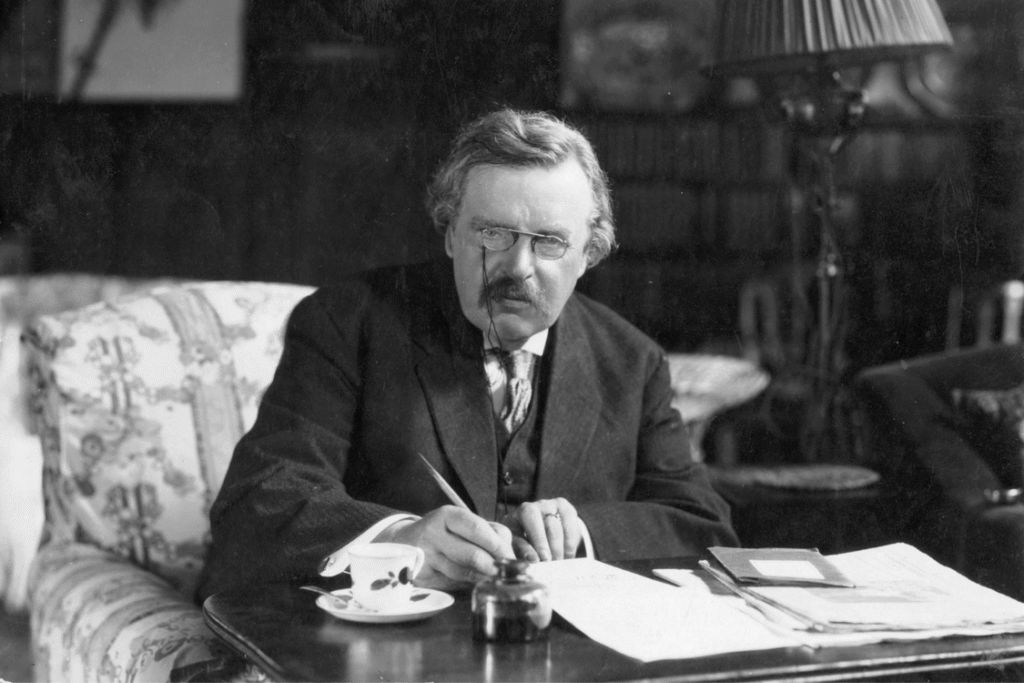
G. K. Chesterton could turn a complaint about cheese into an argument for paying closer attention to life. This collection of G. K. Chesterton quotes brings together his humor, Christian faith, and gift for finding something extraordinary in experiences most people hurry past. They explore gratitude, the courage of fairy tales, and the uncomfortable possibility that loving something means seeing its faults clearly.
Each quotation below includes its source and an explanation of its original setting. Where familiar versions shorten or reshape his words, the selection uses the wording supported by the cited text, so the thought keeps its meaning as well as its punch.
JUMP TO:
Quotes About Life and Everyday Wonder
Chesterton’s essays often begin with an ordinary irritation or pleasure and follow it toward a larger question. Readers who enjoy that movement between everyday experience and belief can also explore our guide to CS Lewis’s quotes and books.
1. Happiness Doubled by Wonder
“I would maintain that thanks are the highest form of thought; and that gratitude is happiness doubled by wonder.”G. K. Chesterton, A Short History of England, Chapter VI, “The Age of the Crusades”
Gratitude adds surprise to pleasure. We enjoy something, then recognize that its existence—and our chance to enjoy it—was never entirely ours to arrange.
The sentence appears in a discussion of medieval England, where Chesterton challenges the idea that spiritual life should draw everything from within the self. His examples emphasize receiving good things from beyond ourselves, including the welcome given to strangers. Gratitude, in this setting, requires an admission of dependence. We have received more than we made.
Although the line works beautifully among Thanksgiving quotes, its original argument reaches beyond a holiday. Giving thanks is a way of understanding our place in the world.
2. Loving What Could Disappear
“The way to love anything is to realise that it might be lost.”G. K. Chesterton, Tremendous Trifles, “The Advantages of Having One Leg”
A sprained foot supplies the unlikely setting for this reflection. Temporarily unable to use it normally, Chesterton notices how remarkable an ordinary working foot has always been.
His argument begins with a small interruption to habit. Familiar things can slip beneath our attention precisely because we depend on them every day. When their absence becomes imaginable, affection sharpens into appreciation. The essay’s comic title should not obscure its tenderness toward the life we already have.
3. The Trouble With Boredom
“There is no such thing on earth as an uninteresting subject; the only thing that can exist is an uninterested person.”G. K. Chesterton, Heretics, Chapter III
Before discussing Kipling, Chesterton offers a defense of people whose enthusiasm exhausts everyone around them. Someone absorbed in a subject has at least discovered a source of delight; the person declaring everything dull may have brought very little curiosity to the encounter. His exaggeration shifts the question from whether a subject deserves attention to how willingly we give it.
4. An Inconvenience Reconsidered
“An adventure is only an inconvenience rightly considered. An inconvenience is only an adventure wrongly considered.”G. K. Chesterton, All Things Considered, “On Running After One’s Hat”
Chasing a hat through the street is embarrassing partly because we insist on looking dignified while doing it. Chesterton suggests that the same scramble can acquire the energy of a game once we stop treating our dignity as an emergency.
The essay concerns ordinary disruptions, including awkward travel and household mishaps. Within that modest scale, a change in attitude can genuinely improve an experience. A delay might offer a story, while a ridiculous situation might permit a laugh.
Extending the sentence to serious suffering would ask it to do work its original examples cannot support.
5. A Serious Cheese Complaint
“Poets have been mysteriously silent on the subject of cheese.”G. K. Chesterton, Alarms and Discursions, “Cheese”
Chesterton treats a neglected food as though it has suffered a grave literary injustice. He promptly considers Virgil and a nursery rhyme, then imagines the destruction he would cause in a forest made of bread and cheese.
The mock seriousness makes room for a real affection: ordinary pleasures deserve imaginative attention, even when they lack the prestige of a sunset.
Quotes About Love and Loyalty
These G. K. Chesterton quotes about love connect affection with responsibility. Several belong to larger arguments about how people can remain devoted to an imperfect world while wanting it to improve.
6. Loved Before Being Loveable
“There is the great lesson of ‘Beauty and the Beast’; that a thing must be loved before it is loveable.”G. K. Chesterton, Orthodoxy, Chapter IV
In Chesterton’s reading of the fairy tale, love helps make transformation possible. Waiting until someone possesses every attractive quality would remove the generosity from the act of loving them.
The surrounding chapter treats fairy stories as serious teachers of moral imagination. “Beauty and the Beast” offers a striking reversal of the assumption that affection must wait for beauty to appear. Care can help bring out qualities that neglect would never encourage.
The sentence also has limits. A fairy-tale transformation cannot establish that another person will change if we love them enough. Chesterton is interpreting a story’s moral pattern, and his insight concerns the generosity that begins before a reward is guaranteed. The full argument appears in Chapter IV of Orthodoxy.
7. Love With Open Eyes
“Love is not blind; that is the last thing that it is. Love is bound; and the more it is bound the less it is blind.”G. K. Chesterton, Orthodoxy, Chapter V
Being “bound” here means being attached or committed. Chesterton argues that affection can make someone more perceptive because they care enough to notice what needs to change.
His examples include family members who defend a person loyally while recognizing their weaknesses with painful accuracy. From there, he develops a wider argument about reform. Improving the world requires some prior attachment to it; otherwise, criticism can collapse into the desire to discard everything. Love gives criticism a purpose beyond the satisfaction of finding fault.
8. What the Soldier Protects
“A real soldier does not fight because he has something that he hates in front of him. He fights because he has something that he loves behind his back.”G. K. Chesterton, Illustrated London News, December 31, 1910
The people and places being defended give courage its direction. Chesterton locates the soldier’s motive in attachment to a life worth protecting, a distinction that also places a moral demand on the fighting itself.
The familiar version beginning “The true soldier fights…” compresses these two sentences into one. The Society of G. K. Chesterton identifies that wording as a paraphrase and supplies the original formulation above. Its emphasis is protective love; the passage should not be treated as an automatic defense of every war or every action taken during one.
Quotes About Faith and Humility
Chesterton’s religious arguments can sound playful even when they ask something demanding of the reader. Humor helps him expose the distance between admiring a virtue and practicing it.
9. The Difficulty of Christianity
“The Christian ideal has not been tried and found wanting. It has been found difficult; and left untried.”G. K. Chesterton, What’s Wrong With the World, Part I, Chapter V
Chesterton distinguishes an ideal from the behavior of people who claim to follow it. Calling Christianity a failure, he argues, does not establish that its demands have received a fair trial.
The surrounding discussion is more pointed than a simple defense of Christians. He explicitly acknowledges the failings of churchmen and contrasts Christian humility with Christian arrogance. His criticism reaches believers who praise an ideal while avoiding its demands, as well as opponents who judge the ideal entirely through those failures.
The argument then extends to the French Revolution and other unfinished social ambitions. Chesterton questions the assumption that an older ideal must have been exhausted merely because history moved away from it. Readers can dispute his historical assessment while recognizing the question he raises: how much of what we reject have we actually attempted?
10. Hope Under Difficult Conditions
“But charity means pardoning what is unpardonable, or it is no virtue at all. Hope means hoping when things are hopeless, or it is no virtue at all. And faith means believing the incredible, or it is no virtue at all.”G. K. Chesterton, Heretics, Chapter XII
These are Chesterton’s own consecutive sentences, rather than the expanded version that begins “To love means loving the unlovable.” His subject is the paradox within the Christian virtues of faith, hope, and charity.
Optimism comes easily when events look promising. Hope earns its name under conditions that give a person reasons to despair. Similarly, charity reaches beyond helping only those whose claims already seem deserved. Chesterton presses each definition toward the point where practicing it becomes difficult.
“Incredible” also needs its setting. The chapter responds to criticism of faith by comparing its apparent unreasonableness with virtues people more readily admire. He is making a theological argument about their shared paradox, rather than offering a general instruction to believe every unlikely claim.
11. Taking Yourself More Lightly
“Angels can fly because they can take themselves lightly.”G. K. Chesterton, Orthodoxy, Chapter VII
The joke turns physical lightness into an image of humility. Chesterton follows it with references to Christian art, where angels appear buoyant and alive with movement.
Self-importance, by comparison, makes a person heavy with the duty of maintaining their own grandeur. The sentence permits seriousness about life without requiring solemn admiration of ourselves.
Quotes About Fairy Tales and Tradition
For Chesterton, inherited stories offer ways to think about fear, moral choices, and the limits of our own experience. Their imaginative settings can make an argument visible before an abstract explanation would make it clear.
12. Giving the Dragon an Enemy
“The baby has known the dragon intimately ever since he had an imagination. What the fairy tale provides for him is a St. George to kill the dragon.”G. K. Chesterton, Tremendous Trifles, “The Red Angel”
Children already experience fear, Chesterton argues. A fairy tale gives that fear a shape and introduces the possibility of resistance through a hero who can confront it.
The essay answers the objection that frightening stories plant frightening ideas in children’s minds. In his account, imagination has already supplied the terrors; the story offers a limit to their power. St. George, the legendary dragon slayer, represents an answer to the monster rather than the invention of one.
The popular saying about fairy tales teaching children that dragons can be killed summarizes this argument, but it does not reproduce these sentences. Chesterton’s original also makes a more specific claim than a promise that every problem will end happily. Stories can help a frightened person imagine that fear does not possess the whole world.
13. Votes for Our Ancestors
“Tradition means giving votes to the most obscure of all classes, our ancestors. It is the democracy of the dead.”G. K. Chesterton, Orthodoxy, Chapter IV
Chesterton imagines a democracy whose electorate includes earlier generations. Their experience deserves a hearing, he argues, even though they can no longer argue their case in person.
The surrounding passage challenges the assumption that people alive today possess an automatic advantage in wisdom. A “vote” suggests participation in judgment, however, rather than a guarantee that every inherited custom deserves preservation.
The useful question is whether we have considered what earlier generations knew before congratulating ourselves on having moved beyond them.
Quotes About Judgment and Enjoyment
Some of Chesterton’s sharpest distinctions concern the reasons behind everyday choices. Permission, pleasure, and good judgment do not always arrive together.
14. Having Rights, Choosing Wisely
“To have a right to do a thing is not at all the same as to be right in doing it.”G. K. Chesterton, A Short History of England, Chapter X
Freedom to make a decision does not certify its wisdom. Chesterton develops this distinction while discussing royal authority, then brings it closer to ordinary life through voting, marriage, and the expression of opinions. A person can possess a genuine right to choose while making a poor choice; recognizing that possibility preserves both liberty and the need for judgment.
15. Pleasure Without Seeking Escape
“Drink because you are happy, but never because you are miserable.”PG. K. Chesterton, Heretics, Chapter VII
This sentence belongs to Chesterton’s response to the philosophy of wine and pleasure he finds in Edward FitzGerald’s Rubáiyát of Omar Khayyám. His concern is the motive for drinking and the kind of relationship a person forms with pleasure.
Celebration allows enjoyment to accompany happiness. Drinking out of misery asks it to supply an escape on which happiness may start to depend. Read within the essay, the line expresses Chesterton’s preference for festive enjoyment over despair disguised as sophistication.
Learning to Look Again
Across these G. K. Chesterton quotes, attention carries unusual weight. A foot, a familiar story, or an ordinary pleasure can reward a second look. Even the jokes ask us to examine a habit of judgment, and occasionally to stop looking so impressed with ourselves long enough to enjoy what is in front of us.
Leave a Reply