Milton Friedman believed capitalism worked best when people were free to choose, trade, compete, and take responsibility for their decisions. To him, economic freedom was not only about money. It was closely tied to personal liberty, political freedom, and the ability of ordinary people to make choices for themselves.
His strongest arguments were often simple but sharp: free markets encourage voluntary cooperation, concentrated power should be treated with caution, and government promises often come with hidden costs.
These Milton Friedman quotes about capitalism, freedom, and other important topics show why his ideas remain influential, debated, and widely shared today.
Who Was Milton Friedman?
Milton Friedman was an American economist, author, professor, and public intellectual known for his strong defense of free markets and limited government. He was awarded the Nobel Prize in Economics in 1976 and became one of the most recognizable economic thinkers of the twentieth century.
Friedman wrote influential books such as Capitalism and Freedom and Free to Choose, the latter co-authored with his wife, Rose Friedman. His work helped bring economic ideas about markets, inflation, government spending, and individual liberty into public conversation.
Whether readers agree with him fully or not, Friedman’s quotes still invite serious reflection. They ask us to think about what freedom costs, what government can and cannot do well, and how economic systems shape everyday life.
For a broader collection, you can also read our list of the best Milton Friedman quotes.
Why Milton Friedman’s Capitalism Quotes Still Matter
Friedman’s quotes about capitalism remain popular because they speak to questions that never really go away. How much should government control? What role should markets play? Can economic freedom exist without personal responsibility? What happens when political power and economic power become too closely connected?
His words are often direct, sometimes provocative, and rarely neutral. That is part of why they continue to circulate in discussions about free enterprise, inflation, regulation, taxes, government spending, and personal choice.
The quotes below are organized by theme so you can read them not just as isolated lines, but as part of Friedman’s broader view of capitalism and freedom.
Milton Friedman Quotes About Capitalism
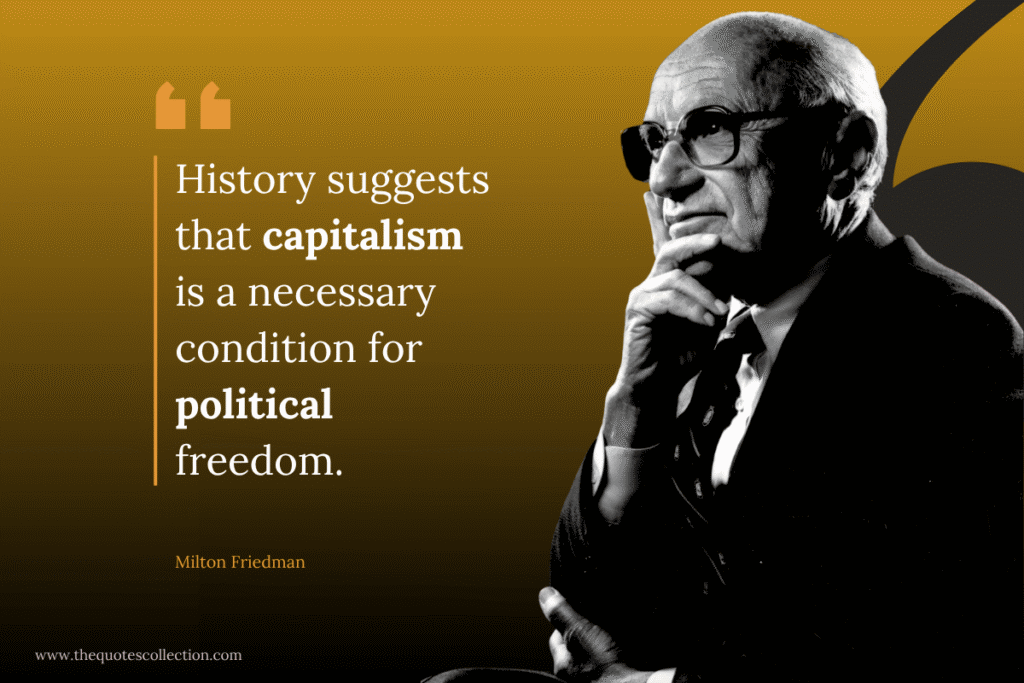
1. “History suggests that capitalism is a necessary condition for political freedom.”
Source: Capitalism and Freedom
This is one of Friedman’s clearest statements about the relationship between capitalism and liberty. He did not argue that capitalism automatically creates a free society, but he believed political freedom was unlikely to survive without economic freedom.
In other words, he saw capitalism as more than an economic arrangement. He saw it as one protection against concentrated power.
2. “The great virtue of capitalism is that it’s that kind of system.”
Source: Playboy interview, 1973
This quote comes from Friedman’s argument that capitalism helps limit the harm people can do with power. He did not claim that people are perfectly selfless. Instead, he believed systems should be judged by how they handle ordinary human motives.
For Friedman, capitalism worked because it dispersed power and gave people alternatives.
3. “After the fall of communism… capitalism was a success.”
Source: Cato Institute speech, 1993
Friedman often contrasted capitalism with socialism and communism. This quote reflects his belief that the twentieth century had already shown the practical failure of centrally planned economies.
The point is not only political. It is also moral and practical: systems should be judged by what they do for real people.
4. “Underlying most arguments against the free market is a lack of belief in freedom itself.”
Source: Capitalism and Freedom
This is one of Friedman’s most famous free-market quotes. He believed many objections to markets were really objections to letting people make their own choices.
It is a strong statement, and not everyone will agree with it. But it captures the heart of Friedman’s philosophy: freedom can be messy, but he believed it was still worth defending.
5. “The problem of social organization is how to set up an arrangement under which greed will do the least harm.”
Source: Playboy interview, 1973
Friedman did not deny self-interest. He argued that every system must deal with it.
His defense of capitalism was not based on the idea that people are always noble. It was based on the idea that markets can channel self-interest through competition, choice, and voluntary exchange.
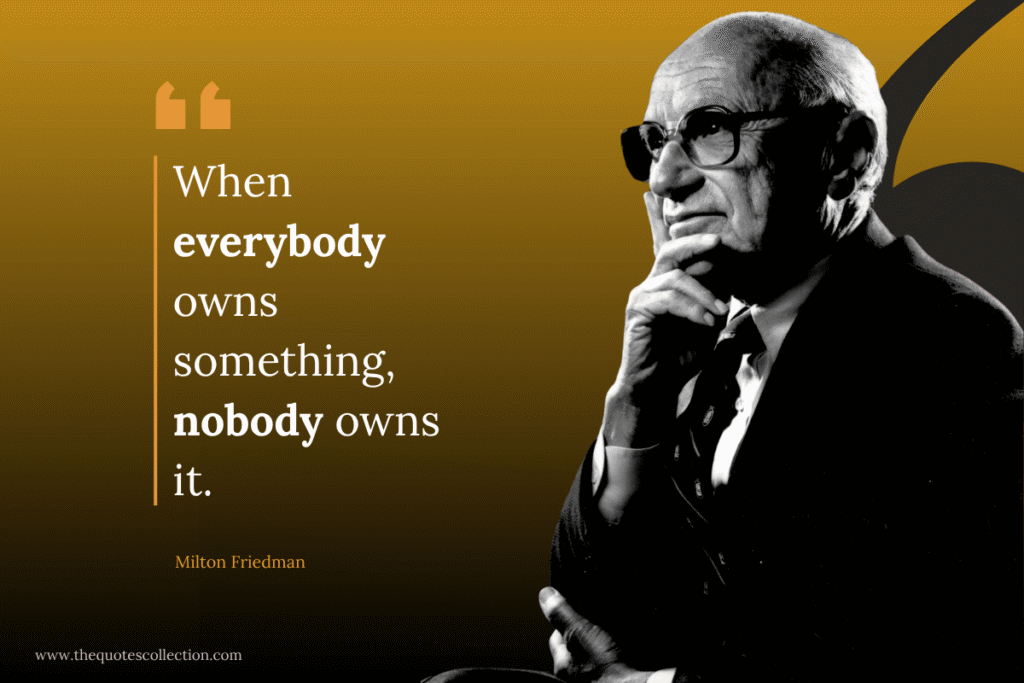
6. “When everybody owns something, nobody owns it.”
Source: Free to Choose
This short line reflects Friedman’s concern about collective ownership and weak accountability. When responsibility is too spread out, no one may feel personally responsible for taking care of what is shared.
It is a simple quote, but it points to a larger argument about incentives, property, and stewardship.
Milton Friedman Quotes About Free Markets
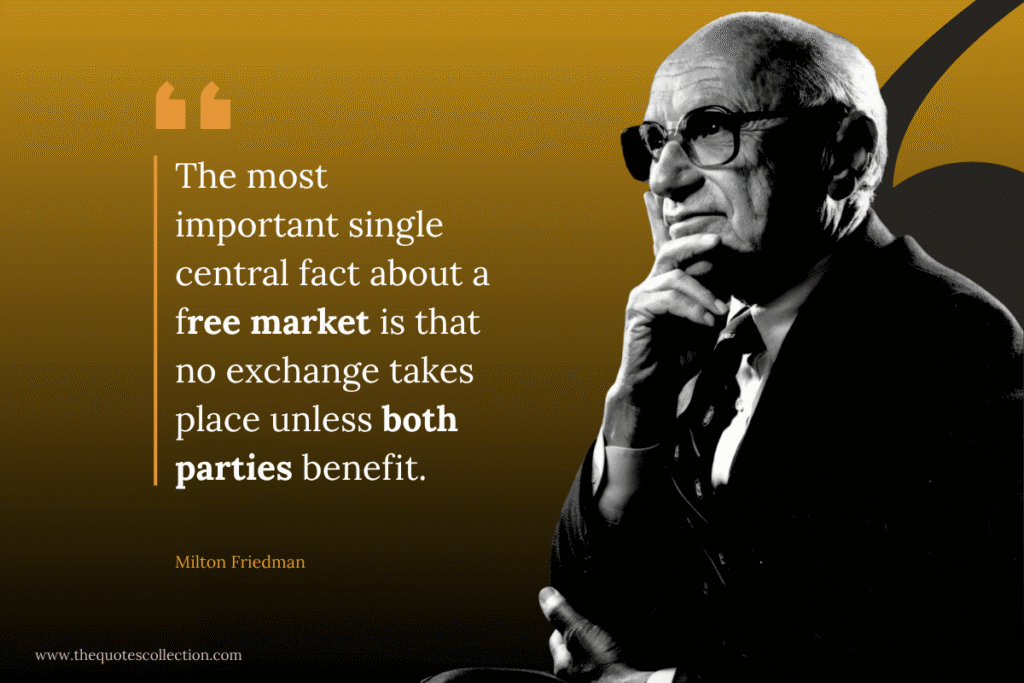
7. “The most important single central fact about a free market is that no exchange takes place unless both parties benefit.”
Source: PBS Commanding Heights interview
This quote explains one of Friedman’s core ideas about voluntary exchange. In a free market, people trade because both sides expect to gain something.
That does not mean every market is perfect. But Friedman believed voluntary exchange was one of the most powerful forces for cooperation.
8. “The price system transmits only the important information.”
Source: Free to Choose
Friedman believed prices carry signals. They help people understand scarcity, demand, and value without needing one central authority to direct every decision.
This is one reason he trusted markets more than central planning. Prices, in his view, helped organize human activity quietly and efficiently.
9. “You must distinguish sharply between being pro free enterprise and being pro business.”
Source note: Big Business, Big Government
This is one of Friedman’s most useful distinctions. Supporting free enterprise does not mean supporting every business or protecting companies from competition.
In fact, free markets often discipline businesses. A company must serve customers well or risk losing them.
10. “The strongest argument for free enterprise is that it prevents anybody from having too much power.”
Source: Free to Choose television series
Friedman believed markets helped prevent power from gathering in one place. In a competitive system, customers, workers, and businesses all have choices.
That is why he often defended free enterprise not just as efficient, but as a way to protect freedom.
11. “The only way… to have a lot of people cooperate together voluntarily is through the free market.”
Source: PBS Commanding Heights interview
This quote shows why Friedman saw markets as a form of cooperation. To him, buying, selling, hiring, producing, and trading were not only economic acts. They were ways people coordinated their lives without being forced.
That idea sits at the center of many of his arguments about capitalism.
Milton Friedman Quotes About Economic Freedom
12. “Economic freedom is… an end in itself.”
Source: Capitalism and Freedom
Friedman believed economic freedom mattered on its own, not only because it could lead to wealth or efficiency. Choosing how to work, trade, save, spend, and build a life was part of human freedom.
This is one of the reasons he resisted the idea that economic policy could be separated from personal liberty.
13. “Freedom as a value… has to do with the interrelations among people.”
Source: Capitalism and Freedom
Friedman’s idea of freedom was not only private or abstract. He connected it to how people relate to one another in society.
In his view, economic freedom helped reduce coercion because people could cooperate through choice rather than command.
14. “The society that puts equality before freedom will end up with neither.”
Source: The Role of Government in a Free Society
This is one of Friedman’s most widely quoted lines. He believed that attempts to force equality often required giving some people power over others.
The quote does not dismiss fairness. It warns that pursuing equality through coercion may weaken both liberty and prosperity.
15. “A society that puts freedom before equality will end up with a great measure of both.”
Source: The Role of Government in a Free Society
This quote completes the thought above. Friedman believed free societies could create more opportunity, mobility, and prosperity than systems built around forced equality.
It is a hopeful line, but also a challenging one. It asks whether freedom may sometimes be the better path toward broad improvement.
Milton Friedman Quotes About Government and Power
16. “The combination of economic and political power in the same hands is a sure recipe for tyranny.”
Source: Free to Choose
This quote captures one of Friedman’s deepest concerns: concentrated power. When the same institution controls both political authority and economic life, individual choice can shrink quickly.
For Friedman, capitalism mattered because it helped separate economic power from political power.
17. “Concentrated power is not rendered harmless by the good intentions of those who create it.”
Source: Capitalism and Freedom
This is a sharp reminder that good intentions do not erase the risks of power. Friedman believed even well-meaning policies could create harmful outcomes if they gave too much authority to too few people.
It is one of his most useful quotes for thinking about regulation, bureaucracy, and political promises.
18. “The power to do good is also the power to do harm.”
Source: Attributed to Milton Friedman
This quote reflects Friedman’s suspicion of centralized authority. A government strong enough to solve problems may also be strong enough to create new ones.
That does not mean government has no role. It means power should always be handled with humility and limits.
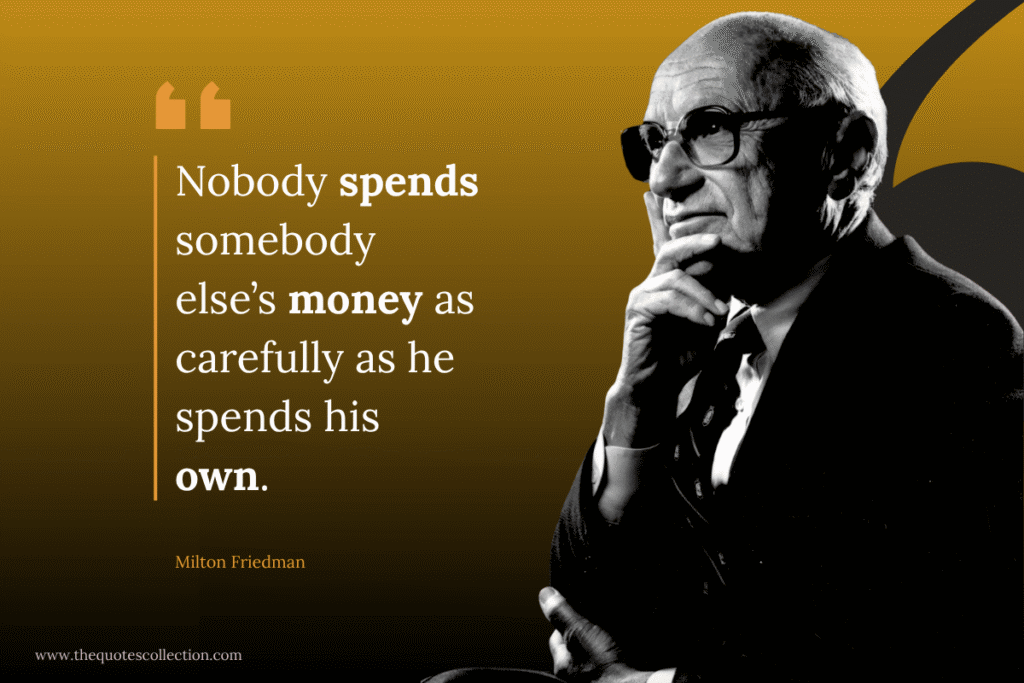
19. “Nobody spends somebody else’s money as carefully as he spends his own.”
Source: Free to Choose television series
This is one of Friedman’s most memorable quotes about incentives. He believed people are usually more careful with their own resources than with money that belongs to someone else.
It is a simple idea, but it shaped many of his criticisms of government spending.
20. “Governments never learn. Only people learn.”
Source: Attributed to Milton Friedman
This line reflects Friedman’s skepticism about political institutions. He often argued that government programs can continue even when they fail because the incentives for correction are weak.
In a market, failure usually brings pressure to change. In government, he believed mistakes were often harder to correct.
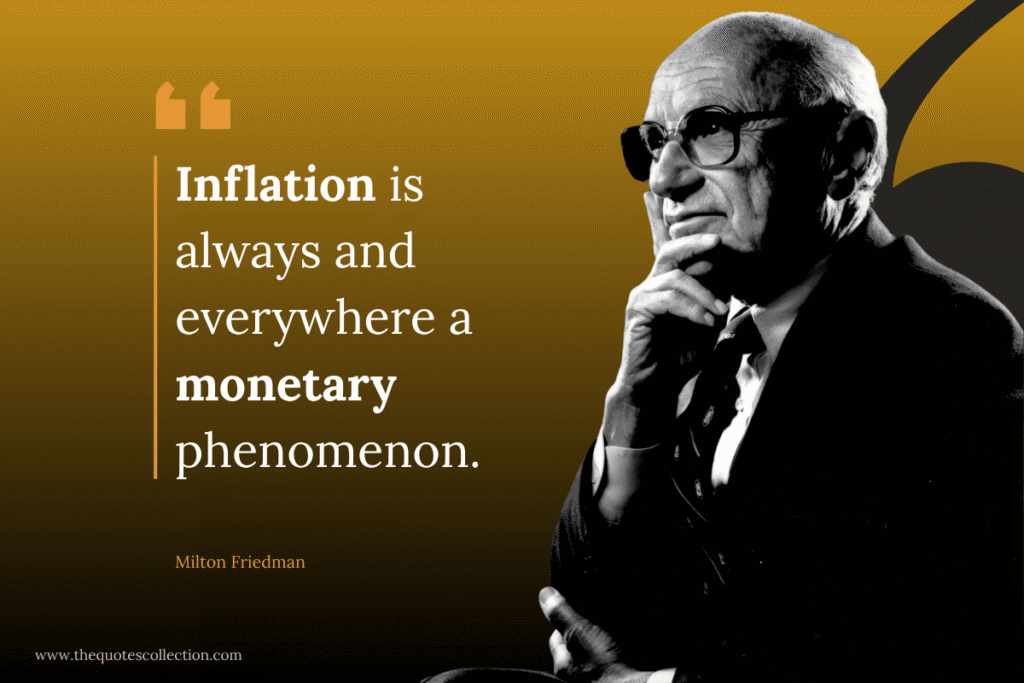
21. “Inflation is always and everywhere a monetary phenomenon.”
Source: The Counter-Revolution in Monetary Theory
Friedman is closely associated with monetarism, and this is one of his most famous economic statements. He argued that sustained inflation is tied to the money supply.
For readers today, this quote remains relevant because inflation affects wages, savings, prices, and everyday purchasing power.
What Can We Learn From Milton Friedman’s Views on Capitalism?
Friedman’s quotes remind us that capitalism, in his view, was never only about business or money. It was about choice, responsibility, competition, and the dangers of concentrating too much power in one place.
His ideas are still debated, and that is part of their lasting importance. Some readers see Friedman as one of the clearest defenders of economic liberty. Others question whether free markets alone can address inequality, public welfare, or social responsibility.
But whether you agree with him or not, his quotes ask important questions: Who should make decisions? What happens when government grows too powerful? How do incentives shape behavior? And how much freedom are we willing to protect when the results are imperfect?
Those questions are why Friedman’s words continue to matter.
Final Thoughts
Milton Friedman’s capitalism quotes are direct, memorable, and often challenging. They do not ask readers to think only about economics in a classroom sense. They ask us to think about freedom in daily life.
For Friedman, capitalism was closely tied to the freedom to choose, the responsibility to live with consequences, and the importance of limiting power. His quotes continue to spark debate because they touch something larger than policy. They touch the question of how free people should live together.
Leave a Reply