
What happens when you spend so long fighting darkness that you start carrying some of it with you? Nietzsche’s abyss quote has survived for more than a century because its warning feels both mysterious and uncomfortably familiar.
The famous line about gazing into the abyss comes from Beyond Good and Evil, but it is only half of the aphorism. Read together with Nietzsche’s warning about fighting monsters, the meaning becomes clearer. He is not simply telling us to fear dark ideas. He is asking what prolonged conflict with them might do to us.
JUMP TO:
- What Is the Full Nietzsche Abyss Quote
- What Does “He Who Fights With Monsters” Mean
- What Does “Gaze Into the Abyss” Mean
- Why Both Sentences Belong Together
- Is Nietzsche’s Abyss About Nihilism
- Why the Nietzsche Abyss Quote Has So Many Versions
- How the Abyss Quote Applies Today
- Does Nietzsche Mean We Should Avoid the Abyss
- Where the Nietzsche Abyss Quote Comes From
- Why the Abyss Still Gazes Back
What Is the Full Nietzsche Abyss Quote?
Nietzsche’s complete aphorism appears in Beyond Good and Evil, published in 1886.
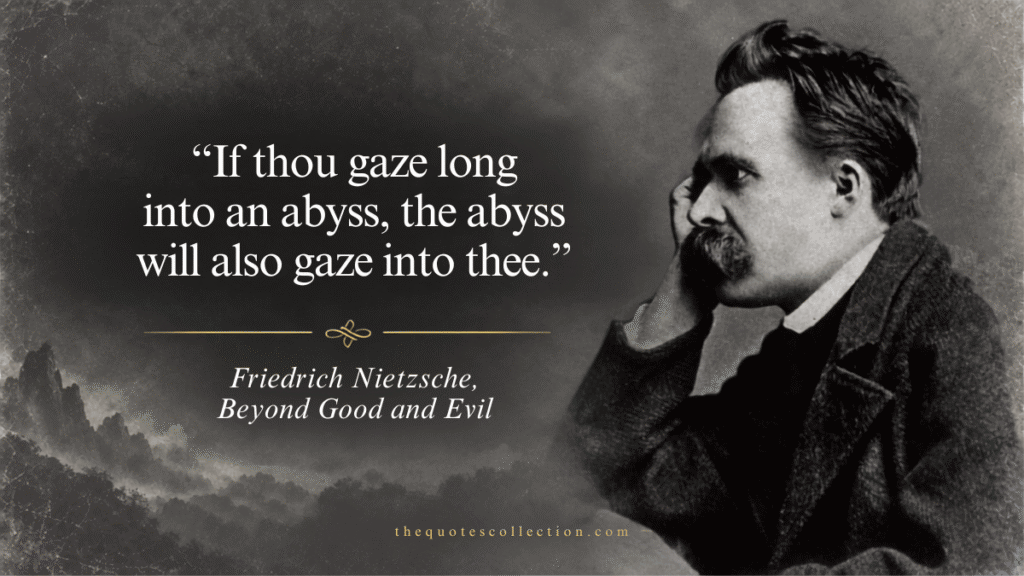
He who fights with monsters should be careful lest he thereby become a monster. And if thou gaze long into an abyss, the abyss will also gaze into thee.Friedrich Nietzsche, Beyond Good and Evil, Chapter IV, Aphorism 146
The wording above comes from Helen Zimmern’s English translation, which is available through Beyond Good and Evil on Project Gutenberg. Project Gutenberg identifies Zimmern as the translator and preserves the aphorism in Chapter IV.
The first sentence often disappears when the quote is shared online. It sounds more dramatic that way, certainly, but it also removes the clearest clue to what Nietzsche is warning about.
What Does “He Who Fights With Monsters” Mean?
The monster is not necessarily a literal person or a single form of evil. Nietzsche leaves the image open enough to cover destructive beliefs, cruelty, corruption, hatred, or anything else that demands prolonged opposition.
His warning points toward the effect of conflict on the person doing the fighting.
Someone may begin by resisting dishonesty, then decide lying is acceptable because the other side lies. A person fighting cruelty may gradually justify cruelty of their own. Opposition can become so consuming that the methods, habits, and attitudes of the enemy begin to feel reasonable.
The danger lies in assuming that having the better cause automatically protects you from becoming corrupted by the struggle.
Nietzsche does not say that monsters should never be confronted. The Zimmern translation tells the fighter to “be careful,” while other respected translations use phrases such as “take care” or “look to it.” The warning concerns how the fight is carried out and what it slowly does to the fighter.
That distinction is easy to miss when the aphorism is reduced to a motivational slogan about defeating enemies.
What Does “Gaze Into the Abyss” Mean?
The abyss is more difficult to pin down because Nietzsche never pauses after Aphorism 146 to define it for us.
A common interpretation connects it with nihilism, meaninglessness, cruelty, or the darker parts of human experience. All are reasonable readings, but none should be presented as a dictionary definition Nietzsche personally supplied.
The image itself gives us more to work with.
An abyss is deep enough that its bottom cannot be seen. Looking into one means confronting something uncertain, frightening, or difficult to comprehend. Nietzsche then reverses the relationship. You are no longer the only observer. The abyss begins looking back.
That reversal is the unsettling part.
What we examine repeatedly can influence how we think. What we fight can shape our behavior. An obsession can slowly reorganize our attention until the thing we believed we were merely studying begins occupying a much larger place in our lives.
The abyss does not need to transform into a supernatural creature for the metaphor to work. Its power comes from suggesting that prolonged exposure is rarely one-directional.
Why Both Sentences Belong Together
Taken alone, “the abyss will also gaze into thee” can sound like a vague warning about introspection, depression, or thinking too much about frightening things.
Put the monster sentence back, and the structure becomes much sharper.
The first sentence concerns what happens when you fight something dangerous. The second concerns what happens when you stare into something dark for too long. Both involve the same uncomfortable possibility.
The encounter may change you.
Nietzsche compresses an entire problem into two sentences. We often imagine moral conflict as a simple contest between ourselves and something outside us. His aphorism asks us to consider whether the boundary stays quite so clean once the struggle continues for long enough.
That is also why the quote remains useful outside nineteenth-century philosophy. The monster and the abyss can change with the situation, while the underlying warning still holds.
Is Nietzsche’s Abyss About Nihilism?
Nihilism is one of the strongest ways to read the abyss, especially when the quote is considered alongside Nietzsche’s wider philosophy.
Nietzsche was deeply concerned with what happens when inherited systems of meaning lose their authority. If familiar answers about morality, religion, and purpose no longer convince us, people may find themselves confronting a frightening absence where certainty once stood.
The abyss works naturally as an image for that experience.
However, Aphorism 146 itself never says that the abyss equals nihilism. Keeping that distinction matters because the metaphor is broader than one philosophical problem.
For more context on how Nietzsche confronted meaninglessness rather than simply surrendering to it, our Nietzsche nihilism quotes explore his ideas about values, purpose, and self-overcoming.
Why the Nietzsche Abyss Quote Has So Many Versions
Readers searching for the Nietzsche abyss quote quickly run into a problem. The wording seems to change from page to page.
You may see “gaze into the abyss,” “look into the abyss,” or “stare into the abyss.” Some versions use “thou,” while others use “you.” The monster sentence varies even more.
There is a simple reason. Nietzsche wrote Beyond Good and Evil in German, and translators make different choices when turning his sentences into English.
Helen Zimmern’s 1906 translation gives us this wording.
“He who fights with monsters should be careful lest he thereby become a monster.”
R. J. Hollingdale later rendered the idea as someone who “should look to it” that he does not become a monster, while Walter Kaufmann used another slightly different construction. The abyss sentence changes in the same way.
One popular version begins with “Battle not with monsters.” It sounds memorable, but it changes the force of Nietzsche’s statement. “Battle not” sounds like an instruction to avoid the fight altogether. The German is closer to a warning to take care during the struggle.
Translation may seem like a small detail until a few changed words alter the lesson.
How the Abyss Quote Applies Today
Nietzsche could not have imagined social media outrage cycles, office group chats, or twenty-four-hour news feeds. His warning still travels remarkably well.
Someone who spends every day monitoring people they despise may begin organizing more and more of life around anger. Eventually, the opponent controls the person’s attention even without speaking to them directly.
The same pattern can appear at work. A person dealing with manipulation may decide the only way to survive is to manipulate better. What started as self-protection gradually turns into a habit.
Politics offers another obvious example. People can condemn a tactic when their opponents use it, then excuse the same behavior from their own side because winning begins to feel more important than consistency.
Personal relationships can create quieter versions of the same problem. Betrayal may produce understandable caution, but carrying that suspicion into every new relationship can allow an old wound to shape people who never caused it.
None of these examples is a hidden scenario Nietzsche inserted into the aphorism. They simply show why the warning remains recognizable.
Does Nietzsche Mean We Should Avoid the Abyss?
Not necessarily.
Nietzsche spent much of his work confronting difficult subjects rather than avoiding them. He questioned morality, religion, truth, suffering, culture, and the possibility of nihilism with very little interest in keeping the discussion comfortable.
That makes it unlikely that Aphorism 146 is simply advice to stay away from everything dark.
A better reading is that confrontation requires awareness.
Fight the monster, if you must, but watch what the fight is teaching you. Look into the abyss, but remember that prolonged attention has consequences.
The warning becomes less about fear and more about vigilance. You can confront something without giving it unlimited permission to shape your character.
Where the Nietzsche Abyss Quote Comes From
The quote appears in Beyond Good and Evil, first published in 1886. It is Aphorism 146 in Chapter IV, a section titled “Apophthegms and Interludes” in Helen Zimmern’s translation.
Unlike many famous lines from Thus Spoke Zarathustra, this quotation is not dialogue spoken by a fictional character. It appears as one of Nietzsche’s numbered aphorisms.
That difference is useful when attributing the quote. The clean attribution is Friedrich Nietzsche, Beyond Good and Evil, Aphorism 146.
Why the Abyss Still Gazes Back
Nietzsche’s abyss quote lasts because it refuses to let the observer remain safely outside the problem.
We like to imagine that fighting something wrong leaves our own character untouched. We also tend to assume that studying darkness gives us knowledge without asking anything in return. Nietzsche unsettles both assumptions.
The monster may influence the fighter. The abyss may influence the person looking into it.
His warning does not require us to retreat from difficult ideas, conflict, or uncomfortable truths. It asks for something harder instead. We have to confront them without allowing the confrontation to decide who we become.
How do you fight what you oppose without slowly learning to resemble it?
Leave a Reply