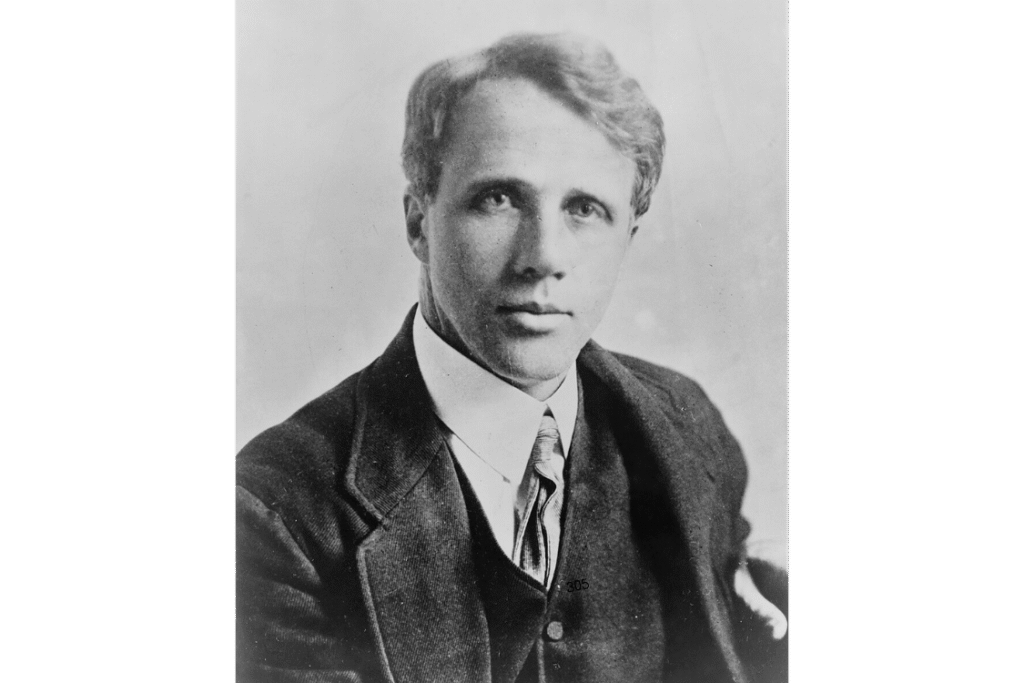
Some encouragement stays with us because it leaves room for doubt. These Robert Frost motivational quotes speak to the uncertain choices and ordinary duties that shape a life. His speakers pause beside snowy woods, question familiar habits, and find unexpected comfort in the natural world.
The selections below bring together famous lines and quieter passages worth discovering. Each includes its source and an explanation, with a closer look at “The Road Not Taken” and what its familiar ending suggests about choosing a direction.
JUMP TO:
- Robert Frost Motivational Quotes About Keeping Going
- The Road Not Taken by Robert Frost
- Robert Frost Quotes About Work and Purpose
- Robert Frost Quotes About Love and Connection
- Robert Frost Quotes About Finding Hope in Ordinary Days
- Questions About Robert Frost’s Motivational Quotes
- Something Worth Carrying Forward
Robert Frost Motivational Quotes About Keeping Going
Frost’s writing offers encouragement without promising an easy passage. There is room for fatigue in these words, along with the possibility that tomorrow may feel different.
1. Life Goes On
“In three words, I can sum up everything I’ve learned about life. It goes on.”Robert Frost, as reported by Ray Josephs in “Robert Frost’s Secret,” This Week Magazine, September 5, 1954
Frost’s answer places a difficult moment within a longer life. Whatever feels overwhelming today belongs to a story whose ending remains unwritten.
There is comfort in that perspective, particularly when discouragement makes the future resemble an endless version of the present. You need not solve everything before allowing yourself to imagine another kind of day.
For encouragement shaped by the changing seasons, explore our November inspirational quotes.
2. Finding a Way Through
“He says the best way out is always through.”Robert Frost, “A Servant to Servants,” North of Boston
The familiar saying has a more troubled setting than its popularity might suggest. An exhausted woman repeats her husband’s advice while describing work that leaves her little chance to recover. She has already explained that she needs rest.
Her circumstances give the line both strength and tension. Persistence can help us face something difficult, yet persistence alone cannot make an unreasonable burden fair. The poem asks us to hear the person carrying that burden.
Read with care, the passage encourages an honest response to hardship. Sometimes that means continuing with a necessary task. Sometimes it means asking for help so that continuing is possible.
3. Permission to Begin Again
I’d like to get away from earth awhile
And then come back to it and begin over.Robert Frost, “Birches,” Mountain Interval
The speaker imagines a temporary escape from a life that has grown difficult to navigate. What makes the wish hopeful is his desire to return.
A little distance can restore the patience that daily demands have worn away. Frost gives that longing a generous form, allowing someone to feel weary of the world while still wanting a place within it.
The Road Not Taken by Robert Frost
“The Road Not Taken” follows a traveler choosing between two woodland paths. Its famous ending invites reflection on independence, but the earlier stanzas complicate any simple lesson about taking the unusual route.
4. Choosing Without Knowing Everything
I took the one less traveled by,
And that has made all the difference.Robert Frost, “The Road Not Taken,” Mountain Interval
These lines belong to a future account the traveler imagines telling. Earlier, he observes that the two paths have been worn roughly equally and that both lie beneath fresh leaves. The choice feels significant, even though he has little evidence that one route is more promising.
That tension gives the poem much of its power. We make decisions with limited knowledge, then look backward and arrange them into a story. A career move or a departure from home may later seem inevitable, although we hesitated at the time.
There is encouragement here for anyone waiting to feel completely certain. You can consider a decision carefully and still be unable to predict its outcome. Frost leaves room for that uncertainty, including the possibility that we will always wonder about the life we never lived.
Read the complete poem at the Academy of American Poets to see how the opening stanzas deepen its familiar conclusion.
Robert Frost Quotes About Work and Purpose
Frost often writes about physical work, giving ordinary effort a place in poetry. His fields and farmyards also raise questions about responsibility and the kind of satisfaction a working day can offer.
5. Promises Worth Returning To
But I have promises to keep,
And miles to go before I sleep,
And miles to go before I sleep.Robert Frost, “Stopping by Woods on a Snowy Evening,” New Hampshire
The traveler pauses in a scene of extraordinary stillness, then remembers the obligations that await him. The repeated final line gives his return to the journey a tired, deliberate rhythm.
For a reader seeking motivation, the passage can recall the commitments that make an effort worthwhile. Its force comes partly from the appeal of stopping. Following through carries weight because the speaker feels the attraction of remaining where he is.
6. Satisfaction in Honest Work
“The fact is the sweetest dream that labour knows.”Robert Frost, “Mowing,” A Boy’s Will
A field cut by hand offers something more substantial than a fantasy of effortless reward. Frost finds satisfaction in the work itself and in the visible result left behind, a useful thought when progress feels too ordinary to celebrate.
7. Working Beyond Our Solitude
‘Men work together,’ I told him from the heart,
‘Whether they work together or apart.’Robert Frost, “The Tuft of Flowers,” A Boy’s Will
A worker discovers flowers that an earlier mower chose to spare. Through that small act of care, he feels a connection with someone who has already left the field.
The poem gives unseen effort a human reach. Something you do thoughtfully may encourage a person you never meet, long after you have moved on to another task. Recognition is only one way for good work to have an effect.
8. Making Time for Friendship
When a friend calls to me from the road
And slows his horse to a meaning walk
I don’t stand still and look around
On all the hills I haven’t hoed,
And shout from where I am, What is it?
No, not as there is a time to talk.Robert Frost, “A Time to Talk,” Mountain Interval
The unfinished work remains in view, but the speaker puts down his tool and goes to meet his friend. Frost treats the visit as a reasonable use of the day.
Ambition can narrow our attention until every interruption feels expensive. This little poem restores a wider measure of a well-spent hour, one that includes the people we would otherwise keep postponing.
Robert Frost Quotes About Love and Connection
Affection in Frost’s poems often grows from familiarity. A place earns our attachment through years of knowing it, while another person may need us to look beyond an awkward manner or an imperfect history.
9. Loving What Is There
“We love the things we love for what they are.”Robert Frost, “Hyla Brook,” Mountain Interval
The brook in this poem loses its water and much of its beauty during the warmer months. Those who know it still remember its earlier life.
Frost’s closing line gives affection a patient quality. Loving something well includes knowing how it looks when its most attractive season has passed.
10. Somewhere to Be Received
Home is the place where, when you have to go there,
They have to take you in.Robert Frost, “The Death of the Hired Man,” North of Boston
Warren speaks these words during a disagreement about an aging worker who has returned to the farm. His wife, Mary, offers a more generous understanding of home, describing a welcome that requires no proof of worth.
Their exchange gives the familiar quotation its emotional depth. One person thinks about obligation, while the other considers mercy. Between them lies a question many families eventually face about what we owe someone who can no longer repay our care.
The passage can inspire us to offer a welcome that leaves a person’s dignity intact. Being useful should never be the only reason someone has a place among us.
11. Letting Yourself Be Known
So all who hide too well away
Must speak and tell us where they are.Robert Frost, “Revelation,” A Boy’s Will
Frost recognizes the strange wish to conceal our feelings while hoping someone will understand them. These closing lines gently place some responsibility on the person waiting to be found.
A clear admission can offer a friend the chance that hints and jokes have withheld. Asking for company may feel less graceful than being understood without a word, but it gives closeness somewhere to begin.
12. Questioning the Familiar Wall
Before I built a wall I’d ask to know
What I was walling in or walling out,
And to whom I was like to give offence.Robert Frost, “Mending Wall,” North of Boston
The speaker questions a boundary his neighbor accepts as necessary. Their yearly repair has become a custom, though its purpose seems uncertain.
This is a useful passage for reconsidering habits inherited without much thought. Before protecting a rule simply because it is familiar, ask what it serves and whom it affects. An honest question can reveal whether a practice still deserves your effort.
Robert Frost Quotes About Finding Hope in Ordinary Days
Some of Frost’s most encouraging passages depend on a small change in attention. A day that seemed exhausted can still offer something worth receiving.
13. Appreciating What Cannot Last
Nature’s first green is gold,
Her hardest hue to hold.Robert Frost, “Nothing Gold Can Stay,” New Hampshire
Frost begins with the brief beauty of new growth, then follows the poem toward loss. The delicate opening carries its own invitation to pay attention.
Knowing that a good season will pass can make us more present within it. A moment needs no promise of permanence to deserve our gratitude.
14. Letting the Day Linger
Begin the hours of this day slow,
Make the day seem to us less brief.Robert Frost, “October,” A Boy’s Will
The speaker asks for a beautiful autumn day to linger before wind scatters its leaves. His wish feels familiar whenever we realize how much of a season we have spent looking past it.
Frost offers a different kind of motivation here. Alongside the work of making a life better, there is the pleasure of noticing the life already within reach.
15. A Day Partly Saved
The way a crow
Shook down on me
The dust of snow
From a hemlock treeHas given my heart
A change of mood
And saved some part
Of a day I had rued.Robert Frost, “Dust of Snow,” New Hampshire
A crow disturbs a little snow, and the speaker’s mood shifts. The incident is almost comically small beside the weight we sometimes give a disappointing day.
Frost’s restraint makes the ending convincing. Only part of the day is saved, which is enough to change how he remembers it. An afternoon can contain frustration and still leave room for an unexpected pleasure.
There is kindness in allowing that smaller recovery to count. You can be glad of a good moment without pretending everything around it has been repaired.
16. Happiness Within Ordinary Life
And make us happy in the happy bees,
The swarm dilating round the perfect trees.Robert Frost, “A Prayer in Spring,” A Boy’s Will
The prayer asks for the ability to enjoy what the orchard offers now. Worry about the eventual harvest gives way to the pleasure of watching life at work among the blossoms.
When your attention stays fixed on an uncertain result, the work leading toward it can lose its joy. Frost’s request makes room for pleasure before the outcome is known.
17. An Errand Worth Remembering
We ran as if to meet the moon
That slowly dawned behind the trees,
The barren boughs without the leaves,
Without the birds, without the breeze.Robert Frost, “Going for Water,” A Boy’s Will
A dry well sends the poem’s companions out to fetch water. What begins as a household need turns into an evening of play and shared attention.
The passage offers a modest freedom within daily responsibility. Even when a task must be done, there may be room to enjoy how we do it and whom we do it with.
Questions About Robert Frost’s Motivational Quotes
Did Robert Frost Say That Life Goes On?
A contemporary account supports the attribution. Journalist Ray Josephs reported Frost’s response in “Robert Frost’s Secret,” published in This Week Magazine on September 5, 1954. The quotation comes from that reported conversation rather than a poem. Quote Investigator traces the source and explains the evidence behind it.
What Does The Road Not Taken Mean?
“The Road Not Taken” explores choice, uncertainty, and the stories people later tell about their decisions. Although its ending describes a less traveled path, the speaker earlier presents the roads as roughly equally worn. That difference invites readers to question how memory gives a past decision its meaning.
Where Does the Best Way Out Quote Come From?
The line appears in “A Servant to Servants,” collected in North of Boston. An exhausted woman repeats her husband’s advice. Her circumstances complicate the familiar motivational reading, particularly because she has already explained her need for rest.
Something Worth Carrying Forward
The most enduring Robert Frost motivational quotes leave room for a complicated life. They can encourage us to honor a promise while reminding us to stop for a friend, or help us accept uncertainty without losing interest in what comes next.
You may never know where the other road would have led. There is still a life worth tending along the one beneath your feet.
Leave a Reply