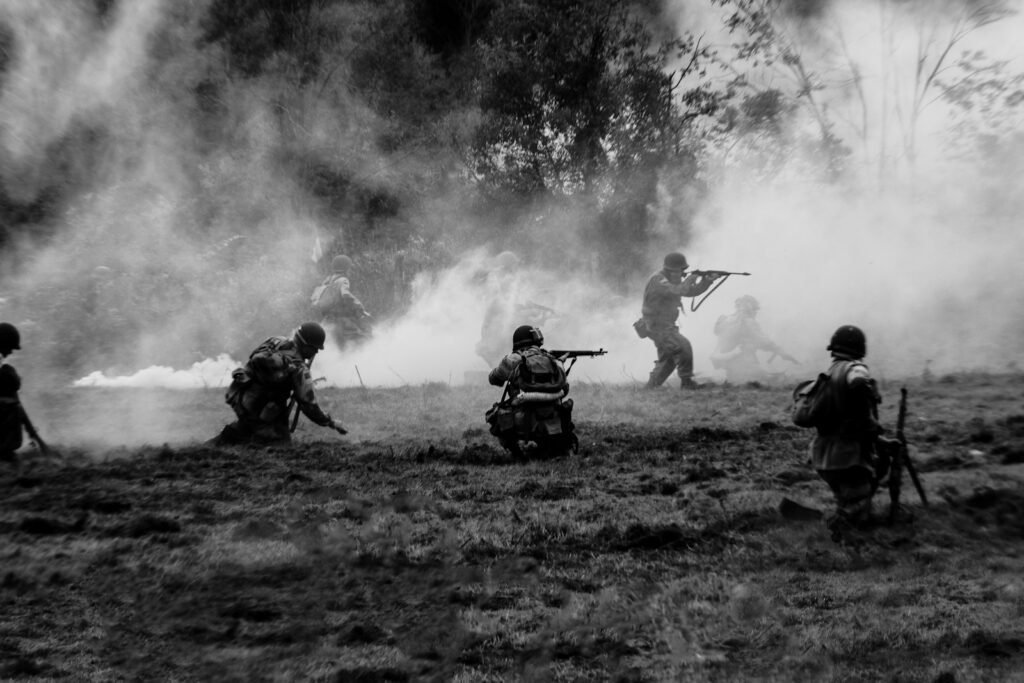
Knowing that someone lived through the events on screen changes the way we watch a film. The best war movies based on true stories help us understand what those people faced, from a medic saving wounded men to a family hiding from danger. They remind us that the people who lived through history had no way of knowing how it would end.
This ranked list ranges from the fighting in Hacksaw Ridge to the tense debates of Darkest Hour. Each entry explores the real story behind the film and includes one memorable quote, with notes on where fact gives way to fiction.
JUMP TO:
How We Ranked These Films
We chose these films for their stories, acting, and ability to bring wartime lives into focus. The list includes soldiers in battle, prisoners planning an escape, and civilians trying to survive the Holocaust. The ranking reflects our view of the films, rather than a score for how closely each follows history.
Some films tell the stories of real people, while others use invented characters to explore a real event. We explain those differences below. The quotes come from the films, with a note when the words also have a known place in history.
If Darkest Hour draws you to Churchill’s speeches, our collection of Winston Churchill quotes explores his words and the events behind them.
The Films at a Glance
| Rank | Film | Historical foundation |
|---|---|---|
| 1 | Schindler’s List (1993) | Oskar Schindler’s efforts to save Jews during the Holocaust |
| 2 | The Pianist (2002) | Władysław Szpilman’s survival in occupied Warsaw |
| 3 | Hacksaw Ridge (2016) | Desmond Doss’s service as a medic on Okinawa |
| 4 | Dunkirk (2017) | The 1940 evacuation of Allied troops from France |
| 5 | Glory (1989) | The 54th Massachusetts Infantry in the American Civil War |
| 6 | Darkest Hour (2017) | Churchill’s early premiership and the crisis of May 1940 |
| 7 | Black Hawk Down (2001) | The 1993 Battle of Mogadishu |
| 8 | The Great Escape (1963) | The 1944 escape from Stalag Luft III |
| 9 | A Bridge Too Far (1977) | Operation Market Garden in 1944 |
| 10 | We Were Soldiers (2002) | The 1965 Battle of Ia Drang |
| 11 | The Longest Day (1962) | The Normandy landings on D-Day |
The Best War Movies Based on True Stories
1. Schindler’s List (1993)
“Whoever saves one life, saves the world entire.”Itzhak Stern speaking to Oskar Schindler, Schindler’s List (1993), farewell and ring scene.
Steven Spielberg’s film follows a businessman who arrives hoping to profit from war, then begins using his wealth and contacts to protect Jewish workers. Liam Neeson gives Schindler charm and pride, making his growing concern for others feel like a hard change in a flawed man.
The real Schindler was a Nazi Party member who helped save more than a thousand Jews. The United States Holocaust Memorial Museum’s account of his life explains that history. The film brings it into focus through the lives at risk and the choices made to protect them.
Stern speaks the quote while explaining the words on a ring given to Schindler. Each person saved has loved ones, memories, and a future that the Nazis sought to destroy. The line asks us to see the full worth of one life, even when the scale of the loss is hard to grasp.
The film takes first place because it makes that human cost so clear. Its ending allows gratitude and grief to exist together, without suggesting that the lives saved can make up for those lost.
2. The Pianist (2002)
“I’ll play the piano again.”Władysław Szpilman to Wilm Hosenfeld, The Pianist (2002), conversation about life after the war; English subtitle excerpt.
Based on Szpilman’s memoir, The Pianist follows a Polish Jewish musician through the Warsaw ghetto and the ruined city beyond it. Adrien Brody grows quieter as Szpilman loses his home, his work, and contact with those he loves. Finding food and staying out of sight take almost all his strength.
His survival depends on help and chance as well as his own efforts. The film never makes living through such horror seem like a reward for courage, as though those who died had somehow lacked it.
When Szpilman speaks of playing again, he allows himself to picture a life beyond the next hiding place. Music connects him to the person he was before fear and hunger filled his days.
He hopes to return to work he knows and loves, with hands that can once again play instead of search for food. The simple wish carries the weight of everything he has lost, making this a strong choice for viewers drawn to personal stories of survival.
3. Hacksaw Ridge (2016)
“Please, Lord, help me get one more.”Desmond Doss praying during the rescue sequence, Hacksaw Ridge (2016).
Desmond Doss joins the Army hoping to serve his country, but his faith leads him to refuse to carry a weapon. The men around him struggle to understand that choice, and some doubt whether they can trust him in battle.
The real Doss served as a medic on Okinawa. The Congressional Medal of Honor Society credits him with saving 75 men from the ridge, while his award citation records repeated acts of courage under fire. The film adds drama to his personal struggles and the fighting, but the rescue at its heart is real.
Andrew Garfield gives Doss a quiet strength amid the film’s graphic violence. His prayer brings a huge task down to the next wounded man he might be able to reach.
Each return puts him back in the danger he has just escaped, so his faith carries a clear and painful cost. Choose this film for its moving account of a man whose beliefs lead him toward people who need help, even when staying with them could mean death.
4. Dunkirk (2017)
“Men my age dictate this war. Why should we be allowed to send our children to fight it?”Mr. Dawson speaking to the rescued soldier, Dunkirk (2017), aboard the Moonstone.
Christopher Nolan tells the story of Dunkirk through events on land, at sea, and in the air. The film spends little time on the characters’ pasts, drawing us instead into their need to escape. Even waiting feels dangerous when soldiers stand on an open beach and hear an aircraft coming closer.
The rescue effort, known as Operation Dynamo, was real, but the main characters are invented. They help us follow the wider event through a few lives rather than through dates and troop numbers.
Mr. Dawson explains why he keeps sailing toward danger when the soldier he has rescued longs to go home. He believes older men share a duty to help the young people sent to fight.
His words add warmth to a film driven by fear and urgency. Choose Dunkirk for tense filmmaking that lets sound, movement, and faces tell much of the story.
5. Glory (1989)
“I ain’t fightin’ this war for you, sir.”Trip to Colonel Robert Gould Shaw, Glory (1989), discussion about carrying the regimental flag.
Glory follows the 54th Massachusetts Infantry, a Black Union regiment preparing to fight in the Civil War. Its soldiers face racism within their own army as well as danger from the enemy. Denzel Washington’s Trip brings anger and doubt to a story that might otherwise place too much faith in good leaders.
The regiment and Colonel Shaw were real, but most of the main soldiers are fictional. As the National Park Service explains, that choice leaves some of the regiment’s real heroes out of the story. The film explores a real unit through lives partly created for the screen.
Trip’s words force Shaw to think about what winning the war would mean for his men. They risk their lives for a country that still refuses to treat them as equals, and an officer’s praise will not be enough to change that.
The scene gives the film much of its depth. Trip wants to know what freedom will look like for Black soldiers once the fighting ends, and Shaw has no easy answer to offer him.
6. Darkest Hour (2017)
“I have nothing to offer but blood, toil, tears and sweat.”Winston Churchill addressing the House of Commons, Darkest Hour (2017), first Commons speech as prime minister.
Joe Wright’s Darkest Hour follows Churchill through his first weeks as prime minister in 1940. German forces are advancing, and Britain’s leaders must decide whether to keep fighting or seek talks. The choices made in quiet rooms could shape the lives of millions.
Gary Oldman gives Churchill doubts and a sharp temper alongside his gift for public speech. The film is at its best when he struggles to find honest words for people who have good reason to be afraid.
The quote comes from Churchill’s real speech of 13 May 1940. He offers no quick victory or gentle promise, but asks the country to face the hard work ahead. His words draw strength from that honesty, trusting people to hear the truth and act despite their fear.
Some scenes were created for the film, including his talk with passengers on the London Underground. Focus Features confirms that this scene is fictional, so it should not be treated as a real turning point in his thinking.
Watch Darkest Hour alongside Dunkirk for two views of the same crisis. One follows the men trying to get home, while the other explores the choices made by those who lead them.
7. Black Hawk Down (2001)
“They won’t understand that it’s about the men next to you, and that’s it.”Hoot to Matt Eversmann, Black Hawk Down (2001), preparing to return to the fighting.
Ridley Scott’s film draws on Mark Bowden’s account of the 1993 Battle of Mogadishu. A US mission turns into a long struggle to reach trapped soldiers, with each attempt to help bringing fresh danger.
The film keeps us close to the fear and confusion on the ground. Streets offer no clear way out, and helping one group can put another at risk. That close focus has limits, though, as Somali lives and the reasons behind the conflict receive much less attention.
Hoot’s words capture the loyalty that drives the soldiers to return. The scene itself was created for the film, rather than copied from a talk during the battle. Norm Hooten, who helped inspire the character, told Task & Purpose that a later talk with the actors shaped the speech.
The words reflect his view of combat, even though the scene places them in a different moment. That is a useful example of how a war film can draw on someone’s experience while changing how the story is told.
8. The Great Escape (1963)
“Colonel von Luger, it is the sworn duty of all officers to try to escape.”Ramsay speaking to Colonel von Luger, The Great Escape (1963), meeting with the camp commandant.
The Great Escape makes the work behind an escape as gripping as the escape itself. The prisoners forge papers, hide soil, and bring their different skills to a plan that depends on everyone doing their part.
The story draws on the March 1944 escape from Stalag Luft III, though it changes characters and events for the screen. TCM notes that the murder of fifty men after their capture did not happen as the single mass shooting seen in the film.
Ramsay’s words explain why the prisoners keep trying. Being held behind wire has changed their lives without ending their sense of duty.
There is humor in their plans and friendships, but the film never lets us forget what failure could cost. Its lasting appeal comes from watching people work together toward freedom while knowing that courage alone may not get them there.
9. A Bridge Too Far (1977)
“Well, as you know, I’ve always thought that we tried to go a bridge too far.”Lieutenant General Browning to Major General Urquhart, A Bridge Too Far (1977), conversation after the Arnhem withdrawal.
Richard Attenborough’s film draws on Cornelius Ryan’s account of Operation Market Garden. In September 1944, Allied forces set out to take a chain of bridges in the Netherlands, hoping to open a route into Germany.
The large cast helps us follow a plan spread across many places and units. Each group depends on others reaching their goals, while the men on the ground face problems that the plan has failed to allow for.
Browning’s words sound painfully small beside the losses Urquhart has suffered. They raise a hard question about how leaders explain failure after others have paid the price.
The film’s view of Browning has been challenged, so this scene should not settle our judgment of the real man. It does, however, give the story a bitter close. Brave soldiers can give everything asked of them and still be failed by the plan they were sent to carry out.
10. We Were Soldiers (2002)
“Dead or alive, we will all come home together.”Lieutenant Colonel Hal Moore addressing his soldiers, We Were Soldiers (2002), speech before deployment.
We Were Soldiers follows American troops in the 1965 Battle of Ia Drang, drawing on the book by Hal Moore and journalist Joseph L. Galloway. Mel Gibson’s Moore feels a deep duty to the men whose lives depend on his choices.
The film also follows families waiting at home, where news of a death changes a life in a moment. Those scenes remind us how far the pain of a battle reaches.
Moore cannot promise that everyone will survive, but he gives his word that no one will be left behind. The line joins an honest fear of loss with a duty he intends to keep.
The film changes parts of the fighting, including the attack near its end, so it is worth reading the fuller account. Its place here rests on the care it gives to the soldiers and the families who share the cost of their service.
11. The Longest Day (1962)
“What’s always worried me about being one of the few is the way we keep on getting fewer.”Flying Officer David Campbell to a fellow airman, The Longest Day (1962), conversation before the invasion.
Based on Cornelius Ryan’s book, The Longest Day follows D-Day from both Allied and German points of view. It gives a broad sense of the invasion, with separate groups working toward goals whose full scale they may never see.
The film draws on historical research while also using invented characters and dialogue. Choose it if you want to follow the wider plan, though its large cast leaves less room to get close to each person.
Campbell’s remark draws attention to the losses behind the proud phrase “the few.” His dry humor lets weariness and grief enter the talk without asking him to speak openly about either.
In a film full of famous faces and large troop movements, this small exchange brings us back to the men themselves. As they prepare to fight again, they know that some of the friends they once served with will never return.
Does Based on a True Story Mean Historically Accurate?
A film can show a real battle through invented characters, or fit years of a person’s life into a few scenes. It helps to ask which parts come from records and which were created to tell the story.
That difference explains why two famous films are absent here. Saving Private Ryan sets an invented rescue mission within the real Normandy campaign, with some inspiration from the Niland brothers. 1917 grew from stories told by Sam Mendes’s grandfather, but its main characters and mission are fictional.
Both are powerful war films. This list focuses on real people and specific events, while explaining where each film changes or adds to the known story.
Choosing a Film That Stays With You
For a close view of one person’s struggle to survive, start with The Pianist. Choose Hacksaw Ridge for a story of faith tested by danger, or pair Darkest Hour with Dunkirk to see how choices made by leaders affect the people sent to fight.
These films give us much to admire, but they also leave room for grief and doubt. Long after the credits, we remember people who wanted what most of us want: to go home, to see those they love, and to live without fear.
Leave a Reply