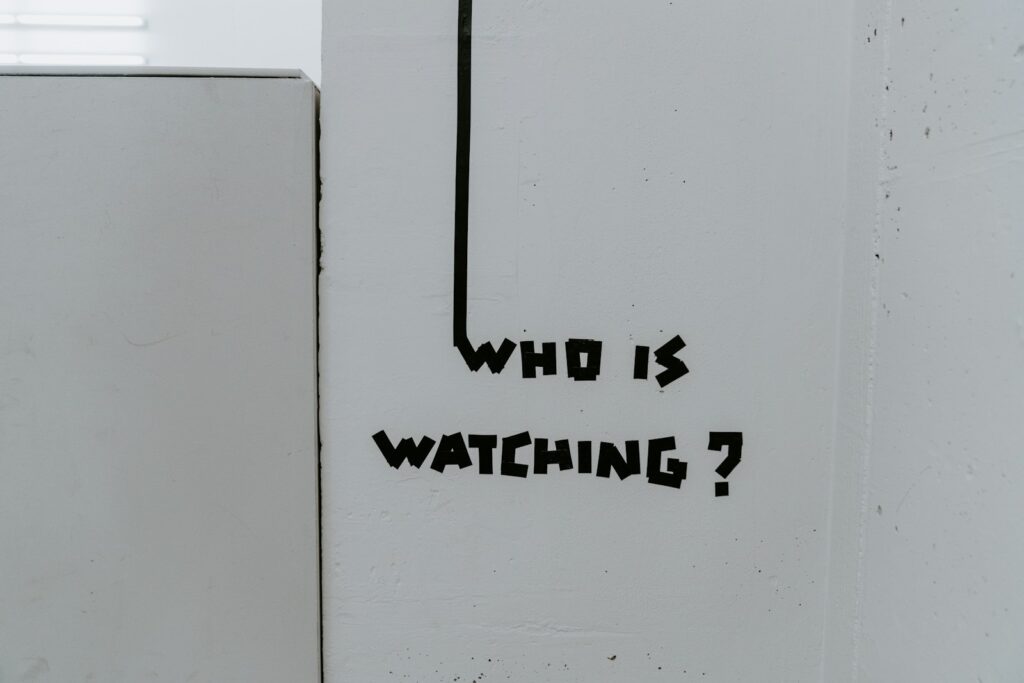
“Big Brother is watching you” means nobody in George Orwell’s 1984 can ever feel completely private or free. The Party uses surveillance, propaganda, and the image of Big Brother to make citizens believe they are always being observed.
The clever part is that Big Brother does not need to watch everyone every second. People start policing themselves because they never know when someone might be watching.
JUMP TO:
- What Does “Big Brother Is Watching You” Mean?
- Where Does the Quote Appear in 1984?
- Why Is Big Brother Always Watching?
- “Watching You” Sounds Protective. That Is the Point.
- Is Big Brother Actually a Real Person?
- Why Does “Big Brother Is Watching You” Still Feel Modern?
- What Is Orwell Really Warning Us About?
What Does “Big Brother Is Watching You” Mean?
On the surface, the slogan is a warning: the Party can see you.
Citizens of Oceania live surrounded by telescreens, informants, posters, and the Thought Police. Even facial expressions can become dangerous if they suggest dissatisfaction with the Party.
But the meaning goes deeper than surveillance.
The real power of Big Brother comes from uncertainty. Winston never knows exactly when he is being watched, so he has to behave as though he is being watched all the time.
That is what makes the slogan so disturbing. The Party does not only control what people do. Eventually, it wants to control what they allow themselves to think.
If you want more of Orwell’s most memorable lines, our collection of 1984 quotes explores the novel’s ideas about truth, freedom, power, and control.
Where Does the Quote Appear in 1984?
Orwell introduces the slogan almost immediately.
When Winston Smith arrives at Victory Mansions near the beginning of the novel, enormous posters show the face of a dark-haired man with a heavy mustache. Beneath the image are the words:
“BIG BROTHER IS WATCHING YOU.”
George Orwell, 1984
There is no gentle introduction to Oceania. Orwell basically hangs a giant surveillance warning on the wall and lets us know what kind of world we have entered.
The posters appear throughout the city, making Big Brother feel impossible to escape. His face is not just propaganda. It becomes part of the environment.
Why Is Big Brother Always Watching?
Big Brother represents the Party’s belief that privacy is dangerous.
Private space gives people room to question, disagree, remember, and form relationships that exist outside Party control. None of those things are particularly helpful when you are trying to run a totalitarian state.
So the Party watches.
Telescreens monitor homes and workplaces. Children are encouraged to report suspicious adults. The Thought Police search for signs of rebellion. Even Winston’s diary is an act of resistance because it gives him a private place to think.
The goal is not simply to catch people breaking rules.
It is to make them afraid of breaking those rules before they even try.
For a quick refresher on Winston, Oceania, and how the story unfolds, read our 1984 book summary.
“Watching You” Sounds Protective. That Is the Point.
The name Big Brother is strangely comforting when you remove it from the novel.
A big brother might protect you. Guide you. Look out for you.
Orwell twists that familiar idea into something threatening.
Big Brother supposedly watches over the people of Oceania, but in reality he watches them.
The Party presents him as a reassuring leader while simultaneously reminding citizens that they are under observation. Protection and control become almost impossible to separate.
It is propaganda with excellent branding and absolutely terrible boundaries.
The Orwell Foundation preserves Orwell’s work and writings, including material that helps place 1984 within his wider concerns about politics, language, and authoritarian power.
Is Big Brother Actually a Real Person?
Maybe. Orwell never gives us a simple answer.
Winston himself wonders whether Big Brother is an actual individual. The Party manipulates photographs, records, newspapers, and history so thoroughly that proving almost anything about the past becomes difficult.
But Big Brother does not really need to exist.
His image is more useful than the man behind it could ever be.
He gives the Party a face people can worship, fear, and obey. Leaders can die. Symbols are much easier to keep alive.
Big Brother therefore represents something larger than one dictator. He becomes the human-looking face of a system that wants complete authority.
Why Does “Big Brother Is Watching You” Still Feel Modern?
You do not have to live in Oceania to understand why the phrase survived.
Today, Big Brother is commonly used as shorthand for excessive surveillance or authorities intruding too far into private life. The phrase comes up whenever people debate cameras, digital tracking, data collection, or how much privacy we should surrender for convenience or security.
Orwell was not predicting one particular gadget.
His warning was broader.
Technology becomes dangerous when the people using it have enormous power and ordinary people have little ability to question how that power is being used.
The telescreen is memorable. The imbalance of power behind it is the bigger problem.
What Is Orwell Really Warning Us About?
The frightening part of “Big Brother is watching you” is not simply that someone may be looking.
It is what happens after people believe the slogan.
Winston learns to control his face, hide his thoughts, and question even his own memories. Surveillance slowly moves from the outside world into his head.
That is where Big Brother becomes most powerful.
A government cannot realistically watch every person every second. It does not have to if people become frightened enough to watch themselves.
And suddenly one of the shortest lines in 1984 becomes one of its most unsettling.
Leave a Reply