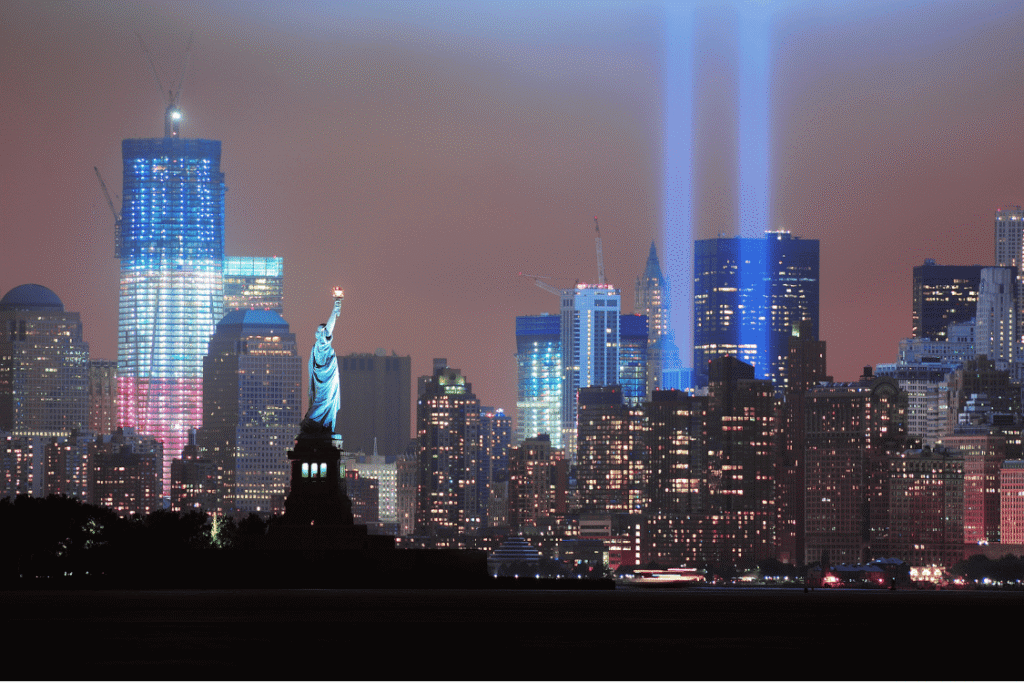
September 11 remembrance honors the people killed in the 2001 terrorist attacks, recognizes those who helped, and preserves the stories of lives changed by that day. The words “Never Forget” express a promise to carry that knowledge forward. Yet a promise becomes more meaningful when we consider what it asks of us.
For some people, September 11 brings personal memories of loss. For others, especially those born afterward, it is history learned through photographs, testimony, and conversations. Although those experiences differ, remembrance offers a shared responsibility: to learn carefully, remember people as individuals, and respond to suffering with compassion.
JUMP TO:
What Does “Never Forget” Mean on 9/11?
In the context of 9/11, “Never Forget” means keeping the victims, the events, and their lasting consequences in public memory. It can also express gratitude toward those who helped and a commitment to support people still affected.
However, the phrase does not carry exactly the same meaning for everyone. A family member may think of a particular voice or an ordinary morning before the attacks. Someone learning about September 11 decades later may understand it as a responsibility to listen and preserve an accurate account.
Our collection of September 11 quotes brings together words for reflection. Understanding their context helps us consider what those words ask us to remember.
A Promise to Remember
On the evening of September 11, 2001, President George W. Bush told the nation:
None of us will ever forget this day.
George W. Bush, Address to the Nation, September 11, 2001
Spoken in his address to the nation on September 11, 2001, while the country was still confronting the attacks, the sentence expressed the certainty that the day would remain with those who experienced it. Years later, it also raises a question for subsequent generations: how do we preserve something we cannot personally remember?
The answer begins with learning what happened and whose lives were changed. From there, remembrance can become a continuing practice of attention and care.
Remembering the People Behind the Names
Public ceremonies must acknowledge the scale of September 11. Nevertheless, numbers alone cannot tell us who the people were.
Those killed had families, friendships, habits, ambitions, and unfinished plans. Remembering them as individuals makes room for the lives they led before the circumstances of their deaths. A family photograph or a remembered conversation can reveal something that a historical timeline cannot.
In his message as chairman of the National September 11 Memorial & Museum, Michael R. Bloomberg describes a shared vow:
that we would never forget those we lost and that we would forever share their stories with the world.
Michael R. Bloomberg, excerpt from the Chairman’s Message
The second part gives the promise a practical direction. Stories need people willing to preserve them, institutions able to care for them, and readers prepared to pay attention.
This also means remembering beyond the most familiar images of the Twin Towers. The people killed at the Pentagon and aboard the four hijacked flights belong fully within that remembrance.
We cannot know every story. Still, learning one carefully gives us a more personal understanding of what was lost. It invites us to recognize someone whose life mattered long before their name became part of a memorial.
Honoring Those Who Helped—and Those Still Affected
Remembering the response to September 11 means acknowledging both immediate courage and the work that continued afterward. Rescue and recovery required sustained effort, much of it carried out beyond the moments most often shown on television.
The consequences also continued. The 9/11 Memorial Glade honors people who became ill or died following exposure to hazards associated with the attacks and their aftermath. Its account includes responders and survivors, workers and residents, and acknowledges those affected at all three attack sites.
As a result, an anniversary cannot be the only measure of how we remember. Families may still be living with loss, while others face illness or the effects of experiences they do not wish to recount publicly.
Gratitude should leave room for those realities. Describing someone as courageous does not mean they were untouched by what happened, or that they owe anyone an uplifting story.
A thoughtful tribute can recognize extraordinary service while allowing people to speak about its cost. It can also acknowledge the caregivers, relatives, and friends whose support rarely appears in anniversary headlines.
Remembering When You Were Not There
You do not need a personal memory of September 11 to approach its history with care. However, there is a difference between understanding another person’s account and claiming to know exactly how they felt.
For younger readers, learning can begin with a clear timeline and then move toward individual testimony. Museum collections, recorded interviews, and family conversations offer different ways into that history. Together, they help explain how a public event entered private lives.
The 9/11 Memorial Museum also uses art to preserve memory. In Memorial Hall, an inscription reads:
No day shall erase you from the memory of time.
Virgil, The Aeneid, Book IX, as inscribed in the Museum’s Memorial Hall
These words come from an ancient poem, not a September 11 speech. At the museum, artist Tom Joyce formed the letters from recovered World Trade Center steel, giving the passage a new setting within an act of remembrance.
That distinction matters when sharing quotations. Knowing where words originated helps us understand both their original context and the meaning they acquire elsewhere.
Similarly, learning about September 11 calls for patience with sources. A striking image or moving sentence can begin our interest, but the account surrounding it deserves attention too.
Meaningful Ways to Remember September 11
September 11 remembrance can take place at a ceremony, in a classroom, at home, or through community service. The National Park Service describes the annual observance as a time to:
remember, reflect, honor, and mourn
National Park Service, excerpt from “September 11: A Day of Remembrance and Service”
Those four verbs allow for different responses. Some people want to gather, while others prefer privacy. You can choose an approach that fits your circumstances and respects the people being remembered.
Learn One Person’s Story
Read a memorial biography or listen to a recorded account from a reliable collection. Give it enough time to notice the details beyond the person’s connection to the attacks.
If you share what you learn, include the source and check names, dates, and quotations. Accuracy is part of treating someone’s story with respect.
Pause for Reflection
Set aside a few quiet minutes to consider what you have learned. You might read a name, reflect on a family’s account, or observe a moment of silence.
A private observance needs no audience. Likewise, you do not need to find an impressive sentence to explain it. Sometimes the useful thing is to stop, put other tasks aside, and give the subject your attention.
Listen Without Pressuring
If someone chooses to discuss their experience, let them decide how much to share. Ask whether they want to talk before inviting details, and accept a change of subject without taking it personally.
For those with personal connections to September 11, the anniversary may already bring repeated requests to remember aloud. Respect can mean being available without expecting a conversation.
Serve Your Community
Service offers another way to mark the day. You could volunteer with a local organization, help a neighbor, or contribute time to a project that meets a real community need.
Ahead of the tenth anniversary, President Barack Obama connected remembrance with everyday kindness:
Even the smallest act of service, the simplest act of kindness, is a way to honor those we lost.
Barack Obama, excerpt from “Observing 9/11 with National Service,” August 27, 2011
The passage makes participation accessible. A person does not need to travel to a memorial or organize a large event to do something useful.
However, the people receiving help should remain central to the activity. Ask an organization what it needs, follow its guidance, and choose something you can carry through. The act gains meaning from the care involved.
Questions About September 11 Remembrance
Why Do We Remember 9/11 Every Year?
Annual remembrance creates a recurring opportunity to honor those killed, acknowledge people still affected, and pass historical knowledge to another generation. It also makes space for communities to gather and for individuals to reflect.
However, each anniversary reaches people at different points in their lives. Its meaning may change as children grow older, families share new memories, or readers encounter the history for the first time.
Can I Participate Without Attending a Ceremony?
Yes. You can read a memorial biography, listen to an oral history, observe a quiet moment, or take part in community service. These approaches make remembrance possible wherever you live.
Choose something you can approach with care. A modest act of attention can be more personally meaningful than joining an activity without understanding its purpose.
What We Carry Forward
“Never Forget” leaves each generation with work to do. Records must be preserved, and people given the freedom to remember in their own way. Meanwhile, those encountering September 11 as history need reliable accounts and thoughtful guidance.
We cannot restore the futures taken that morning. We can, however, take care with the lives entrusted to public memory. When we learn a name, listen to a story, or make time to help someone, we give the promise something concrete to rest on.
Leave a Reply