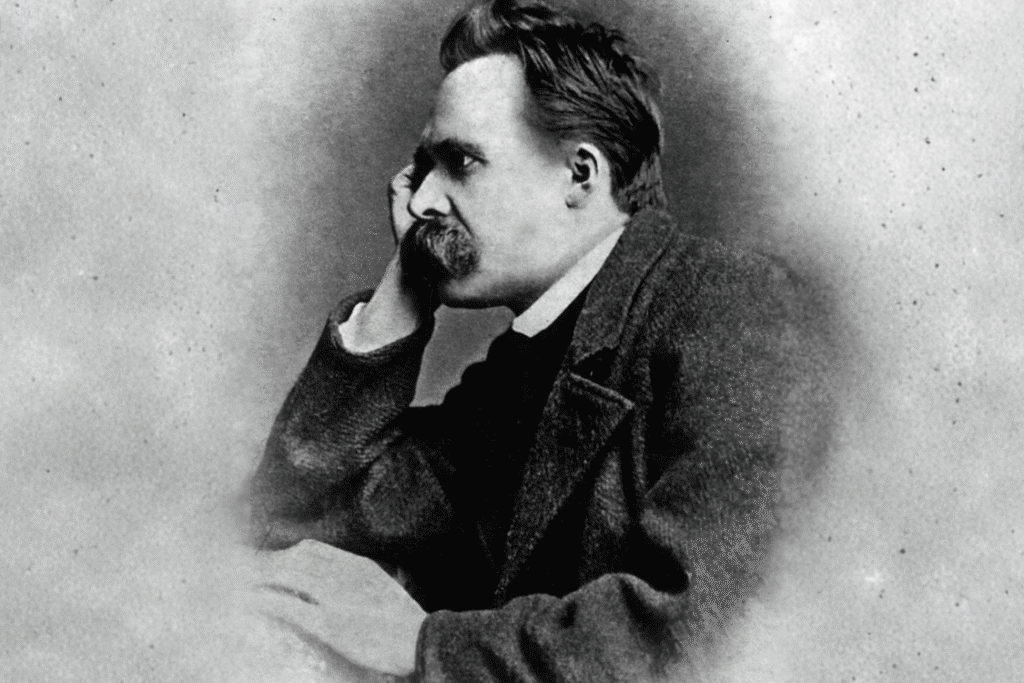
Few philosophers are linked so closely with the idea that life has no meaning. Yet asking “is Nietzsche a nihilist?” leads to a more complex answer than his reputation suggests. He questioned the beliefs that had guided European culture, but he also feared what might follow when those beliefs lost their force.
Nietzsche sometimes described himself as having lived through nihilism and moved beyond it. That claim helps explain why a thinker famous for tearing down old values also wrote about embracing life.
JUMP TO:
Is Nietzsche a Nihilist?
Nietzsche was not simply a nihilist who believed that nothing mattered. He examined how inherited values lose their authority and sought ways to overcome the crisis that followed. Whether the label fits depends on what we mean by nihilism.
That distinction separates his criticism of traditional beliefs from his hopes for what might replace them. Our collection of Nietzsche’s quotes on nihilism explores both sides through passages about meaning, doubt, and self-overcoming.
His views are hard to reduce to a single label because nihilism has several meanings in his writing. It can describe a cultural crisis, a stage of tearing down old beliefs, or an exhausted rejection of life.
Scholars disagree about how far Nietzsche escapes the problem he describes. Still, his effort to affirm life is central to his response. The Stanford Encyclopedia of Philosophy’s discussion of Nietzsche explores that connection in greater depth.
What Nietzsche Meant by Nihilism
In one notebook passage, Nietzsche defines nihilism through the collapse of values that once gave life direction:
“What does Nihilism mean?—That the highest values are losing their value. There is no bourne. There is no answer to the question: ‘to what purpose?”Friedrich Nietzsche, notebook material collected posthumously in The Will to Power, translated by Anthony M. Ludovici.
“Bourne” is an older word for a destination or goal. Nietzsche describes a culture whose most trusted beliefs can no longer explain what life is for. Those beliefs also lose their power to guide how people choose to live.
The problem goes deeper than sadness or disappointment. A person can feel miserable while still believing that life has purpose. Someone else may live comfortably while doubting that anything has lasting value.
Imagine spending years building a life around a definition of success you never questioned. When that definition loses its appeal, achieving more of the same may no longer satisfy you. This offers a small comparison with Nietzsche’s broader concern about a culture losing faith in its highest ideals.
The source requires care as well. The Will to Power was assembled after Nietzsche’s death from his notebooks. It should not be treated as a finished book he approved for publication.
Why Nietzsche Is Associated With Nihilism
Nietzsche attacked beliefs that many people saw as the foundations of meaning and morality. He criticized Christianity and questioned universal moral rules. Along with his statement that God is dead, these arguments help explain the connection.
Yet his concern went beyond whether individuals believed in God. He asked what would happen to European culture when the religious beliefs supporting its values no longer seemed convincing.
Nietzsche also questioned whether some inherited ideals had already turned people against life. A belief system could offer meaning while teaching people to distrust their bodies. It could also encourage them to judge earthly life against an unreachable standard.
This helps explain why nihilism means more in his work than the absence of religion. He could see a rejection of life within beliefs that seemed to protect people from meaninglessness.
Did Nietzsche Call Himself a Nihilist?
Yes, although the surrounding words matter greatly. In a draft preface later included in The Will to Power, Nietzsche describes himself through a series of comparisons. The passage ends with these words:
“…like the first perfect European Nihilist, who, however, has already outlived Nihilism in his own soul—who has out-grown, overcome, and dismissed it.”Friedrich Nietzsche, draft preface collected posthumously in The Will to Power, translated by Anthony M. Ludovici; excerpt.
Calling himself a nihilist while claiming to have overcome nihilism may seem to make little sense. The passage becomes clearer when read as an experience he believes he has passed through.
He presents himself as someone who has followed the collapse of old values to its depths. He also claims that this experience has prepared him to move beyond it.
For that reason, saying “Nietzsche is not a nihilist” without explaining further leaves out important evidence. Saying he accepted meaninglessness as his final answer misses the direction he wanted his thinking to take.
His claim to have overcome nihilism is not proof that he succeeded. It does tell us, however, that remaining within nihilism was not his goal.
Active and Passive Nihilism
Nietzsche’s notebooks distinguish between active and passive nihilism. Both involve a breakdown in belief, but they differ in how a person responds.
Passive nihilism is linked with exhaustion. When familiar goals no longer seem worthwhile, a person may lose the will to pursue anything demanding. Relief from the burden of caring can begin to seem more appealing than a new purpose.
Active nihilism has a more forceful character. It attacks values that no longer seem credible and clears away beliefs that have become restrictive.
However, destruction alone does not provide a new purpose. Someone may be skilled at exposing weak arguments while remaining unable to name anything worth building or defending.
Rejecting inherited answers can help our thinking develop, but tearing something down requires different strengths from creating something valuable.
Nietzsche’s interest in overcoming nihilism reaches toward that harder task. His work asks how people might live after criticism has stripped away the answers they once accepted.
Why Nietzsche Wanted to Overcome Nihilism
Nietzsche’s writing often sounds combative, but he resisted the idea that his purpose was merely to deny. In Ecce Homo, he describes his own position this way:
“I contradict as no one has contradicted hitherto, and am nevertheless the reverse of a negative spirit.”Friedrich Nietzsche, Ecce Homo, “Why I Am a Fatality,” §1, translated by Anthony M. Ludovici.
The chapter is deliberately dramatic, and this sentence gives Nietzsche’s view of himself rather than a neutral judgment. Even so, it captures the link he sees between criticism and renewal.
His attacks on old values were connected with the search for ways to affirm earthly life. He questioned standards that made life seem guilty or worthless. He also challenged the belief that its value lay only in preparing us for another world.
Life affirmation, in this sense, asks more of us than optimism. It involves facing suffering and uncertainty without deciding that life itself should be rejected.
His idea of amor fati, or love of fate, expresses that ambition. It asks whether a person could embrace life as a whole, including the painful parts they might wish to remove.
This should not be reduced to telling someone to feel grateful for every hardship. Nietzsche raises a difficult question about how we relate to life, and readers can challenge what his answer asks of us.
Does Creating Values Mean Anything Goes?
Nietzsche’s challenge to inherited morality can sound like permission to choose whatever feels convenient. Yet his focus on self-overcoming involves discipline and the shaping of character. It asks more of a person than simply following every impulse.
He also judged ways of living differently. His writing repeatedly values strength, creativity, and the courage to face difficult truths. That makes it hard to describe his views as a belief that all choices are equally worthwhile.
At the same time, his preferred values remain open to debate. Readers can recognize his effort to overcome nihilism without accepting every judgment he makes about human excellence or weakness.
That distinction keeps the article’s central question honest. Understanding what Nietzsche was trying to achieve does not require accepting all his answers.
A More Accurate Way to Read Nietzsche
So, is Nietzsche a nihilist? He belongs at the center of the discussion because he examined nihilism closely and used the label to describe himself. He challenged beliefs that had supported traditional meaning, yet also saw his work as an effort to move beyond that crisis.
The most useful reading holds those facts together. Nietzsche leaves us with a question that survives the collapse of easy answers: once we have challenged what we inherited, what will we consider worthy of our lives?
Leave a Reply