Few philosophical statements have been quoted as confidently, or misunderstood as quickly, as Nietzsche’s “God is dead.” The phrase sounds like a blunt declaration of atheism, but Friedrich Nietzsche was describing something much larger than disbelief in God.
In The Gay Science, the famous words come from a madman speaking to people who already consider themselves unbelievers. His concern is what happens after a religious framework that once supported morality, purpose, and truth begins to lose its authority.
For Nietzsche, the death of God does not settle the argument. It creates a much harder one.
JUMP TO:
- What Is Nietzsche’s Full “God Is Dead” Quote?
- What Did Nietzsche Mean by “God Is Dead”?
- Why Does Nietzsche Say “We Have Killed Him”?
- Why Is the Madman Speaking to Atheists?
- What Does “I Come Too Early” Mean?
- How the Death of God Leads to Nihilism
- Was Nietzsche Celebrating the Death of God?
- Nietzsche’s “Shadow of God” and What Comes Next
- What Comes After “God Is Dead”?
What Is Nietzsche’s Full “God Is Dead” Quote?
The best-known passage appears in Book III of The Gay Science, Section 125, usually titled “The Madman.”
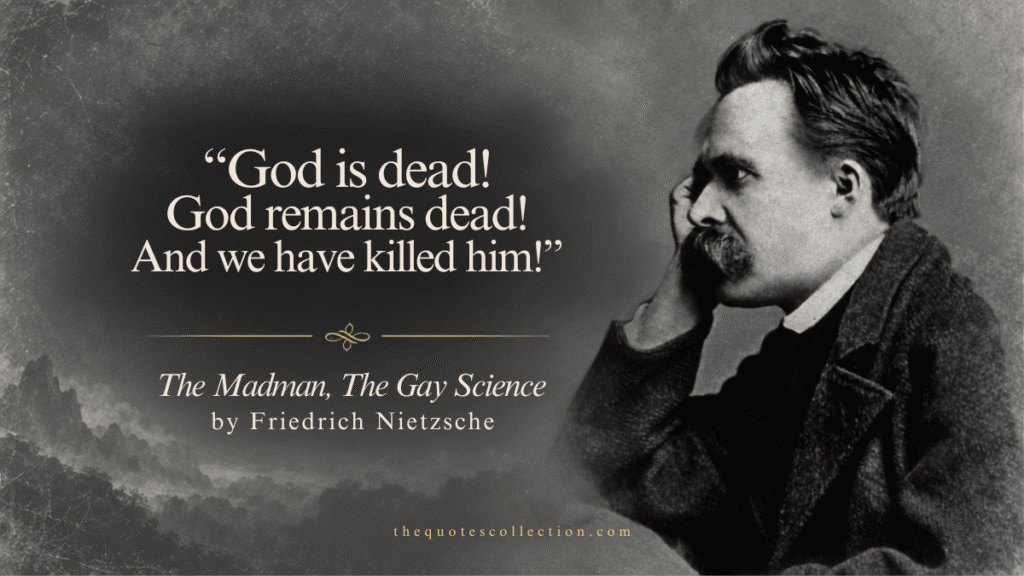
God is dead! God remains dead! And we have killed him!The Madman, The Gay Science by Friedrich Nietzsche
Nietzsche places the declaration inside a strange and memorable scene. The Madman enters a marketplace carrying a lantern in broad daylight and announces that he is searching for God. The people gathered there laugh because many of them already do not believe.
Their amusement quickly gives way to something darker. The Madman asks what humanity has done by killing God and imagines the earth cut loose from its sun, drifting without a clear direction.
The public-domain Thomas Common translation appears under the older English title The Joyful Wisdom. Readers can compare the passage in the Project Gutenberg text.
The speaker also matters. Nietzsche wrote the passage, but these specific words belong to the Madman within the scene.
What Did Nietzsche Mean by “God Is Dead”?
Nietzsche was not describing the literal death of a divine being. He was pointing to the declining power of Christianity as Europe’s main source of moral and cultural authority.
For centuries, Christian belief had offered answers to some of life’s largest questions. It gave explanations for human purpose, suffering, right and wrong, and humanity’s place within a larger order.
By Nietzsche’s time, those answers faced growing pressure from science, historical criticism, secular philosophy, and changing views of religious authority. People could reject belief in God, but Nietzsche suspected they had not yet understood how much of their moral world had rested on that belief.
The real problem begins there. If the old foundation weakens, people must decide what can support their values in its place.
Why Does Nietzsche Say “We Have Killed Him”?
“We have killed him” sounds almost like a confession, and Nietzsche wants it to feel unsettling.
He does not mean humanity somehow murdered a supernatural being. Instead, he points to the cultural and intellectual forces that made traditional belief harder to sustain.
Modern science offered new explanations of nature. Historical criticism examined religious texts differently, while philosophy questioned claims that earlier generations had treated as permanent truths.
Nietzsche also sees an irony in this process. Western culture placed enormous value on truth, yet its pursuit of truth helped weaken some of the religious claims that had shaped that culture.
Human beings therefore helped create the crisis they now face. Removing an old answer is one achievement. Deciding what should replace it is another.
Why Is the Madman Speaking to Atheists?
One of the cleverest details in the passage is the audience.
The Madman does not announce the death of God to devout believers. He says it to people who already consider themselves unbelievers, and they first think his behavior is absurd.
Nietzsche turns the joke back on them. They assume disbelief is the end of the story. The Madman believes they have barely begun to understand what their unbelief may eventually change.
A person can reject God while still relying on moral ideas, cultural habits, and assumptions inherited from a religious world. Values do not necessarily disappear the moment their original source loses authority.
Nietzsche’s concern is whether those values can continue without the structure that once supported them. His audience has abandoned belief, but they have not yet faced the full cost of doing so.
What Does “I Come Too Early” Mean?
Near the end of the passage, the Madman realizes his audience still does not understand him. He says he has come too early because the event has not yet reached people in its full meaning.
Nietzsche compares the delay to light traveling from distant stars. Something may already have happened even though its effects are not yet visible. The image explains how cultural change can unfold slowly. A society may stop believing before it understands what those beliefs were holding together.
Moral habits can survive for generations. Ideas about duty, truth, responsibility, and human worth may remain even after people reject the worldview that helped shape them.
The Madman believes those effects are still traveling toward his listeners. They know God is gone from their beliefs, but they have not yet seen where that loss may lead.
How the Death of God Leads to Nihilism
Nietzsche’s concern about the death of God connects directly to nihilism.
If inherited values lose their authority, people may begin to suspect that no goal deserves commitment and no value has a stronger claim than another. The question “why?” can become hard to answer once familiar sources of meaning stop convincing us.
Nietzsche saw this possibility as a major danger, but describing him simply as a nihilist misses the direction of his work. He studies the crisis and then asks how people might move through it.
Our Nietzsche nihilism quotes delve into how often his writing turns toward self-overcoming, purpose, and a fuller embrace of life.
His response is not easy optimism. Nietzsche does not promise that the universe will replace one lost certainty with another. Instead, he asks whether people can take responsibility for examining and creating values without pretending they were handed down from somewhere beyond human life.
Was Nietzsche Celebrating the Death of God?
Nietzsche’s reaction is more complicated than either celebration or despair.
In Section 125, the Madman speaks with alarm. He understands the death of God as an event large enough to unsettle the moral and cultural world his listeners still inhabit. Later, in Section 343 of The Gay Science, the mood changes. Nietzsche describes the decline of Christian belief as news that can make the horizon feel open again for certain “free spirits.”
The old certainty has disappeared, but the loss also creates room for exploration. New ideas become possible once inherited assumptions no longer stand beyond question.
Both reactions belong to the same event. The death of God can produce nihilism and uncertainty, yet it can also open space for new ways of thinking and valuing.
Nietzsche is interested in what people do with that freedom. Simply rejecting an old belief is not enough.
For a very different exploration of belief and uncertainty, explore Jordan Peterson’s quotes on faith and doubt from his book, We Who Wrestle with God.
Nietzsche’s “Shadow of God” and What Comes Next
Nietzsche had already introduced the image of God’s death before the Madman appears.
In Section 108 of The Gay Science, he writes that God is dead but his shadow may continue to appear for thousands of years. The image suggests that belief can disappear long before its cultural effects do.
People may stop believing in God while keeping ideas shaped by religious morality. Old categories can continue to influence how people understand guilt, duty, truth, and human worth even after their original foundation has faded.
Nietzsche’s famous abyss quote raises a related problem from another direction. Once old certainties weaken, facing uncertainty can shape the person doing the confronting.
The challenge is not simply escaping inherited values. Nietzsche wants to know whether people can create something stronger without falling into resignation, emptiness, or another unquestioned system.
What Comes After “God Is Dead”?
The quote endures because its underlying problem extends beyond nineteenth-century Christianity.
Cultures change, institutions lose authority, and ideas once treated as permanent can suddenly begin to look historical. Removing an old framework is often easier than agreeing on what should take its place.
Nietzsche’s Madman forces attention toward that second stage.
Religious readers may see a warning about what happens when higher foundations disappear. Secular readers may recognize the responsibility of defending values without appealing to divine authority.
More than a century later, “God is dead” still provokes because Nietzsche does not treat the loss of certainty as intellectually convenient. He sees freedom in it, but he also recognizes the risk. The Madman is less interested in proving that God is dead than in asking whether humanity understands what its deepest beliefs were holding up.
Once an old source of meaning no longer convinces us, what are we prepared to build in its place?
Leave a Reply