
Anne Frank wrote about wanting to be understood, finding comfort in nature, and hoping her work would reach people she had never met. These Anne Frank quotes offer a glimpse of that inner life, shaped by the fear and confinement of hiding from Nazi persecution.
Her words deserve more than a quick reading as messages of hope. Anne was a Jewish teenager with ambitions, frustrations, and a future she should have been allowed to live. Reading her reflections in context helps us appreciate both the comfort they offer and the person behind them.
JUMP TO:
Who is Anne Frank?
Anne Frank was a Jewish diarist born in Frankfurt, Germany, on June 12, 1929. Her family moved to the Netherlands after the Nazis came to power, but the German occupation brought persecution into their lives there as well.
In July 1942, the Frank family went into hiding in the Secret Annex behind Otto Frank’s business premises in Amsterdam. Anne recorded the strain of confinement alongside family disagreements, her feelings for Peter van Pels, and her growing ambition to write.
The people in hiding were arrested in August 1944. Anne and her sister Margot later died in Bergen-Belsen concentration camp in early 1945; Anne was fifteen. The Anne Frank House’s account of her life provides further historical background.
The Diary and the Writer Behind It
Anne received her first diary for her thirteenth birthday. While in hiding, she used writing to examine her experiences and express thoughts she could not always share with the people around her.
She also took her ambition seriously. After hearing a radio appeal to preserve wartime accounts, Anne began revising her diary for possible publication. Her writing was both a private refuge and work she hoped others would eventually read.
After the war, Otto Frank prepared a version using her original and revised writings. The Diary of a Young Girl was first published in Dutch in 1947 as Het Achterhuis. English editions followed in 1952.
For another literary perspective on power and oppression, our collection of Animal Farm quotes considers how language can help sustain injustice.
Anne Frank Quotes on Hope and Happiness
Anne Frank’s life may be short-lived but her wisdom that is beyond her years and her well-written words continue to live on and inspire. Here are some of the most profound Anne Frank diary quotes on life, love and hope:
1. Holding On to Goodness
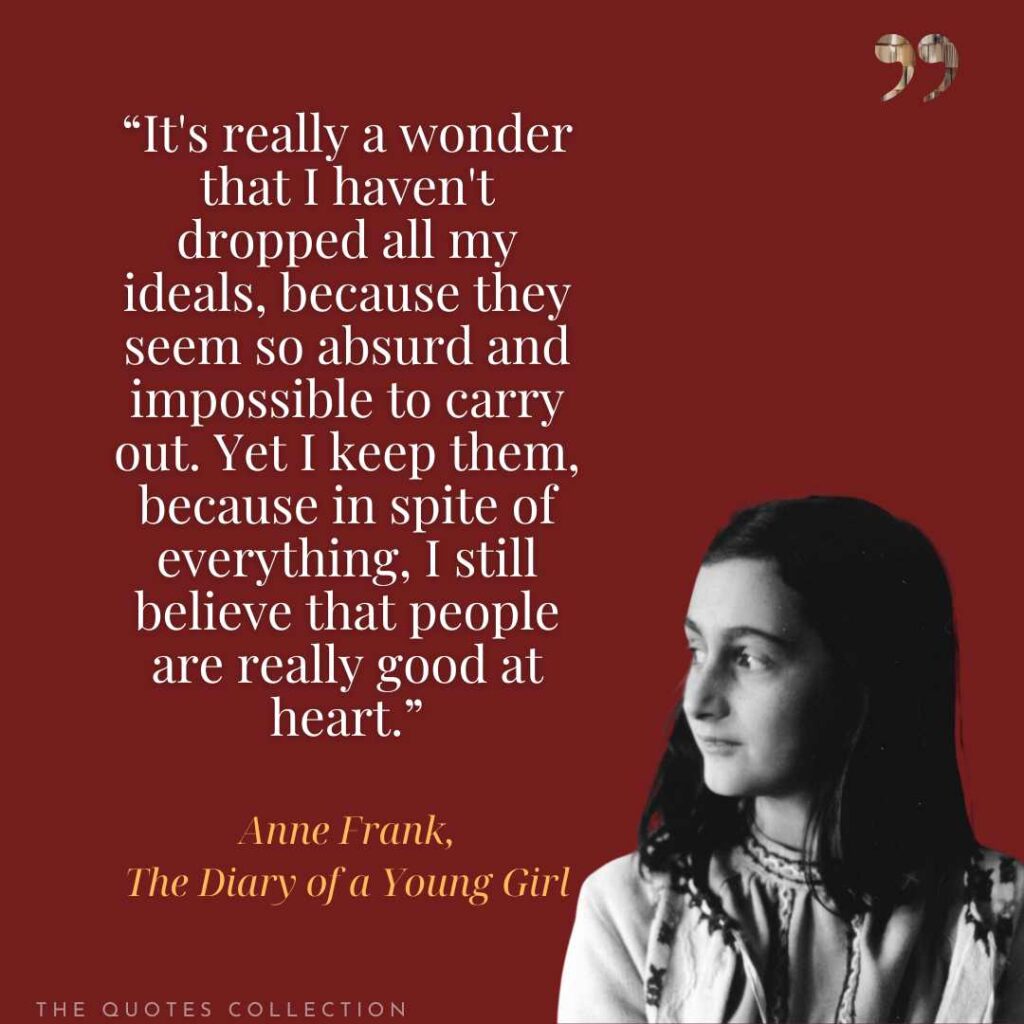
“It’s really a wonder that I haven’t dropped all my ideals, because they seem so absurd and impossible to carry out. Yet I keep them, because in spite of everything, I still believe that people are really good at heart.”Anne Frank, The Diary of a Young Girl, July 15, 1944
Anne’s best-known belief carries more weight when read alongside the fear surrounding it.
Her words invite us to consider how we live with that knowledge. We can recognize injustice without allowing it to decide everything we believe about others. That requires judgment as well as hope, since believing in human goodness should make us more willing to defend it.
Anne’s faith in people was not an assurance that she would be safe. Remembering what happened to her makes our responsibility toward one another more urgent.
2. Hope During the Waiting
“Where there’s hope, there’s life. It fills us with fresh courage and makes us strong again.”Anne Frank, The Diary of a Young Girl, June 6, 1944
Anne wrote this after hearing news of the Allied landings in Normandy. Liberation suddenly seemed possible, although she knew that danger and hardship remained. Her hope had a clear, deeply personal meaning: the chance to leave hiding and return to ordinary life.
Anyone who has endured a long wait may recognize how much a credible sign of change can help. The situation may remain difficult, but the possibility of a different future can make the next day easier to face.
3. Happiness We Can Share
“Whoever is happy will make others happy.”Anne Frank, The Diary of a Young Girl, March 7, 1944, alternate English rendering
This thought appears in Anne’s reflection on beauty and the ways people respond to unhappiness. Other translations express it as a happy person making others happy.
There is something familiar in the idea. A person who feels at ease may listen more patiently or help a tense conversation soften. Yet we need not turn Anne’s observation into a duty to appear cheerful. Shared happiness is most generous when it leaves room for someone else’s sadness.
4. A Glimpse of Freedom
“As long as this exists, this sunshine and this cloudless sky, and as long as I can enjoy it, how can I be sad?”Anne Frank, The Diary of a Young Girl, February 23, 1944
Anne describes looking out over Amsterdam from the attic, where the sky offered a view beyond the limits of hiding. That setting gives the passage its tenderness: she could see a world she was unable to move through freely.
Her response allows joy and grief to exist within the same life. A beautiful moment need not solve a problem to offer comfort, nor does enjoying it mean we have forgotten what hurts.
For readers, this may be the most useful part of the quotation. We can accept a brief moment of peace without demanding that it explain or repair everything around it.
5. Comfort Beyond Four Walls

“The best remedy for those who are afraid, lonely, or unhappy is to go outside, somewhere where they can be quite alone with the heavens, nature and God.”Anne Frank, The Diary of a Young Girl, February 23, 1944, English translation variant
Anne’s own freedom to go outdoors had been taken away, which makes this advice especially poignant. She understood the value of something many readers could easily take for granted.
For those able to step outside, her words offer a gentle invitation to pause. A quiet place may give us room to breathe, pray, or think without having to explain ourselves. Such moments cannot resolve every difficulty, but they can offer comfort while we find our way through it.
6. The Beauty That Remains

“I don’t think of all the misery, but of the beauty that still remains.”Anne Frank, The Diary of a Young Girl, March 7, 1944, English translation variant
Anne questioned whether thinking about people who suffered more could offer real comfort. She turned instead toward the beauty she could still recognize. The Anne Frank House confirms this passage and its date.
Her words leave room for something beyond sorrow without asking us to deny it. During a difficult season, enjoying a familiar song or noticing sunlight through a window need not feel like a betrayal of what we are going through. We can be hurting and still welcome something beautiful.
The word “remains” gives this thought its depth. Anne knew how much had been taken from her, yet she continued to value what persecution had not entirely placed beyond her reach.
7. The Happiness We Seek
“We all live with the objective of being happy; our lives are all different and yet the same.”Anne Frank, The Diary of a Young Girl, July 6, 1944, variant English translation
The wording varies across translations, but the thought belongs to Anne’s July 6 reflection on happiness, purpose, and the effort involved in building a life.
We may disagree about what a good life looks like while sharing a desire to feel loved, useful, or secure. Remembering that common ground can make us slower to dismiss another person’s hopes. Understanding someone does not require an identical life; it begins with taking their longing seriously.
Anne Frank Quotes on Being Heard and Understood
8. The Right to Think
“People can tell you to keep your mouth shut, but that doesn’t stop you from having your own opinion.”Anne Frank, The Diary of a Young Girl, March 2, 1944, alternate English wording
Anne wrote this while frustrated that the adults around her dismissed the views of younger people. Her protest concerned the right to be taken seriously, even when those listening disagreed.
It is easy to confuse authority with understanding. Someone may have more experience without fully grasping what another person is trying to express, particularly when age becomes a reason to end the conversation.
Anne’s words encourage confidence in our own judgment, but they also challenge how we listen. We cannot fairly ask others to hear us while treating their thoughts as unworthy of attention.
9. Lonely Among Loved Ones
“You can be lonely even when you are loved by many people, since you are still not anybody’s one and only.”Anne Frank, The Diary of a Young Girl, December 29, 1943
Anne reaches this thought while remembering her grandmother and wondering about the loneliness she may have carried. The context extends beyond romantic love to the private experiences of people we think we know well.
Being included and feeling understood are different experiences. Someone can have family nearby, receive kind messages, and still feel that no one knows what they are going through.
This quotation gives us a reason to ask more thoughtful questions of the people we love. Affection is valuable, but attention helps us discover where that affection is most needed.
10. A Little Room for Laughter
“There’s only one rule you need to remember: laugh at everything and forget everybody else!”Anne Frank, The Diary of a Young Girl, June 16, 1944
This is an authentic diary line, but its context matters. Anne wrote it during a strained account of quarrels and frayed tempers in the Annex. It expresses an exasperated attempt to cope, rather than a settled rule for treating other people.
The humor helps preserve a fuller picture of her personality. Anne could be impatient and sharp, as well as thoughtful and compassionate.
We may recognize the need to step back from an argument before answering it. Sometimes a little distance makes it easier to return with perspective, even if the problem itself still needs attention.
Anne Frank Quotes on Writing and Purpose
11. A Place to Speak Freely

“Paper has more patience than people.”Anne Frank, The Diary of a Young Girl, June 20, 1942, excerpt
A blank page offers a kind of freedom that conversation cannot always provide. We can hesitate, contradict ourselves, or admit something before we know how to explain it. There is no need to defend the first sentence before reaching the second.
Anne’s observation helps explain why private writing can feel so valuable. A diary gives unfinished thoughts somewhere to go, allowing us to understand them before deciding whether to share them.
12. Courage Through Writing
“My sorrow disappears, my spirits are revived!”Anne Frank, The Diary of a Young Girl, April 5, 1944, excerpt
Anne connects this relief with the act of writing. Her diary gave her room to express feelings that were difficult to contain or explain aloud.
Writing cannot remove every source of pain, but it can help us describe what has felt confused or overwhelming. Even a few honest sentences may offer a clearer understanding of what we need and what we can do next.
13. The Wish to Leave Something

“I don’t want to have lived in vain like most people. I want to be useful or bring enjoyment to all people, even those I’ve never met. I want to go on living even after my death!”Anne Frank, The Diary of a Young Girl, April 5, 1944
This passage belongs to Anne’s discussion of her ambition to write. She wanted work of her own and hoped that what she created might reach people beyond her immediate world.
Her judgment about other lives is sweeping, as a teenager’s certainty can sometimes be. We can recognize the force of her ambition without agreeing that quiet or unrecognized lives are wasted. People leave lasting effects through care and service as well as published work.
The passage is especially moving because Anne imagines a future in which she can develop her gift. Her diary did reach readers she never met, but that legacy cannot replace the life she should have had. She deserved time to keep writing, revise her ideas, and discover what else she could do.
An Anne Frank Quote From Her Other Writings
14. Begin With What You Can
“How wonderful it is that nobody need wait a single moment before starting to improve the world!”Anne Frank, “Give,” March 26, 1944, collected in Tales from the Secret Annex
The Anne Frank House identifies this quotation as part of “Give,” rather than a diary entry. It belongs in a broader collection of Anne Frank quotes, provided that distinction remains clear.
The invitation is practical because it removes the need to wait for influence or recognition. We can respond to someone’s immediate need with the resources already available to us.
Small acts cannot take the place of wider efforts against injustice, but they can be part of those efforts. A person offering help does not need to solve every problem before doing something worthwhile.
Remembering the Person Behind the Words
Anne Frank’s diary allows us to meet someone whose life held far more than the suffering imposed on her. She could be impatient, funny, affectionate, and sharply observant, while writing with increasing care about the person she hoped to become.
Her words offer comfort, but they also ask us to pay attention to the prejudice that threatened her life and the choices people made around her. Remembering Anne means making room for her whole voice, including the questions that are harder to turn into an uplifting quotation.
She deserved the chance to grow older, change her mind, and write much more.
Leave a Reply