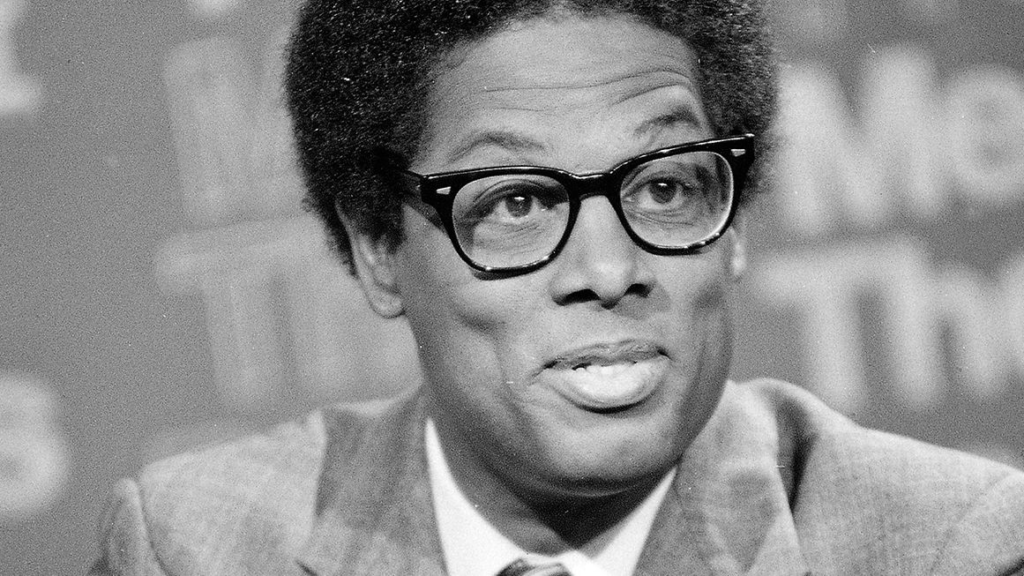
Thomas Sowell rarely approaches social justice through slogans. He asks who makes the decisions, what evidence supports them, and what happens after a policy meets the real world.
These Thomas Sowell quotes on social justice explore equality, fairness, freedom, government power, and unintended consequences. Some are deliberately provocative. The ideas behind them remain debated, which makes context more useful than simply agreeing or disagreeing with the quote.
JUMP TO:
Who is Thomas Sowell?
Thomas Sowell is an American economist, social theorist, author, and longtime public-policy scholar. His work covers economics, race, education, political institutions, inequality, and the history of ideas.
He earned his economics degree from Harvard, a master’s from Columbia, and a PhD from the University of Chicago. He later taught at universities including Cornell and UCLA and joined the Hoover Institution in 1980. Hoover currently lists him as the Rose and Milton Friedman Senior Fellow on Public Policy, Emeritus.
Readers who want a deeper look at his career can explore the Hoover Institution profile of Thomas Sowell.
Sowell has written dozens of books, including Basic Economics, Knowledge and Decisions, Discrimination and Disparities, The Quest for Cosmic Justice, and Social Justice Fallacies. Across them, one habit appears again and again. He wants readers to look beyond intentions and ask what the evidence actually shows.
GET INSPIRED: 100+ Powerful Quotes from Jordan Peterson
Thomas Sowell Quotes on Social Justice
Sowell’s criticism of social justice centers on a basic concern. He believes the term can sound clear while hiding difficult questions about what justice requires, who should define it, and how much power governments need to enforce a particular vision of fairness.
His arguments are controversial by design. They also explain why his writing continues to attract readers from across the political spectrum.
1. Fairness Can Expand Power
Lofty talk about ‘social justice’ or ‘fairness’ boils down to greatly expanded powers for politicians.
Thomas Sowell, “A Dangerous Obsession”
Sowell worries that words such as fairness can carry enormous moral force without telling us exactly what policy should follow.
Once government accepts responsibility for producing a particular vision of fairness, someone still has to decide what counts as fair and how to enforce it. For Sowell, this is where a moral argument turns into a question about political power.
2. When Envy Changes Names
Envy was once considered to be one of the seven deadly sins before it became one of the most admired virtues under its new name, ‘social justice’.
Thomas Sowell, The Quest for Cosmic Justice
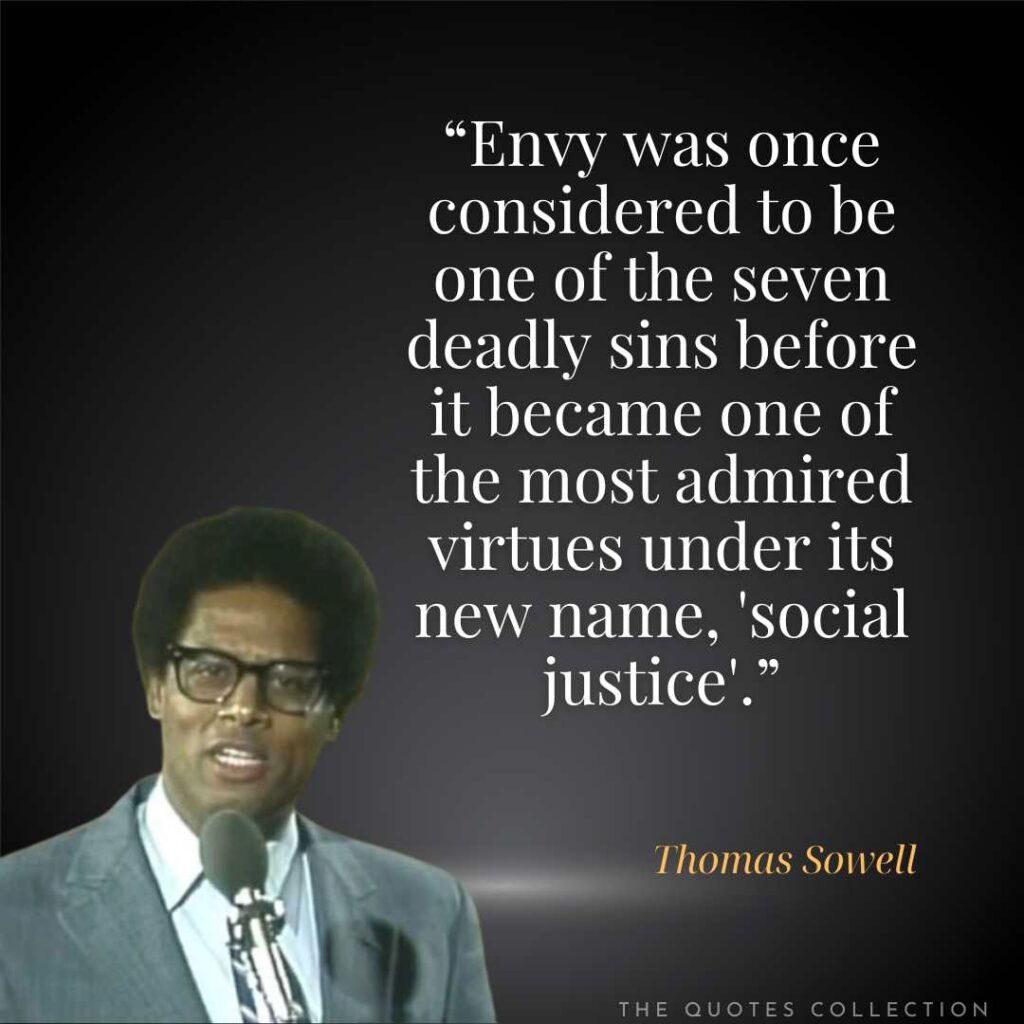
This is classic Sowell. Sharp, provocative, and unlikely to end a dinner-table debate peacefully.
He argues that some demands for equality can reflect resentment toward people who have more rather than evidence that an injustice occurred.
Critics would push back that concern about unequal opportunity cannot simply be reduced to envy. The useful question is whether a particular disparity came from injustice, different choices, different circumstances, or some combination of them.
Our deeper article on Thomas Sowell on equality of outcome examines that distinction more closely.
3. Justice Has a Cost
Justice at all costs is not justice.
Thomas Sowell, The Quest for Cosmic Justice
Sowell argues that correcting one injustice can create another if the remedy imposes serious costs on innocent people.
This does not mean society should ignore injustice because fixing it is difficult. He wants those costs included in the calculation.
A policy can pursue a fair goal and still deserve scrutiny for what it asks other people to give up.
4. The Wider Costs Count
What is called ‘social justice’ might more accurately be called anti-social justice.
Thomas Sowell, The Quest for Cosmic Justice
The full argument behind this line focuses on policies designed to help one part of society while overlooking their effects on everyone else.
Sowell asks readers to follow consequences beyond the intended beneficiaries. A subsidy may help one group while raising costs elsewhere. A regulation may protect one set of workers while reducing opportunities for another.
His point is not that redistribution always fails. It is that the rest of society does not disappear from the equation.
5. Redistribution Gets Political
What do you call it when a politician takes someone else’s money in taxes… ? Social Justice.
Thomas Sowell
Sowell uses deliberately confrontational language here to attack political redistribution.
The quote reflects his suspicion that politicians can present spending as compassion while benefiting from the votes and political support that follow.
Of course, taxation also funds roads, schools, defense, healthcare programs, courts, and other public services. The real debate is not whether all taxation equals theft. It is how governments justify taking and redistributing resources, and where legitimate public obligation ends.
5. Who Decides Deserving?
The question is who is to take on the God-like role of deciding what everybody else deserves.
Thomas Sowell, Controversial Essays
Sowell shifts the debate from what people deserve to who receives the authority to decide.
Imagine a government trying to determine the “correct” income for every occupation. Doctors, teachers, farmers, engineers, carers, artists, and business owners could all make plausible claims about their social value.
The problem quickly moves beyond fairness. Someone needs enough power to impose the answer.
7. Passion Needs Knowledge
A passionate commitment to social justice is no substitute for knowing what the hell you’re talking about.
Thomas Sowell
This line gets attention because it sounds blunt. The principle behind it is more useful than the punchline.
Caring deeply about poverty, discrimination, housing, education, or inequality does not automatically tell us which policy will work.
Compassion can tell us why a problem deserves attention. Evidence still has to tell us whether the proposed solution helps.
8. Power Has Its Risks
Giving leaders enough power to create ‘social justice’ is giving them enough power to destroy all justice.
Thomas Sowell
Sowell’s distrust of concentrated authority runs through much of his work.
A government powerful enough to force society toward a desired outcome also has enough power to make serious mistakes or abuse that authority.
History gives us extreme examples, but the principle also appears in ordinary politics. The question is not only whether we trust today’s leaders. Would we still want the same powers available when someone we strongly disagree with takes office?
8. What Is Fair Share?
What is your ‘fair share’ of what someone else has worked for?
Thomas Sowell, Dismantling America
“Fair share” appears constantly in debates over taxation and wealth.
Sowell challenges the phrase because it often sounds precise without giving us a number or principle. Should someone’s fair share depend on income, ability to pay, benefits received, social need, or something else?
Different answers can all claim the language of fairness.
His question forces the debate toward the part political slogans sometimes skip. Fair according to what standard?
10. Envy Plus Rhetoric
Envy plus rhetoric equals ‘social justice.
Thomas Sowell, The Thomas Sowell Reader
Few Sowell quotes pack more criticism into five words. His argument is that political language can turn resentment into a moral claim simply by describing unequal outcomes as unjust.
The obvious counterargument is that some unequal outcomes really do result from unfair systems or discrimination.
The quote works best as a challenge rather than a conclusion. Before labeling inequality either injustice or envy, we still need to know what caused it.
11. Justice Is Already Social
All justice is inherently social. Can someone on a desert island be either just or unjust?
Thomas Sowell, Intellectuals and Society
Sowell questions why justice needs the adjective “social” at all.
Justice already concerns how people treat one another. Someone living completely alone has nobody to treat fairly or unfairly.
He argues that adding “social” often shifts attention away from equal rules for individuals and toward outcomes among groups. Whether that shift improves our idea of justice sits at the heart of the wider debate.
12. Economic Justice Gets Tested
What does ‘economic justice’ mean, except that you want something that someone else produced, without having to produce anything yourself in return?
Thomas Sowell
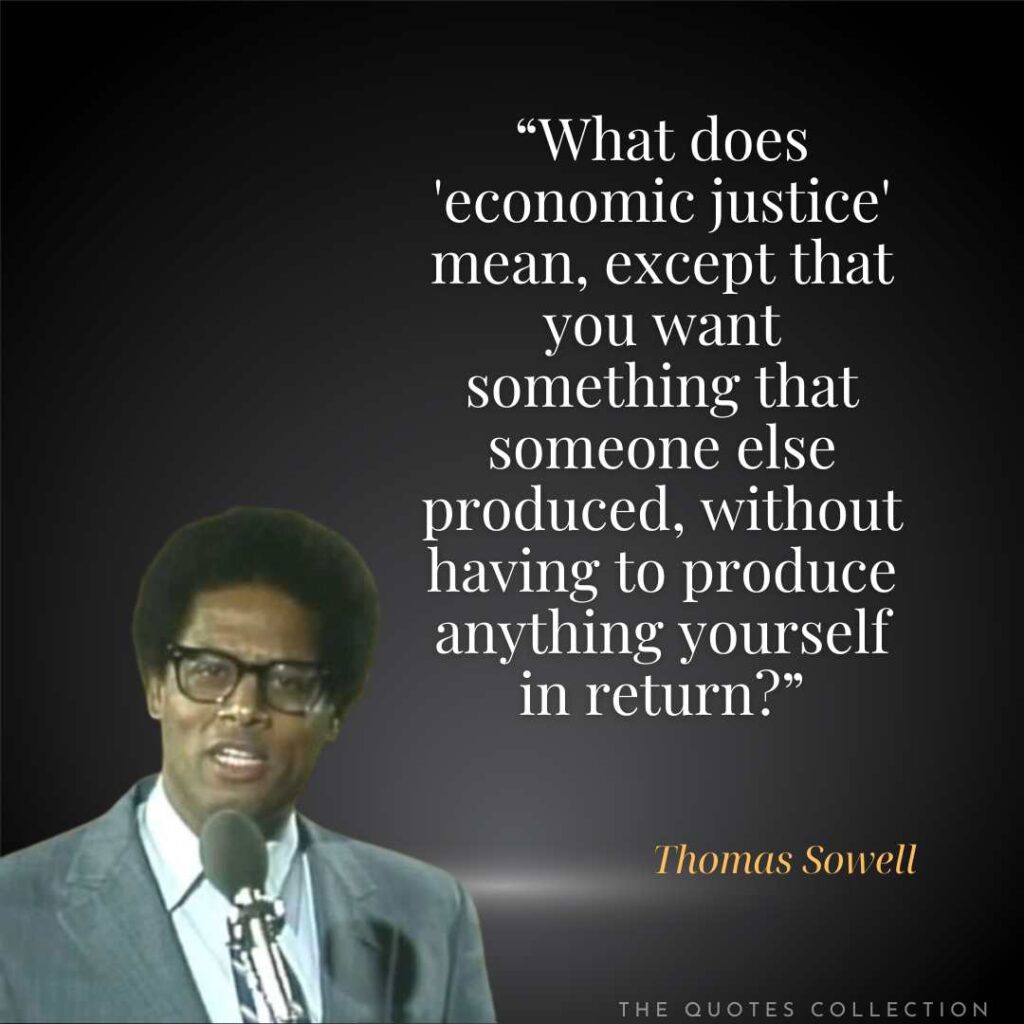
Sowell often challenges phrases that sound morally clear until someone has to define them. Economic justice might mean a living wage to one person, equal opportunity to another, wealth redistribution to a third, and protection of property rights to someone else.
Those definitions lead in very different directions.
Before debating whether an economic system is just, Sowell wants us to explain what standard of justice we are actually using.
13. Justice Needs Trade-Offs
The costs of achieving justice matter.
Thomas Sowell, The Quest for Cosmic Justice
This short line explains much of Sowell’s approach. Public policy rarely gives society a clean choice between justice and injustice. More often, governments choose among imperfect options with different costs.
A policy may improve access while reducing choice. Another may protect freedom while leaving some inequalities untouched.
Sowell wants those trade-offs discussed openly rather than hidden behind the moral appeal of the goal.
14. Define Social Justice
Social justice… is a term with no real definition.
Thomas Sowell, Intellectuals and Society
Sowell sees vague political language as dangerous because people can agree with a phrase while imagining completely different things.
Ask five people what social justice requires and you may hear answers involving equality before the law, redistribution, anti-discrimination policy, workers’ rights, healthcare, education, reparations, or equal outcomes.
The phrase can unite people emotionally while leaving the actual policy unresolved.
15. Decisions Have a Price
What is called ‘social justice’ is government imposition of the notions of third parties.
Thomas Sowell, “Think Things, Not Words”
Sowell argues that markets generally involve people making choices with their own resources, while political decisions can allow third parties to impose choices on others.
His concern is accountability. If policymakers design a program that fails, the people who suffer the consequences may not be the people who designed it.
This does not prove government action is unnecessary. It asks who bears the cost when political confidence turns out to be wrong.
16. Diversity Includes Ideas Too
Social justice warriors can talk about diversity all they want, but when it comes to diversity of ideas, they seem as monolithic as any old bunch of Stalinists ever were.
Thomas Sowell

Sowell argues that diversity should include ideas, not just backgrounds or identities. His criticism is aimed at spaces that celebrate inclusion while leaving little room for genuine disagreement.
If a group values diversity, should intellectual diversity count too?
Why Sowell’s Social Justice Quotes Still Draw Attention
Sowell’s writing attracts readers because he rarely allows a moral goal to finish the argument.
He asks what caused the problem. Who gets to decide? Who pays? What incentives change? What happens after the policy takes effect?
This approach also explains why his work draws strong criticism.
Some scholars and commentators argue that Sowell gives too little weight to structural discrimination, unequal starting conditions, or the role government can play in expanding opportunity. His supporters value the same skepticism because they believe social policy too often gets judged by intentions instead of results.
His 2023 book Social Justice Fallacies brings many of those arguments into one place. The publisher describes the book as a challenge to assumptions surrounding unequal outcomes, discrimination, knowledge, and public policy.
The debate remains active because Sowell rarely asks comfortable questions.
Thomas Sowell Books to Read Next
If these quotes sparked your interest, you do not need to read Sowell’s books in publication order.
Start with the question you care about most.
- The Quest for Cosmic Justice explores his criticism of attempts to correct unequal circumstances through political power.
- Discrimination and Disparities examines why statistical differences between groups can have many causes.
- Basic Economics explains prices, scarcity, incentives, trade-offs, and unintended consequences without relying heavily on equations.
- Knowledge and Decisions goes deeper into one of Sowell’s recurring concerns, namely who possesses useful information and who receives the authority to act on it.
- Social Justice Fallacies offers the most direct continuation of the themes in this article.
Final Thoughts
The best Thomas Sowell quotes on social justice do not ask readers to stop caring about fairness. They ask what fairness means once ideals meet evidence, incentives, costs, freedom, and human choice.
Sowell gives his own answers, and plenty of readers disagree with them.
But when a policy sounds unquestionably fair before we have asked who decides, who pays, and what happens next, have we finished thinking about justice or only started?
Famous Thomas Sowell Books
Here are some of Thomas Sowell’s best books in order they were published if you want to learn more:
- Race and Culture – 1994
- The Quest for Cosmic Justice – 1996
- Conquests and Cultures – 1998
- Basic Economics – 2000
- Affirmative Action Around the World – 2004
- Black Rednecks and White Liberals – 2005
- Economic Facts and Fallacies – 2007
- Intellectuals and Society – 2009
- Wealth, Poverty and Politics – 2015
- Discrimination and Disparities – 2018
- Charter Schools and Their Enemies – 2020
- Social Justice Fallacies – 2023
Social Justice Fallacies Interview
While the best Thomas Sowell quotes are already thought-provoking in themselves, this recent interview will make you dig deeper into the topic of social justice.
Final Thoughts
Thomas Sowell’s quotes on social justice are memorable because he rarely gives the language of fairness a free pass. He wants definitions, evidence, trade-offs, and a clear account of who receives the power to act.
His answers are open to debate. The questions are harder to dismiss.
When we describe a policy as fair or just, how often do we ask what it will actually do before deciding that its intentions are enough?
Leave a Reply