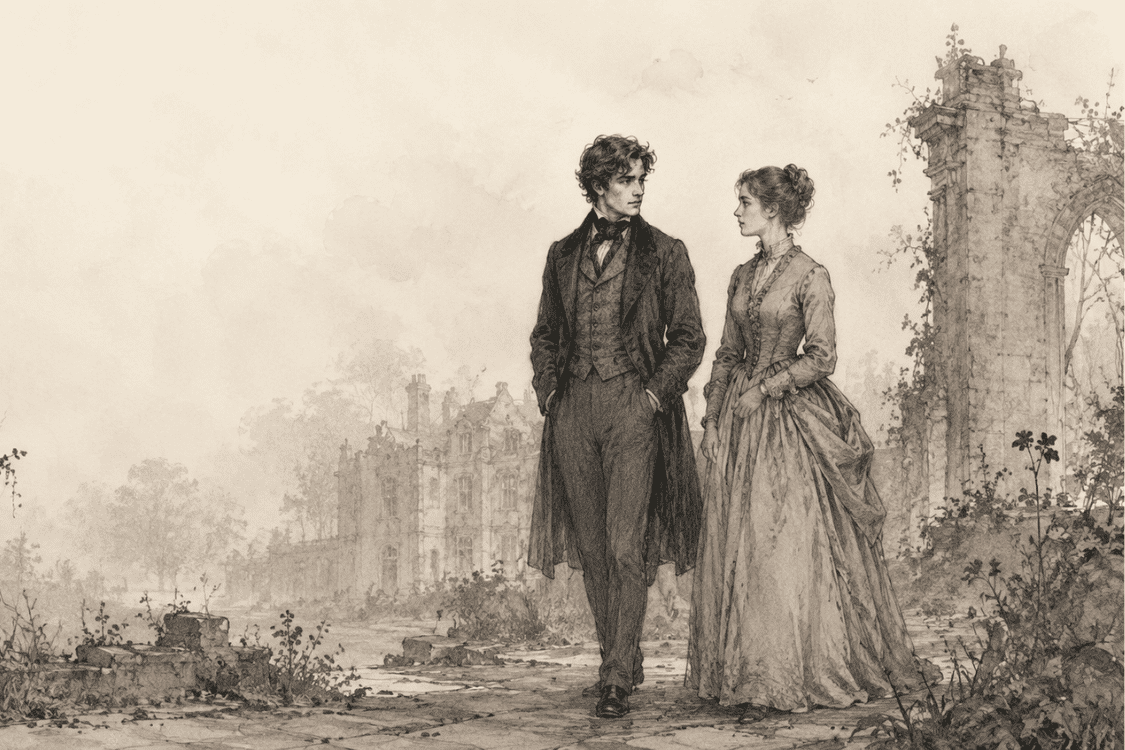
The ending of Great Expectations is famous partly because Charles Dickens wrote it twice.
In the version readers usually know, Pip and Estella meet again at the ruins of Satis House after years apart and walk away together. Yet Dickens never tells us they marry, which leaves the final scene open to interpretation. His original ending was much more definite: Pip and Estella meet again, but they do not reunite romantically. So, does Pip get the future he once imagined? Not exactly.
The ending matters because Pip has stopped demanding that happiness look the way he once expected it to.
How Does Great Expectations End?
By the final chapter, Pip’s life looks very different from the future he once pictured. His fortune is gone, Magwitch is dead, and Pip has spent years working abroad with Herbert. When he returns to England, he finds Joe and Biddy happily married with a young son named Pip.
Later, he visits the remains of Satis House. The house itself is gone, and only the ruined grounds remain. There, almost by chance, he meets Estella.
She has changed too. Bentley Drummle is dead, and the unhappy marriage Estella endured has forced her to confront the emotional distance she once wore like armor. When she speaks to Pip, she no longer sounds like the girl Miss Havisham trained to break hearts.
I have been bent and broken, but—I hope—into a better shape.
Estella, Great Expectations
The line does not erase the damage between them. Instead, it tells us that Estella finally understands what Pip once offered her and what she was unable to return.
From there, the two leave the ruined grounds together. Dickens gives them a reunion, but he stops just before giving readers a conventional romantic ending.
Do Pip and Estella End Up Together?
Possibly—but the novel never confirms that they marry. The final sentence is hopeful without being completely definite:
I saw no shadow of another parting from her.
Pip, Great Expectations
It is easy to read this as Dickens telling us Pip and Estella remain together. After all, they leave Satis House hand in hand, and Pip imagines no further separation.
However, the sentence tells us what Pip sees in that moment, not what actually happens years later. This is also Pip, a man who has spent much of the novel being remarkably certain about futures he has misunderstood.
Earlier, he assumes Miss Havisham is his benefactor. He convinces himself that Estella is somehow meant for him. He also believes becoming a gentleman will lead naturally to happiness. Again and again, his expectations outrun the evidence.
The ambiguity does not make the final line pessimistic, but it keeps the ending open.
For more of Pip’s changing ideas about love and expectations, see our collection of Great Expectations book quotes.
What Was the Original Great Expectations Ending?
Dickens first wrote a much less romantic ending.
In that version, Pip meets Estella by chance in London years later. Drummle has died, but Estella has remarried a Shropshire doctor. Their conversation allows Pip to see that suffering has changed her, yet there is no suggestion that the two will begin a life together.
Pip looks back on the encounter simply:
“I was afterwards very glad to have had the interview.”
The difference is striking. The original ending gives Pip something closer to closure. He sees Estella again, recognizes that she has changed, and then continues with his own life.
There is no ruined Satis House, no hand-in-hand departure, and no suggestion that another chapter of Pip and Estella’s relationship might begin. In other words, the original ending closes the door. The revised one leaves it slightly open.
Why Did Dickens Change the Ending?
The change came after Dickens showed the ending to his friend and fellow novelist Edward Bulwer-Lytton. Bulwer-Lytton encouraged him to reconsider the bleaker conclusion, and Dickens replaced it with the reunion at Satis House before publication. Stanford University’s Discovering Dickens project documents the history of the revision.
The revision changed more than Pip’s relationship status. It also shifted the emotional tone of the final chapter.
The original ending suggests that Pip can love Estella, let her go, and move forward. The published version offers another possibility. Perhaps two people who once hurt each other can meet again after both have changed.
Even then, Dickens wisely avoids turning Estella into a prize Pip receives for finally becoming a better person.
Why the Final Line Is More Ambiguous Than It Looks
Just before Pip and Estella walk away together, she says something easy to overlook:
“And will continue friends apart.”
A few lines later, Pip sees “no shadow of another parting.”
Those statements pull in slightly different directions. Estella expects them to remain friends while living separate lives. Pip, meanwhile, looks into the evening mist and imagines no further separation. Dickens leaves both thoughts standing.
The setting adds another layer. Pip and Estella meet at the ruins of Satis House, the place where their unhealthy relationship began. Miss Havisham is gone. The house is gone. Even Estella’s old certainty that she has “no heart” has been broken down by experience.
So, the scene does not have to mean Pip finally “gets” Estella. A more interesting reading is that they can finally meet without Miss Havisham’s plans, Pip’s fantasies, or Estella’s old defenses deciding who they must be to each other.
The mist reinforces that uncertainty. Earlier in the novel, it often surrounds moments when Pip cannot clearly see where his choices will lead. This time, the mist rises into tranquil light, but Dickens still refuses to tell us exactly what happens after they walk away.
Which Great Expectations Ending Fits the Story Better?
There is a strong argument for Dickens’ original ending.
Pip spends years believing that wanting Estella deeply enough must somehow make her part of his future. Letting them part for good completes his education in a hard but important way. That love does not guarantee possession, and personal growth does not earn a romantic reward.
Yet the published ending offers something different.
By the time Pip and Estella meet again, neither is the person who once walked through Satis House under Miss Havisham’s influence. Pip has lost his fortune, worked for his living, and learned to value people he once overlooked. Estella has suffered through a cruel marriage and gained the empathy Miss Havisham tried to train out of her.
Their reunion therefore does not have to undo the novel’s lessons. Instead, it can represent forgiveness, maturity, and the possibility of knowing each other without repeating the old pattern.
The revised ending works best when it is read as possibility rather than a guaranteed happily-ever-after.
The Ending Gives Great Expectations One Last Meaning
The title follows Pip everywhere.
At first, his “great expectations” are financial. A mysterious benefactor will turn him into a gentleman. Yet Pip quickly attaches more dreams to that fortune. He expects status to make him worthy of Estella, assumes Miss Havisham planned his future, and imagines that becoming someone grander will fix the dissatisfaction he feels with himself.
Most of those expectations collapse. By the final chapter, however, Pip has stopped arranging his life around a fantasy. He has a job, earns his own living, and no longer needs wealth or Estella to prove his worth.
The final scene therefore differs from his younger dreams. Pip does not arrive at Satis House expecting Estella to be waiting for him. Nor does he ask her to fulfill an old promise that never existed.
For once, the future is not something Pip has carefully invented in advance. Perhaps that is why Dickens can leave it unwritten.
A Better Ending, or Just a Different Expectation?
Dickens softened the ending of Great Expectations, but he did not turn it into a neat romantic reward.
Pip and Estella leave Satis House together, yet what happens beyond the gate remains uncertain. The original ending offers closure, while the published version offers possibility.
For a novel built around mistaken assumptions about money, love, class, and happiness, that uncertainty feels appropriate. Pip spends years believing he knows exactly what his future should look like. In the final pages, he finally reaches a moment where he can walk forward without controlling what comes next.
Leave a Reply