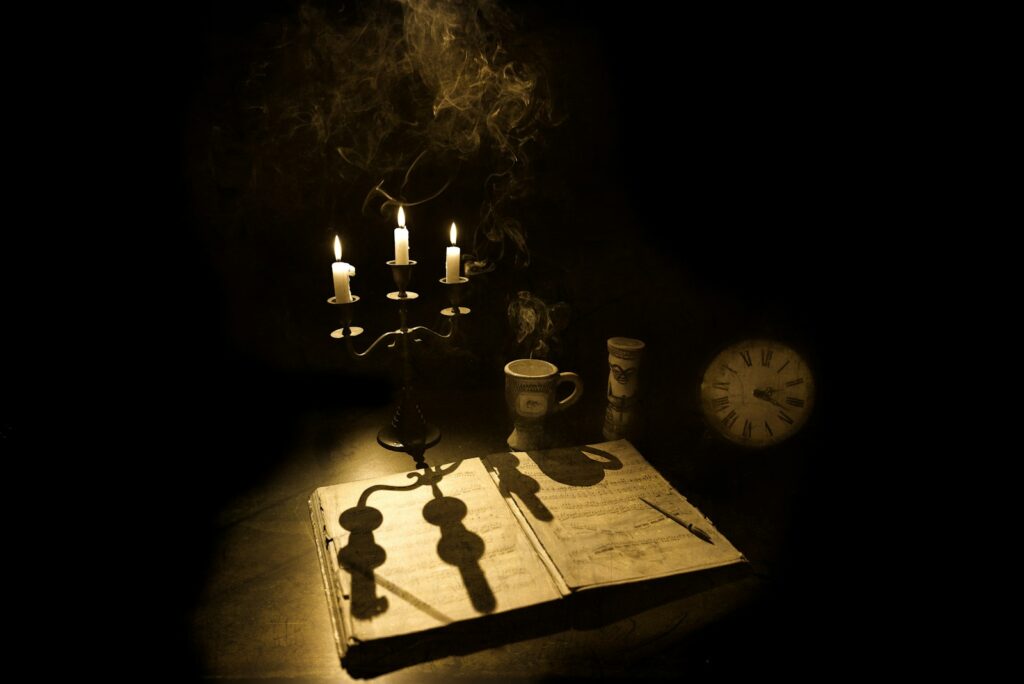
Halloween belongs to readers. Long before horror films filled screens with masked villains and suspiciously poor lighting choices, writers were summoning witches, ghosts, monsters, and things that knock after midnight. These Halloween quotes from literature gather 31 haunting lines, one for every day of October.
From Shakespeare’s prophecies to Poe’s restless narrators, each selection includes the context behind the words and the strange little chill that keeps them alive.
JUMP TO:
When Literature Meets Halloween
Literature gave Halloween much of its language. Witches speak in riddles, old houses remember their dead, and monsters reveal that human beings may be the more frightening creatures. The best literary Halloween quotes do more than sound spooky. They create unease by showing us something familiar with one important detail turned wrong.
For another tale where love, death, and memory refuse to remain peacefully separated, explore the full poem and meaning of “Annabel Lee”.
This collection includes complete sentences, stanzas, and brief dialogue exchanges instead of fragments stripped from their scenes. Some are frightening. Others are darkly beautiful. A few might make you reconsider answering the door, which is probably sensible advice throughout October.
Witches, Spells, and Prophecies
Shakespeare understood that the right words could make the air feel dangerous. His witches do not simply predict events. They make every certainty feel unstable, including the difference between victory and defeat.
1. The Witches Gather
First Witch: “When shall we three meet again
In thunder, lightning, or in rain?”Second Witch: “When the hurlyburly’s done,
When the battle’s lost and won.”Third Witch: “That will be ere the set of sun.”
— William Shakespeare, Macbeth, Act 1, Scene 1 (c. 1606)
Macbeth begins with the witches calmly arranging their next meeting. They already know when the battle will end, while the soldiers fighting it remain trapped inside uncertainty. The supernatural arrives early, and apparently it keeps a very organized calendar.
2. Fair Becomes Foul
“Fair is foul, and foul is fair:
Hover through the fog and filthy air.”— The Three Witches, William Shakespeare, Macbeth, Act 1, Scene 1 (c. 1606)
This chant establishes the play’s moral confusion. Good appearances may conceal evil intentions, while frightening truths can arrive disguised as promises. From this moment forward, almost nothing in Macbeth is exactly what it appears to be.
3. Inviting Dark Spirits
“Come, you spirits
That tend on mortal thoughts, unsex me here,
And fill me from the crown to the toe top-full
Of direst cruelty.”— Lady Macbeth, William Shakespeare, Macbeth, Act 1, Scene 5 (c. 1606)
Lady Macbeth does not wait for darkness to find her. She invites it closer and asks to be stripped of anything that might weaken her resolve.
The speech is frightening because she understands the horror of what she plans. Instead of turning back, she asks to become capable of carrying it through.
4. The Floating Dagger
“Is this a dagger which I see before me,
The handle toward my hand? Come, let me clutch thee.
I have thee not, and yet I see thee still.
Art thou not, fatal vision, sensible
To feeling as to sight?”— Macbeth, William Shakespeare, Macbeth, Act 2, Scene 1 (c. 1606)
Before murdering King Duncan, Macbeth sees a dagger floating before him. He cannot tell whether it is a supernatural sign or an image created by his guilty mind. Either possibility leads him toward the crime he has already chosen.
5. Something Wicked Arrives
Second Witch: “By the pricking of my thumbs,
Something wicked this way comes.
Open, locks,
Whoever knocks!”— William Shakespeare, Macbeth, Act 4, Scene 1 (c. 1606)
The wicked figure approaching the witches is Macbeth himself. Earlier, he encountered evil as an outside temptation. Now the witches recognize him as part of it before he even enters the cave.
6. Trouble in the Cauldron
“Double, double toil and trouble
Fire burn, and cauldron bubble.
Fillet of a fenny snake,
In the cauldron boil and bake.”— The Three Witches, William Shakespeare, Macbeth, Act 4, Scene 1 (c. 1606)
The chant has become playful Halloween language, but the original scene is much darker. The witches are preparing a potion from poisonous and grotesque ingredients. Its cheerful rhythm only makes the recipe more unsettling.
Ghosts and Haunted Places
Ghost stories rarely depend on the spirit alone. They also need a place that seems willing to keep secrets. Castles, villages, corridors, and family homes become frightening when the past refuses to leave them.
7. A Father Returns
“I am thy father’s spirit,
Doom’d for a certain term to walk the night,
And for the day confined to fast in fires,
Till the foul crimes done in my days of nature
Are burnt and purged away.”— The Ghost, William Shakespeare, Hamlet, Act 1, Scene 5 (c. 1600)
The ghost identifies himself as Hamlet’s dead father and explains his nightly punishment. His appearance transforms Hamlet’s grief into a demand for revenge, leaving the prince to decide whether the spirit speaks truth or leads him toward ruin.
8. The Horseman’s Story
“It is said by some to be the ghost of a Hessian trooper, whose head had been carried away by a cannon-ball, in some nameless battle during the Revolutionary War, and who is ever and anon seen by the country folk hurrying along in the gloom of night, as if on the wings of the wind.”
— Washington Irving, The Legend of Sleepy Hollow (1820)
Irving gives the Headless Horseman a violent history before sending him across the countryside. The ghost seems trapped in the final urgency of his life, still riding through the darkness in search of something the battle took from him.
9. Sleepy Hollow’s Spell
“A drowsy, dreamy influence seems to hang over the land, and to pervade the very atmosphere. Some say that the place was bewitched by a high German doctor, during the early days of the settlement.”
— Washington Irving, The Legend of Sleepy Hollow (1820)
The whole landscape feels enchanted before the Horseman appears. Sleepy Hollow encourages dreams, stories, and nervous interpretations of ordinary sounds. It is the ideal home for legends and the worst possible destination for Ichabod Crane’s imagination.
10. The Canterville Stain
Mrs. Otis: “I don’t at all care for blood-stains in the sitting-room. It must be removed at once.”
Mrs. Umney: “It is the blood of Lady Eleanore de Canterville, who was murdered on that very spot by her own husband, Sir Simon de Canterville, in 1575.”
— Oscar Wilde, The Canterville Ghost (1887)
Wilde turns a traditional haunted-house discovery into a disagreement about housekeeping. Mrs. Otis hears “centuries-old murder.” Her main concern is apparently whether the stain will come out.
11. The Beauty of Death
“Death must be so beautiful. To lie in the soft brown earth, with the grasses waving above one’s head, and listen to silence. To have no yesterday, and no to-morrow. To forget time, to forgive life, to be at peace.”
— The Canterville Ghost, Oscar Wilde, The Canterville Ghost (1887)
Behind Wilde’s comedy is a spirit exhausted by centuries of haunting. Sir Simon no longer wants to frighten the living. He longs for forgiveness, silence, and rest. The passage becomes moving once we understand how long he has existed without any of them.
12. Every House Remembers
“All houses wherein men have lived and died
Are haunted houses. Through the open doors
The harmless phantoms on their errands glide,
With feet that make no sound upon the floors.”— Henry Wadsworth Longfellow, “Haunted Houses” (1858)
Longfellow imagines haunting as something quiet and ordinary. Homes retain traces of those who once lived there, even when no visible ghost appears. Memory becomes a presence moving gently beside the living.
Monsters and Divided Selves
The finest monsters are rarely frightening because of appearance alone. They become memorable when they speak, reason, suffer, and expose uncomfortable similarities between themselves and the people who fear them.
13. The Creature Speaks
“Remember that I am thy creature. I ought to be thy Adam, but I am rather the fallen angel, whom thou drivest from joy for no misdeed.”
— The Creature, Mary Shelley, Frankenstein (1818)
The Creature confronts Victor with the responsibility he has avoided since the moment of creation. He did not ask to be brought to life, yet Victor abandoned him almost immediately because his appearance inspired disgust.
His comparison with Adam and the fallen angel reveals how carefully he has studied human stories. Adam receives companionship and guidance from his creator. The Creature receives rejection. He begins without hatred, but repeated cruelty teaches him to expect it from others.
Shelley does not ask readers to excuse the violence that follows. Instead, she asks a more difficult question. How much responsibility does a creator bear when he gives life to someone, denies him love, and then acts surprised when loneliness becomes rage?
14. Misery Makes Monsters
“I was benevolent and good. Misery made me a fiend. Make me happy, and I shall again be virtuous.”
— The Creature, Mary Shelley, Frankenstein (1818)
The Creature claims that cruelty changed him rather than revealing what he had always been. His argument does not erase his later choices, but it forces Victor to confront how abandonment helped create the danger he now fears.
15. Life Through Anguish
“Life, although it may only be an accumulation of anguish, is dear to me, and I will defend it.”
— The Creature, Mary Shelley, Frankenstein (1818)
Despite rejection, loneliness, and fear, the Creature still values his life. That determination makes him more human than Victor wants to admit.
16. Children of the Night
“Listen to them, the children of the night. What music they make!”
— Count Dracula, Bram Stoker, Dracula (1897)
Dracula hears wolves howling outside his castle and calls the sound music. Jonathan Harker hears danger. Their reactions reveal which man belongs to the night and which one has wandered much too far from home.
17. Light Within Darkness
“There are darknesses in life and there are lights, and you are one of the lights, the light of all lights.”
— Professor Van Helsing, Bram Stoker, Dracula (1897)
Van Helsing’s words to Mina offer warmth inside a story filled with blood, fear, and pursuit. He does not pretend the darkness is gone. Instead, he reminds her that goodness can remain visible within it.
The Project Gutenberg edition of Dracula lets readers explore Stoker’s complete novel and its original supernatural atmosphere.
18. Learning Through Failure
“We learn from failure, not from success!”
— Professor Van Helsing, Bram Stoker, Dracula (1897)
Van Helsing and his companions repeatedly misunderstand the power they are fighting. Rather than surrender, he treats each failure as new knowledge. The line gives the novel an unexpectedly hopeful idea about facing fear together.
For more lines that find courage and hope inside frightening stories, explore our inspirational Halloween quotes collection.
19. Two Selves Within
“I learned to recognise the thorough and primitive duality of man. I saw that, of the two natures that contended in the field of my consciousness, even if I could rightly be said to be either, it was only because I was radically both.”
— Dr. Henry Jekyll, Robert Louis Stevenson, Strange Case of Dr Jekyll and Mr Hyde (1886)
Jekyll creates Hyde because he wants to separate his respectable identity from the desires he hides. He imagines that science can divide him into two independent selves, allowing one to remain honorable while the other acts without consequence.
Instead, his experiment proves that Hyde is not a stranger who invades his life. Hyde emerges from impulses Jekyll already possesses. The transformation changes his body and removes his restraint, but it does not create the darkness from nothing.
That is what makes the confession so unsettling. Jekyll’s mistake is not simply releasing a monster. It is believing that wrongdoing belongs to another version of himself and therefore carries no claim on his conscience.
20. Sinner and Sufferer
“If I am the chief of sinners, I am the chief of sufferers also.”
— Dr. Henry Jekyll, Robert Louis Stevenson, Strange Case of Dr Jekyll and Mr Hyde (1886)
Jekyll recognizes his guilt while viewing himself as a victim of the life he created. He is responsible for Hyde and terrified of him, guilty of choosing transformation and increasingly powerless to stop it.
21. Heaven and Hell Within
“Each of us has Heaven and Hell in him, Basil.”
— Dorian Gray, Oscar Wilde, The Picture of Dorian Gray (1890)
Dorian says this after Basil confronts him about his ruined reputation. His appearance remains beautiful, but the hidden portrait reveals the consequences his face refuses to show.
Madness, Death, and the Unknown
Edgar Allan Poe had a particular gift for narrators who insist they are perfectly reasonable while providing persuasive evidence to the contrary. His stories enter frightened minds and remain there long after the final sentence.
22. The Narrator Insists
“True! Nervous, very, very dreadfully nervous I had been and am. But why will you say that I am mad? The disease had sharpened my senses, not destroyed, not dulled them.”
— The Narrator, Edgar Allan Poe, “The Tell-Tale Heart” (1843)
The narrator denies an accusation the reader has not yet made. His desperate insistence immediately creates suspicion, and every later claim of sanity makes his instability more obvious.
23. A Midnight Visitor
“Once upon a midnight dreary, while I pondered, weak and weary,
Over many a quaint and curious volume of forgotten lore,
While I nodded, nearly napping, suddenly there came a tapping,
As of some one gently rapping, rapping at my chamber door.
‘’Tis some visitor,’ I muttered, ‘tapping at my chamber door,
Only this and nothing more.’”— Edgar Allan Poe, “The Raven” (1845)
Poe begins with grief, exhaustion, and a sound that could still have an ordinary explanation. The tapping draws the speaker toward the door and deeper into his sorrow. “Nothing more” becomes tragically optimistic once the raven settles in.
24. Approaching Usher House
“During the whole of a dull, dark, and soundless day in the autumn of the year, when the clouds hung oppressively low in the heavens, I had been passing alone, on horseback, through a singularly dreary tract of country, and at length found myself, as the shades of the evening drew on, within view of the melancholy House of Usher.”
— The Narrator, Edgar Allan Poe, “The Fall of the House of Usher” (1839)
The low clouds, silence, autumn landscape, and approaching evening create dread before anything supernatural happens. By the time the narrator sees the mansion, it already seems less like a building and more like a warning.
25. Darkness Takes Dominion
“And now was acknowledged the presence of the Red Death. He had come like a thief in the night. And Darkness and Decay and the Red Death held illimitable dominion over all.”
— Edgar Allan Poe, “The Masque of the Red Death” (1842)
Prince Prospero believes wealth and locked gates can protect his guests from the plague. The masked figure proves otherwise, stripping away every illusion that privilege can permanently bar the door against death.
26. Montresor’s Last Reply
Fortunato: “For the love of God, Montresor!”
Montresor: “Yes, for the love of God!”
— Edgar Allan Poe, “The Cask of Amontillado” (1846)
Fortunato appeals to faith, pity, and shared humanity after realizing Montresor intends to leave him behind the wall. Montresor repeats the words without offering any of them. The echo is colder than silence.
27. The Black Cat Begins
“For the most wild, yet most homely narrative which I am about to pen, I neither expect nor solicit belief. Mad indeed would I be to expect it, in a case where my very senses reject their own evidence.”
— The Narrator, Edgar Allan Poe, “The Black Cat” (1843)
Once again, Poe gives us a narrator who wants to control how readers judge him. He calls his story ordinary and unbelievable at the same time, preparing us for cruelty, murder, guilt, and a cat with excellent timing.
28. Haunted From Within
“One need not be a Chamber—to be Haunted—
One need not be a House—
The Brain has Corridors—surpassing
Material Place—Far safer, of a Midnight Meeting
External Ghost
Than its interior Confronting—
That Cooler Host.”— Emily Dickinson, “One need not be a Chamber—to be Haunted—” (c. 1862)
Dickinson suggests that the mind can contain corridors more frightening than those in any haunted house. An outside ghost may startle us, but our own memories and fears already know where we live.
Masks, Goblins, and Strange Encounters
Halloween is not only about terror. It also invites mischief, masquerade, and the pleasure of entering a world where normal rules loosen for one night.
29. The Following Footsteps
“Like one, that on a lonesome road
Doth walk in fear and dread,
And having once turned round walks on,
And turns no more his head
Because he knows, a frightful fiend
Doth close behind him tread.”— Samuel Taylor Coleridge, The Rime of the Ancient Mariner (1798)
Coleridge captures the fear of believing something is following you. The traveller refuses to look again because confirmation would be worse than uncertainty. Unfortunately, not turning around has never persuaded a fiend to leave.
30. Do Not Eat
“We must not look at goblin men,
We must not buy their fruits:
Who knows upon what soil they fed
Their hungry thirsty roots?”— Laura, Christina Rossetti, “Goblin Market” (1862)
Laura and Lizzie know the goblin fruit is dangerous, but its beauty makes resistance difficult. The warning turns temptation into something colorful, fragrant, and best left uneaten.
31. The Beautiful Captor
“I saw pale kings and princes too,
Pale warriors, death-pale were they all
They cried, ‘La Belle Dame sans Merci
Thee hath in thrall!’”— John Keats, “La Belle Dame sans Merci” (1819)
The knight dreams of other powerful men enchanted by the same mysterious woman. Their warning comes too late. When he wakes, he is alone in a barren landscape, still trapped by the memory of beauty that concealed danger.
Choosing a Quote for Halloween Night
The right literary Halloween quote depends on the mood you want to create. Shakespeare’s witches suit parties, decorations, and dramatic readings. Poe offers something darker for quiet October nights, while Shelley and Stevenson explore the monsters people create or conceal.
For a haunted-house atmosphere, choose Irving, Wilde, or Longfellow. Readers looking for eerie beauty may prefer Dickinson, Keats, or Coleridge. If you want a line that is spooky without becoming bleak, Van Helsing’s reminder about light within darkness brings a little hope into the shadows.
These quotations can also become reading prompts. Choose one each day in October, find its original work, and read the scene surrounding it. By Halloween night, you will have visited castles, laboratories, crypts, forests, haunted chambers, and at least one goblin market without paying for suspicious fruit.
If you need something briefer for a party sign, card, or October message, browse our short Halloween quotes and funny sayings.
Turn These Literary Quotes Into Halloween Postcards

12 Printable Halloween Postcards inspired by classic gothic literature
If you’d like to bring a few of these literary lines off the screen, I created a set of 12 printable Halloween postcards inspired by classic gothic literature.
The collection features quotations from writers including Shakespeare, Mary Shelley, Bram Stoker, Washington Irving, Oscar Wilde, and Robert Louis Stevenson, paired with atmospheric Halloween artwork.
The cards are designed as 4×6 printables and come as an instant digital download, making them easy to print for Halloween mail, October decor, literary gifts, or a seasonal reading nook.
Final Thoughts
The best Halloween quotes from literature survive because they give fear a voice. Some warn us about supernatural creatures. Others reveal guilt, loneliness, temptation, grief, or the hidden parts of human nature.
Yet these stories are not interested in darkness alone. They also contain courage, companionship, humor, and people carrying light into places where it seems least likely to survive. Halloween lets us approach frightening ideas from the safety of a page, close the book, and return when we feel brave enough for another chapter.
After all, every shadow becomes slightly less powerful once someone finds the words to describe it.
Leave a Reply