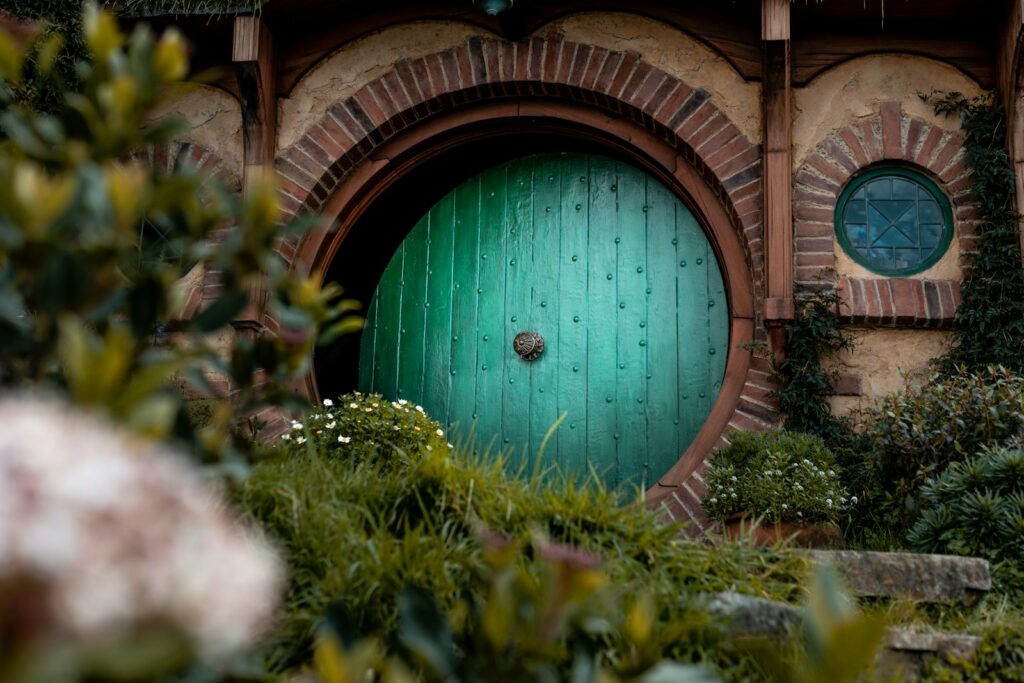
The most memorable The Hobbit quotes carry the personality of the book. Gandalf can turn a polite greeting into an argument, while Bilbo finds himself offering advice about dragons he would once have preferred never to meet. Beneath the humor lies a tender concern for what makes a life worth returning to.
These fourteen selections come from J.R.R. Tolkien’s novel, with speakers, chapter references, and explanations of their meaning.
Together, they follow the movement from a comfortable home toward danger, hard-earned judgment, and a different understanding of wealth.
The explanations include spoilers, including events near the end of the novel.
JUMP TO:
The Hobbit Quotes About Home and Hospitality
Bilbo’s adventure opens the door to a much larger story. Our collection of Lord of the Rings quotes follows that story further into Middle-earth. Here, the journey begins with the comforts Bilbo has every reason to cherish.
1. The Comfort of Home
“In a hole in the ground there lived a hobbit.”Narrator, The Hobbit, Chapter 1, “An Unexpected Party”
Tolkien begins with a home before he asks us to care about an adventure. The sentence has the easy assurance of a storyteller pulling up a chair, confident that a hole in the ground deserves our attention.
Its simplicity gives the unfamiliar creature an ordinary place in the world. Before Bilbo acquires any heroic reputation, he has somewhere to live. That domestic beginning gives the journey its emotional weight, because leaving home costs something when home is good.
2. A Complicated Good Morning
“Do you wish me a good morning, or mean that it is a good morning whether I want it or not; or that you feel good this morning; or that it is a morning to be good on?”Gandalf, The Hobbit, Chapter 1, “An Unexpected Party”
Bilbo offers a perfectly serviceable greeting, and Gandalf subjects it to an absurdly thorough examination. The humor comes from the mismatch between one person’s social ease and another’s refusal to let an ordinary phrase pass unchallenged.
It is a wonderful introduction to Gandalf’s unsettling company. Even conversation refuses to follow its usual course around him. Bilbo would like the morning to remain pleasantly predictable; the wizard has already begun interfering with that ambition.
3. A Peculiarly Hobbitish Blessing
“…may the hair on his toes never fall out!”Thorin Oakenshield, referring to Bilbo, The Hobbit, Chapter 1, “An Unexpected Party”
Thorin includes this blessing in his formal speech at Bag End. Its elaborate goodwill lands on an endearingly humble subject, giving his grand manner a comic flourish.
The wording is “his toes,” because Thorin is speaking about Bilbo to the assembled company. As a piece of hospitality, the blessing also has a peculiar charm. A good wish feels warmer when it belongs to the person receiving it, even when that person happens to prize a healthy covering of foot hair.
The Hobbit Quotes About Adventure and Uncertainty
4. Looking Beyond the Familiar
“There is nothing like looking, if you want to find something.”Narrator, The Hobbit, Chapter 4, “Over Hill and Under Hill”
On its own, this sounds like cheerful common sense. Looking requires an effort that wishing can comfortably avoid, so the line lends itself to anyone waiting for an opportunity to arrive.
Yet Tolkien gives the advice an ironic edge. In the surrounding passage, finding something carries no guarantee that it will be what the searchers hoped for. Read that way, the quotation captures both the usefulness and the risk of curiosity. We can choose to investigate; we have less control over what the investigation uncovers.
5. Beyond the Safe Paths
“There are no safe paths in this part of the world. Remember you are over the Edge of the Wild now, and in for all sorts of fun wherever you go.”Gandalf, The Hobbit, Chapter 7, “Queer Lodgings”
Gandalf offers this answer when Bilbo hopes for a route around Mirkwood. His reference to “fun” has a distinctly wicked cheerfulness, especially for someone who will not accompany the travelers through the forest.
The phrase “Edge of the Wild” gives uncertainty a geographical boundary. Beyond it, the familiar rules no longer offer much protection. Bilbo’s wish for a safer route is reasonable, and the passage keeps that fear intact. Courage here requires judgment within an uncomfortable situation, with no promise that careful choices will remove every danger.
6. A Blessing for Departure
“May the wind under your wings bear you where the sun sails and the moon walks.”Gandalf, The Hobbit, Chapter 7, “Queer Lodgings”
This lyrical farewell belongs to Gandalf’s exchange with the eagles. Its beauty comes partly from speaking to them in terms of their own lives, imagining a good journey through the open sky.
The moving sun and moon lend the blessing a vast, unhurried rhythm. Among the adventure quotes in The Hobbit, it offers a moment of generosity rather than a challenge to prove oneself. Sometimes the loveliest thing to offer a traveler is the hope that the world will carry them kindly.
Funny and Unsettling Quotes From The Hobbit
7. Treasure Inside a Riddle
“A box without hinges, key, or lid,
Yet golden treasure inside is hid.”Bilbo Baggins, The Hobbit, Chapter 5, “Riddles in the Dark”
The answer is an egg. The riddle dresses an everyday object in the language of a treasure chest, making the familiar briefly mysterious.
Its pleasure lies in the accuracy of the disguise. A shell encloses something golden, yet opens without any of the mechanisms a box would need. Tolkien invites the reader to enjoy that small act of recognition even while Bilbo faces a dangerous opponent. The scene leaves room for delight without allowing us to forget the stakes.
8. A Very Uncomfortable Appetite
“Is it nice, my preciousss? Is it juicy? Is it scrumptiously crunchable?”Gollum, The Hobbit, Chapter 5, “Riddles in the Dark”
Gollum’s interest in Bilbo is alarmingly culinary. “Scrumptiously crunchable” has the playful sound of an extravagant food description, which makes its use here both funny and horrible.
That uneasy mixture belongs to the texture of Tolkien’s storytelling. A reader can enjoy the sound of the words while understanding why Bilbo would hear them very differently. Gollum’s speech gives danger a voice so distinctive that it needs little explanation.
9. A Dragon’s Wounded Pride
“Never laugh at live dragons, Bilbo you fool!”Bilbo Baggins, The Hobbit, Chapter 12, “Inside Information”
Bilbo’s rebuke preserves the embarrassment of realizing he has been too pleased with his own cleverness. The danger has teeth, and a successful exchange of words has encouraged him to forget them.
The sentence is funny because its advice seems so obvious after the mistake. It also separates resourcefulness from sound judgment. Being quick enough to impress yourself is no guarantee that you have understood the consequences. Bilbo’s willingness to recognize his foolishness gives his growing confidence a welcome limit.
The Hobbit Quotes About Hope and Judgment
10. Remembering the Living Dragon
“It does not do to leave a live dragon out of your calculations, if you live near him.”Narrator, The Hobbit, Chapter 12, “Inside Information”
The narrator delivers this warning with the composure of someone discussing a minor practical inconvenience. That understatement makes the sentence especially sharp. A dragon ought to dominate any sensible calculation, yet excitement can push even an enormous danger out of view.
For readers, the line offers a useful distinction between hope and selective attention. A promising plan still has to account for whatever could undo it. Tolkien lets the absurdity carry the lesson, sparing us a solemn lecture on the merits of caution.
11. Hope With Work Ahead
“While there’s life there’s hope!”Bilbo Baggins, The Hobbit, Chapter 13, “Not at Home”
Bilbo draws on a familiar family saying when the company needs to act. The correct opening word in this passage is “While,” which ties hope to the continued possibility of doing something.
The proverb offers no assurance about how events will turn out. Its usefulness lies in refusing to treat the present difficulty as a finished verdict. There is still a decision to make, and Bilbo is prepared to make it.
There is affection in the reference to his father, too. Far from home, he carries a piece of its language into a place where familiar comforts are unavailable. An ordinary saying can acquire unexpected force when experience finally asks us to live by it.
12. Silence Without Much Wisdom
“He thought much but said little…”Narrator, The Hobbit, Chapter 14, “Fire and Water
Detached from its setting, this fragment can sound like praise for a thoughtful, reserved person. In the novel, it describes the Master of Lake-town, and the rest of the sentence undercuts that flattering impression with his demands for food and warmth.
The irony makes this a more interesting passage than a simple endorsement of silence. Quietness tells us little about the quality of someone’s thoughts or the generosity of their character. A person may appear reflective while remaining thoroughly occupied with personal comfort.
Read in context, the line asks us to judge character through conduct. An impressive manner, whether talkative or restrained, can conceal how little someone is willing to do for others.
The Hobbit Quotes About What We Treasure
13. A Merrier Kind of Wealth
“If more of us valued food and cheer and song above hoarded gold, it would be a merrier world.”Thorin Oakenshield, The Hobbit, Chapter 18, “The Return Journey”
Thorin speaks these words during his final reconciliation with Bilbo. They carry the sorrow of a judgment reached too late to spare him its cost. The publisher’s guide to The Hobbit provides a useful starting point for exploring the novel’s treatment of greed and Bilbo’s values.
The word “hoarded” gives the comparison its force. Food can nourish a guest, and a song can draw a room together. Gold kept only for possession offers neither kind of companionship. Thorin recognizes the poverty of having much while allowing the desire to keep it to govern every relationship.
His choice of “merrier” is equally moving. After so much ambition and conflict, the good he names is something as ordinary as shared happiness. Bilbo’s homely pleasures have a dignity that grander appetites can easily overlook.
14. Even Dragons Have Endings
“So comes snow after fire, and even dragons have their ending!”Bilbo Baggins, The Hobbit, Chapter 18, “The Return Journey”
Looking back toward the Lonely Mountain on his journey home, Bilbo sees snow where he once knew the threat of fire. The line uses the singular “ending,” and its exclamation carries the relief of someone who has survived enough to speak with conviction.
The image offers a gentler perspective on power. Fire can consume the whole field of attention while it burns, making anything beyond it difficult to imagine. Snow belongs to another season, when the same landscape can be seen differently.
There is room for comfort in that change without pretending the journey has cost nothing. Bilbo can acknowledge what happened and still turn toward home. An experience may remain part of a life without occupying all of its future.
Are These Quotes From the Book or the Movies?
These selections come from Tolkien’s novel. Some also appear in adaptations, but this collection uses their literary setting and identifies the character speaking, or the narrator when appropriate.
Chapter names are included because page numbers vary by edition. When using a passage in an essay, check its punctuation and page number in the copy you are citing.
What Bilbo Carries Home
The appeal of these The Hobbit quotes lies in the company they keep. A ridiculous blessing can sit beside a hard truth about greed, and a familiar proverb can help someone face an unfamiliar danger. Tolkien allows wisdom to retain its humor and its human imperfections.
Bilbo’s love of home gives that wisdom a lasting tenderness. There is something deeply hopeful in a journey that enlarges a person’s world while leaving them able to cherish a chair beside their own fire.
Leave a Reply