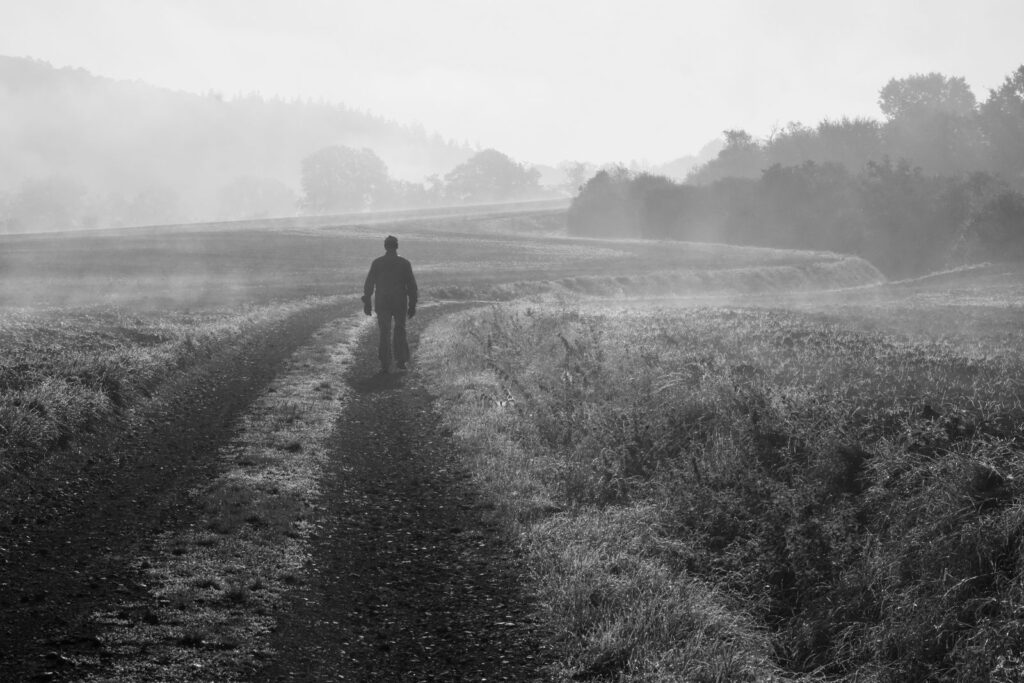
A mysterious ranger sits in the shadows of an inn, watching four hobbits who have wandered into danger. To Frodo, the stranger seems more threatening than trustworthy. Yet the meaning of “Not all those who wander are lost” is closely tied to this man, whose weathered appearance hides a remarkable past.
J. R. R. Tolkien’s famous quotation has become a favorite among travelers and dreamers. In The Fellowship of the Ring, however, it carries a deeper message about hidden worth, lasting purpose, and the danger of judging someone by appearances.
JUMP TO:
What Does Not All Those Who Wander Are Lost Mean?
“Not all those who wander are lost;”J. R. R. Tolkien, The Fellowship of the Ring (1954), Book I, Chapter 10, “Strider.”
The quotation means that someone who seems to wander without direction may have a purpose others cannot see. An unfamiliar path is not always a mistaken one, and outward appearances can tell us little about a person’s goals.
In Tolkien’s story, these words describe Aragorn, a wandering ranger who is secretly the heir to the throne of Gondor. To most people, he appears to be a rough traveler who spends his days roaming the wilderness. Few know of the royal blood beneath his worn cloak.
Tolkien is not praising aimless wandering or suggesting that every uncertain journey will lead somewhere wonderful. He reminds us that appearances can be misleading, especially when we know so little about the person before us.
Where the Quote Comes From in The Lord of the Rings
The quotation appears in The Fellowship of the Ring, the first volume of Tolkien’s The Lord of the Rings. It belongs to a short poem known as the Riddle of Strider, which Bilbo Baggins wrote about Aragorn.
Frodo encounters the poem in Chapter 10, “Strider,” after arriving at the Prancing Pony in Bree. Having left the safety of the Shire, he knows that dangerous servants of the Enemy are searching for him.
At the inn, Frodo meets a mysterious ranger called Strider. The stranger knows more about the hobbits and their journey than seems possible, leaving Frodo unsure whether he has found a friend or another enemy.
The innkeeper, Barliman Butterbur, eventually remembers a letter that Gandalf had left for Frodo. In it, the wizard identifies Strider as an ally and reveals his true name, Aragorn. He also includes Bilbo’s poem to help Frodo recognize the man.
The verse offers an important clue. Aragorn’s humble appearance hides his royal ancestry. His years in the wilderness have prepared him for duties far greater than Frodo can yet imagine.
For more memorable passages, explore our collection of Lord of the Rings quotes, including reflections on courage and friendship.
Why Aragorn’s Wandering Matters
Aragorn’s life gives the quotation its original meaning. Although he belongs to an ancient royal line, he has spent much of his life traveling through Middle-earth under different names.
As one of the Rangers of the North, he helps protect lands whose inhabitants know little about him. His work takes him across lonely roads and dangerous country, far from the comfort one might expect for a future king.
The people of Bree know him as Strider, a strange wanderer who seldom explains his affairs. They see his rough clothing and solitary habits, but know nothing of the hardships and duties that have shaped his life.
This contrast lies at the heart of Tolkien’s message. Aragorn’s wandering does not mean he lacks direction. His travels have given him the knowledge, experience, and strength needed for the difficult choices ahead.
The Deeper Meaning of the Riddle of Strider
The famous quotation becomes richer when we consider the poem surrounding it. Bilbo’s verse begins by reversing a familiar proverb:
“All that is gold does not glitter,”J. R. R. Tolkien, The Fellowship of the Ring (1954)
Instead of warning that attractive things may be worthless, Tolkien suggests that something precious may lack an impressive appearance. Aragorn resembles neither the splendid kings of old nor the powerful rulers of his own age. Yet his bloodline and character remain unchanged.
The poem continues with images of strength surviving age and roots enduring the frost. These descriptions suggest a royal family that has survived generations of hardship without losing its dignity.
Later, the poem turns toward a broken sword and a crown awaiting its rightful bearer. Its final promise points to Aragorn’s future and the return of a king to Gondor.
These details make the verse far more than a celebration of travel. It tells the story of a man whose true identity has survived years of hardship and obscurity.
The verse also gains meaning through its contrast with the One Ring, whose hidden nature brings danger rather than hope.
What the Quote Can Teach Us About Life
Beyond Middle-earth, the quotation invites us to reconsider how easily we mistake an unfamiliar life for one without purpose.
We often measure progress through visible achievements, such as a successful career, a settled home, or a carefully planned future. When someone chooses a different direction, we may assume they are uncertain about what they want.
Consider someone who leaves a promising career to pursue work that offers less money but greater personal meaning. Friends and relatives may question the decision, believing that years of effort have been wasted. Yet the person making that choice may understand their priorities more clearly than ever before.
The same idea applies to quieter decisions that attract little attention. A person may spend years caring for family, learning a craft, or working toward a goal whose rewards are not yet visible.
Aragorn’s story offers a different way of looking at such lives. He does not need the approval of strangers to give his work meaning, nor does their failure to recognize him lessen what he has achieved.
Still, Tolkien’s words carry an important distinction. There is a difference between choosing an unusual path and wandering without considering where it may lead. Aragorn’s travels matter because they are guided by loyalty, duty, and a greater purpose.
His example encourages us to respect the paths others have chosen while giving careful thought to our own.
Is the Quote From the Book or the Movie?
The original quotation comes from Tolkien’s novel The Fellowship of the Ring, published in 1954. It is part of Bilbo’s poem about Aragorn, which Gandalf includes in his letter to Frodo.
The line is not delivered as a famous standalone speech in Peter Jackson’s The Lord of the Rings film trilogy. However, other parts of the poem appear in the films, particularly those concerning Aragorn’s broken sword and royal inheritance.
A related variation also appears in The Lord of the Rings: The Rings of Power, within a song performed by Poppy Proudfellow. The song shares the idea of wandering without being lost, although it is separate from Bilbo’s original verse.
Another common question concerns the wording. Tolkien wrote “Not all those who wander are lost,” while the shorter version, “Not all who wander are lost,” is widely shared in captions, artwork, and inspirational collections.
Both express a similar thought, but the longer version preserves Tolkien’s exact words.
Finding Purpose Along an Unfamiliar Path
The meaning of “Not all those who wander are lost” may feel especially personal if your own journey has taken an unexpected turn. Perhaps you have chosen a path that few understand, or you are still searching for a place where you truly belong.
Remember that Aragorn spent years walking lonely roads before claiming his crown. Those years were far from wasted, for they shaped the wisdom and strength he would later need as king.
You may not yet understand where your present circumstances are leading you, but that does not diminish the value of what you are learning along the way. Take heart in knowing that even the roads you never intended to travel may prepare you for a future you have yet to imagine.
Leave a Reply