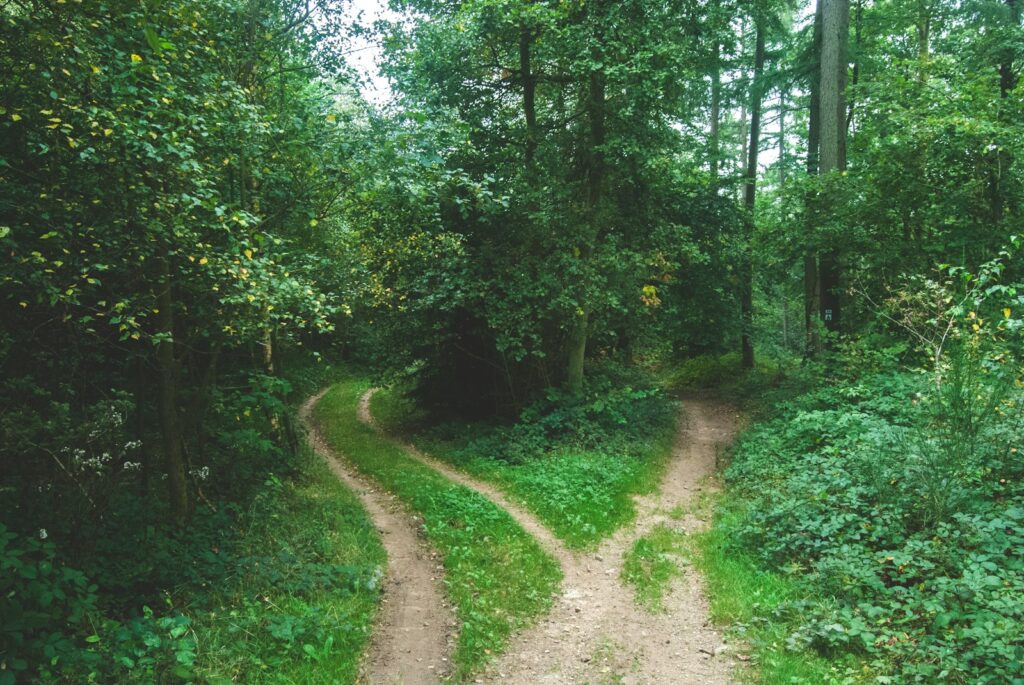
The meaning of The Road Not Taken is more complicated than its famous ending suggests. Robert Frost’s traveler later claims that he chose the less traveled road, although earlier he admits the two paths looked almost identical. His poem explores the uncertainty of difficult decisions and the stories we create about them afterward.
The traveler cannot see where either road leads, yet he imagines retelling his choice as a turning point years later.
Why does his future account sound so certain when his decision was not?
JUMP TO:
The Road Not Taken by Robert Frost
First published in The Atlantic Monthly in 1915, the poem later appeared in Frost’s collection Mountain Interval (1916). Readers often call it “the road less traveled” poem, but its title is The Road Not Taken.
Two roads diverged in a yellow wood,
And sorry I could not travel both
And be one traveler, long I stood
And looked down one as far as I could
To where it bent in the undergrowth;
Then took the other, as just as fair,
And having perhaps the better claim,
Because it was grassy and wanted wear;
Though as for that the passing there
Had worn them really about the same,
And both that morning equally lay
In leaves no step had trodden black.
Oh, I kept the first for another day!
Yet knowing how way leads on to way,
I doubted if I should ever come back.
I shall be telling this with a sigh
Somewhere ages and ages hence:
Two roads diverged in a wood, and I—
I took the one less traveled by,
And that has made all the difference.Robert Frost, The Road Not Taken, Mountain Interval (1916)
What Does The Road Not Taken Mean?
The two roads stand for choices that close off other possibilities. The traveler studies both, but each path disappears into the undergrowth before he can see what waits ahead. Frost captures the frustration of having to decide without knowing how either choice will turn out.
Imagine growing up in a family of doctors who expect you to study medicine. You’ve earned a place in medical school, yet you dream of making music professionally. Medicine promises stability, while music offers a chance to pursue your passion without the same financial security.
You could become a doctor who finds unexpected joy in caring for patients. You might also discover that earning a living through music brings pressures you never faced when it was a hobby. Either way, you cannot test both lives before deciding, much as Frost’s traveler cannot follow both roads.
Frost often writes about decisions that remain uncertain long after they are made. Our collection of Robert Frost quotes about life and choices explores more of his reflections on these moments.
Why Does Frost Say He Took the Road Less Traveled?
The ending seems to celebrate a brave choice, but the poem itself unsettles that reading. Although one road initially appears grassier, the traveler admits that both have been worn “really about the same.” Neither has fresh footprints on it that morning, so he has no clear evidence that one was less traveled.
Instead, he imagines how he will describe the moment many years later. The words “I shall be telling this” place the proud account in the future, when memory may have reshaped the choice.
Even “all the difference” offers no verdict about what followed. He might look back with gratitude or regret, but he will never know what the other road would have brought. Frost lets us hear a convincing story that the traveler has not yet lived.
What Does the Sigh Mean in The Road Not Taken?
The sigh could express regret, relief, or the quiet amusement of someone who recognizes how dramatic his memories have become. Frost leaves its meaning unresolved, allowing more than one emotion to linger in the final lines.
The poem grew partly from Frost’s walks with his friend Edward Thomas, who often wondered whether they should have chosen another route. Frost teased that habit and later suggested the sigh was playful, as David Orr explains.
Yet humor does not rule out sadness. We can laugh at how often we second-guess ourselves while still wondering whether another choice might have changed our lives.
Why Is It Called The Road Not Taken?
The title directs our attention toward the road left behind, rather than the route the traveler actually takes. He hopes to return someday, but suspects that one choice will lead to another until going back becomes impossible.
Consider someone in a long marriage that has grown unhappy. They might remain together for the children’s sake, even though the relationship has become distant and difficult. Or they might separate because conflict at home is hurting the family, knowing that such a change would bring new challenges. The right decision depends on their circumstances, with safety and well-being taking priority.
Years later, the person who stayed may wonder whether separation would have brought peace, while the one who left may question whether the marriage could have healed. Neither can test the other life or know what it would have held.
That is what makes the title so quietly painful. The untraveled road remains alive in the imagination, where it can seem far better or worse than reality might have been.
What Can We Learn From Frost’s Poem?
We often describe past decisions as though the right answer had been obvious all along. When things go well, we credit our courage, but when they go badly, we imagine that another choice would have spared us years of trouble.
Frost challenges both versions because we never possess the whole picture when we decide. We can compare our options and listen to advice, but circumstances beyond our control will shape what follows.
The traveler may someday call his decision life-changing, though he cannot know whether the other route would have changed his life just as much.
The poem does not tell us to choose the unusual path at any cost. It asks us to accept responsibility for our choices without pretending we could foresee their results.
The Roads We Leave Behind
The Road Not Taken turns our attention toward the life that remains unexplored as well as the one we choose. Frost’s traveler has to move forward, even though neither route promises a certain ending.
We cannot experience every version of our lives. Part of growing older is learning to live with the unanswered question of where another road might have led.
Leave a Reply