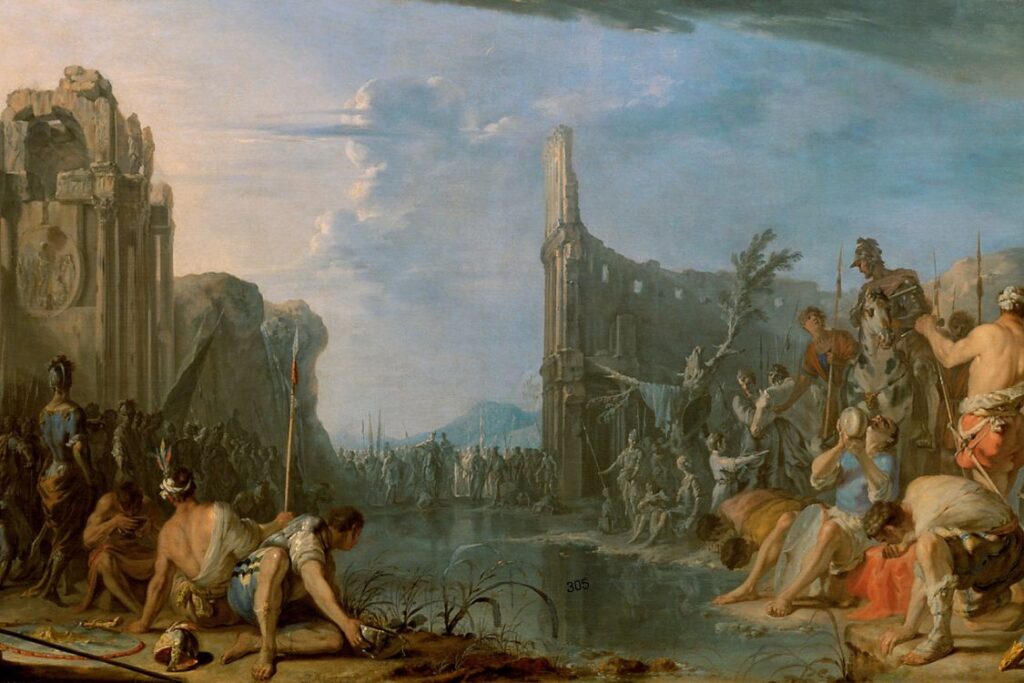
Gideon was trying to protect a small harvest when God called him to lead a nation. The story of Gideon in the Bible begins with a man hiding from his enemies, unsure how he could possibly help his people. His questions are easy to understand, especially for anyone who has faced a responsibility that seemed beyond their strength.
In Judges 6–8, Gideon leads Israel against Midian with an army reduced to just 300 men. Yet his story reaches beyond that remarkable victory.
Through his doubts, obedience, and later mistakes, we find both encouragement for uncertain times and a warning about the choices we make when those times have passed.
JUMP TO:
Who Was Gideon in the Bible?
Gideon was the son of Joash, from the tribe of Manasseh, and lived in Ophrah. He served as one of Israel’s judges, leaders whom God raised up to deliver His people during the years before Israel had kings.
At the beginning of his story, the Midianites had oppressed Israel for seven years. They invaded at harvest time, taking crops and livestock until the Israelites struggled to survive. Many sought shelter in caves and mountain strongholds, while Gideon threshed wheat in a winepress to keep it hidden.
Judges places this suffering within Israel’s repeated turn toward other gods. When the people cried out for help, God sent a prophet to remind them of His past deliverance and their failure to obey Him. Gideon’s calling followed that message.
Fear and questions run through these early scenes, which also connect with our collection of Bible verses about peace and anxiety.
The Story of Gideon Through Bible Verses
The account unfolds across Judges 6–8. These selected Bible verses about Gideon mark its main turning points, from his first questions to the consequences of his later choices.
Called While Still Afraid
The angel of the Lord found Gideon beating out wheat in a winepress and addressed him as a mighty man of valor. The greeting stood in sharp contrast to his situation, but Gideon’s first concern was his people’s suffering. If the Lord was with Israel, why had so much gone wrong?
When God told him to deliver Israel, Gideon raised another objection. He described his clan as the weakest in Manasseh and himself as the least in his father’s household. From his point of view, there was little reason to choose him.
God answered with a promise.
“And the LORD said to him, ‘But I will be with you, and you shall strike the Midianites as one man.Judges 6:16, ESV
The answer directed Gideon toward the One sending him. He was not asked to pretend that the enemy was small or that he felt ready for battle. His calling rested on God’s presence rather than his confidence.
For readers who feel unprepared, that distinction offers a more lasting comfort than praise alone. We may have real limits, but we can still take a responsible step without waiting to feel equal to every challenge ahead.
Peace Before the Battle
Gideon asked for a sign that the message truly came from God. He prepared an offering of meat and unleavened bread, which the angel instructed him to place on a rock. When the angel touched it with his staff, fire consumed the offering.
After the angel vanished, Gideon feared for his life because he had seen the angel of the Lord. God reassured him that he would not die.
But the LORD said to him, ‘Peace be to you. Do not fear; you shall not die.’Judges 6:23, ESV
Gideon then built an altar and named it The Lord Is Peace. The Midianites were still a threat, and the battle had yet to begin, so this moment of peace came before any change in Israel’s military position.
That order is worth noticing. Gideon received reassurance while the danger remained, which gives this scene a particular tenderness. People facing uncertainty often need strength for the next step long before they know how the larger situation will end.
Obedience Begins at Home
Before Gideon confronted Midian, God told him to tear down his father’s altar to Baal and cut down the Asherah beside it. He was then to build an altar to the Lord and offer a sacrifice.
Gideon obeyed with the help of ten servants, but he worked at night because he feared his family and the townspeople. Judges 6:27 openly records that fear, even as it records his obedience.
The next morning, the people demanded his death. His father, Joash, defended him by asking why they needed to defend Baal if Baal was truly a god. Gideon received the name Jerubbaal, connected with the challenge that Baal should contend for himself.
This part of the story gives courage a practical meaning. Gideon acted while afraid, and the action carried a real cost within his own community. His first task required him to address the worship practiced at home before leading others into battle.
Reassurance Through the Fleece
As enemy forces gathered, the Spirit of the Lord clothed Gideon, and he summoned men to join him. Even then, he asked for further reassurance through the signs of the fleece.
In Judges 6:36–40, Gideon placed wool on the threshing floor and asked that dew cover the fleece while the ground remained dry. God granted his request. Gideon then asked for the reverse, and the next morning the fleece was dry while dew covered the ground.
There were two fleece tests, both requested after God had already told Gideon what to do. This context helps us read the story carefully. Gideon was seeking confirmation of a promise he had received, rather than using random events to discover an unknown calling.
The passage reveals God’s patience with a hesitant man. It gives us reason to examine our own search for reassurance. Seeking wisdom can help us act well, but repeated demands for certainty may also delay a step we already know we should take.
An Army Reduced to 300
Gideon gathered 32,000 men, only to hear that his army was too large. God explained that Israel might claim the victory for itself and say:
The LORD said to Gideon, ‘The people with you are too many for me to give the Midianites into their hand, lest Israel boast over me, saying, “My own hand has saved me.”Judges 7:2, ESV
Gideon first allowed anyone who was afraid to leave, and 22,000 men returned home. God then reduced the remaining 10,000 through a test at the water, leaving just 300.
The account describes how the men drank, but it does not say that those selected were better trained or more alert. The reason given for reducing the army was to prevent Israel from taking credit for its own deliverance.
For Gideon, each reduction removed another reason to feel secure. Yet the promise had not changed with the numbers.
This scene challenges the habit of measuring every possibility by the resources we can count. It does not promise that smaller plans always succeed or that preparation is unnecessary. Within this particular calling, God made clear that Israel’s rescue would depend on Him.
Courage Before the Attack
Even after the army had been reduced, God acknowledged that Gideon might still be afraid. He told him to visit the enemy camp with his servant Purah and listen to what the soldiers were saying.
There, Gideon overheard a man describing a dream in which a loaf of barley bread struck a tent and overturned it. The man’s companion understood the dream as a sign that God had given Midian into Gideon’s hand.
According to Judges 7:15, Gideon responded by worshiping. He then returned to his own camp and prepared the men to act.
His confidence grew through reassurance, but fear had been present throughout the journey. Earlier acts of obedience had not removed every doubt. God continued to strengthen him as the next task approached.
You may recognize that pattern in less dramatic circumstances. Taking one brave step rarely settles every future worry, and needing encouragement again does not erase the progress already made.
Victory With Unlikely Weapons
Gideon divided the 300 men into three groups and gave each man a trumpet and an empty jar with a torch inside. At his signal, they blew the trumpets, broke the jars, and held up their lights around the enemy camp.
Judges 7:19–22 describes panic spreading through the opposing army. The Lord turned the soldiers’ swords against one another, and they fled while Gideon’s men held their positions.
The victory belongs at the center of the story because it fulfills the promise Gideon had struggled to trust. The man who had hidden his wheat now stood with a small force before an enormous enemy camp.
However, the campaign continued beyond that night. Other Israelites joined the pursuit, and Gideon called on Ephraim to seize the waters and crossings. The 300 played a decisive role, but they were not the only Israelites involved in the wider defeat of Midian.
A Troubling Turn Afterward
Judges 8 begins with Gideon calming the angry men of Ephraim, who felt excluded from the initial summons. He praised their contribution, and the dispute eased.
His dealings with Succoth and Penuel took a harsher course. When those towns refused food to his exhausted men during the pursuit, Gideon threatened punishment. After capturing the Midianite kings, he returned to carry out those threats, including killing the men of Penuel.
The chapter also reveals a personal motive in his treatment of the kings Zebah and Zalmunna. They had killed his brothers, and Gideon told them that he would have spared their lives if they had spared his family.
These events complicate the picture of a victorious leader. Readers can recognize his perseverance without treating every action as an example to follow. His courage in battle gives us no reason to overlook the severity of his retaliation.
Success Brings Another Test
After the victory, the Israelites asked Gideon to rule over them and establish a family line of rulers. He refused, telling them:
“I will not rule over you, and my son will not rule over you; the LORD will rule over you.”Judges 8:23, ESV
His answer directed their loyalty toward God, yet the decision that followed had damaging results. Gideon asked for gold from the spoils and used it to make an ephod, a religious object that he placed in Ophrah.
The people turned to it in unfaithful worship, and Judges describes it as:
“…And all Israel whored after it there, and it became a snare to Gideon and to his family.”Judges 8:27, ESV, excerpt
The warning is especially striking because Gideon had earlier destroyed his father’s altar to Baal. A man who helped confront false worship later made something that drew people into it.
Israel enjoyed forty years of rest during his lifetime, but peace did not remove the need for faithfulness. After Gideon died, the people again turned to the Baals and forgot the Lord who had delivered them.
What Can We Learn From Gideon?
Gideon’s life offers more than a lesson about overcoming fear. His story asks how we respond to a calling, where we place our trust, and whether success changes the way we treat others.
Courage Can Include Fear
Gideon’s fear appears at several points, including when he obeys the command to destroy Baal’s altar. This makes his courage easier to understand because it involves action rather than a fearless personality.
In daily life, courage may mean admitting a mistake, having a difficult conversation, or accepting a duty we would rather avoid. We can think carefully, seek support, and still feel nervous when the time comes to act.
The useful question is whether fear is guiding the decision more than wisdom and conviction. Gideon’s early obedience reminds us that we may be able to do what is right before we feel fully ready.
Reassurance Should Lead Somewhere
God repeatedly reassured Gideon, but the story eventually moved toward action. The signs served the calling he had received, and he still had to gather the men, approach the camp, and lead them.
There is room here for honest questions. Gideon did not hide his uncertainty behind confident language, and readers need not pretend that faith removes every concern.
At the same time, reassurance has a purpose beyond helping us feel better. Advice, prayer, and reflection can prepare us to take a sound next step. When we keep seeking confirmation without acting on what we have learned, it may help to ask what further certainty we expect to find.
Success Requires Continued Humility
Gideon’s greatest military success was followed by choices that harmed others and helped lead Israel astray. His story therefore challenges the idea that one faithful season secures the rest of a person’s life.
The danger can be ordinary and gradual. Someone who once welcomed guidance may resist it after gaining respect, while a leader praised for good work may begin to excuse behavior they would question in anyone else.
Past achievements deserve gratitude, but they cannot replace present judgment. Gideon’s later years encourage us to remain open to correction, especially when success makes correction harder to hear.
Faithful People Still Need Discernment
Hebrews 11:32 names Gideon among those remembered for faith. That recognition belongs alongside the account in Judges, including its difficult ending.
We do not have to choose between admiring his faith and acknowledging his failures. The Bible preserves both, allowing us to learn from a person without approving everything he did.
This is useful when considering any respected leader. A person may have served others well and still need correction or accountability. Gratitude for what was good should leave us able to speak honestly about what caused harm.
What Gideon’s Victory Leaves Us to Consider
The story of Gideon in the Bible begins with a man who sees little reason to trust his own strength. With God’s reassurance, he takes steps that once seemed beyond him and helps deliver Israel from years of oppression.
Yet the ending asks us to look beyond the moment of victory. The same man who needed courage in danger also needed humility when the danger had passed.
Gideon’s life gives hope to those of us who feel unready, while reminding us that faithfulness requires care through every season. We need courage when we are afraid, and humility when we finally feel strong.
Scripture quotations are from the ESV® Bible (The Holy Bible, English Standard Version®), © 2001 by Crossway, a publishing ministry of Good News Publishers. ESV Text Edition: 2025.
Leave a Reply