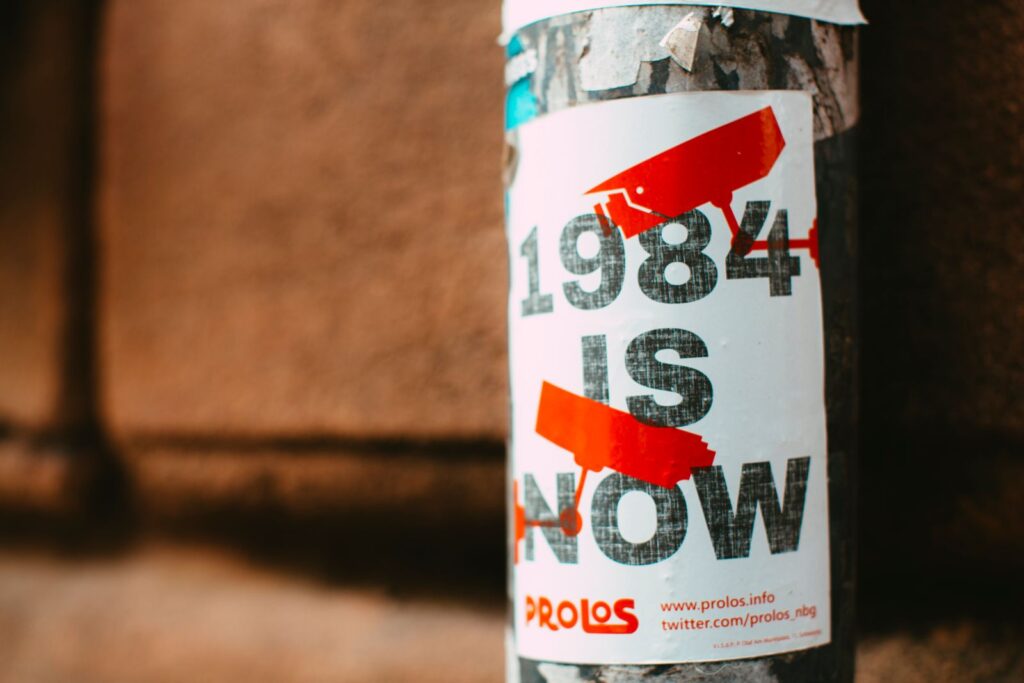
Is Big Brother real? George Orwell never gives a clean answer to who is Big Brother in 1984, and that uncertainty is not a hole in the plot. Oceania treats Big Brother as its supreme leader, yet nobody meets him, hears him speak in person, or watches him grow older.
He may once have been a real revolutionary, or the Party may have invented him entirely. Either way, he serves as the human face of a hidden political machine. Big Brother is difficult to overthrow because there may be no man behind the moustache at all.
JUMP TO:
- Who Is Big Brother in 1984?
- Is Big Brother a Real Person?
- If Big Brother Is Not Real, Who Rules Oceania?
- Why Does the Party Need Big Brother?
- How Big Brother Controls People Without Appearing
- Big Brother and Emmanuel Goldstein
- Was Big Brother Based on Stalin?
- What Does Big Brother Mean Today?
- Why Does Winston Love Big Brother at the End?
- Final Thoughts
Who Is Big Brother in 1984?
Big Brother is presented as the leader and protector of Oceania, the totalitarian state in which Winston Smith lives. His dark eyes, black hair, and heavy mustache appear on posters throughout London. Citizens also see his image on coins and telescreens.
Yet those images are almost all the citizens receive. Big Brother never enters a room, gives a live speech, or speaks privately with another character. Instead, the Party supplies stories about his heroic role in the Revolution, then revises those stories whenever political needs change.
Citizens must accept each version as if it had always been true.
The novel introduces him through one of the most recognizable quotes from George Orwell’s 1984.
“BIG BROTHER IS WATCHING YOU.”
Party poster described by the narrator, 1984, Part 1, Chapter 1
The sentence works as both a warning and a promise. Big Brother watches for disobedience, although the Party presents that attention as protection rather than intrusion. Even his name sounds reassuring because an older brother is supposed to look after you.
Orwell twists that familiar idea until care and control become difficult to separate.
Is Big Brother a Real Person?
Orwell deliberately leaves Big Brother’s physical existence unresolved.
Winston tries to remember when he first heard the name and thinks it may have been sometime in the 1960s. Official histories, however, place Big Brother at the heart of the Revolution much earlier. As the Party rewrites the past, his achievements stretch further backward until he appears to have guided Oceania from the start.
That inconsistency suggests he may have been invented later. However, it does not prove that no real person ever inspired the image. A revolutionary leader could have existed before the Party turned him into an ageless political symbol.
The clearest discussion occurs when Winston questions O’Brien during his imprisonment.
“Does Big Brother exist?”
“Of course he exists. The Party exists. Big Brother is the embodiment of the Party.”
Winston Smith and O’Brien, 1984, Part 3, Chapter 2
O’Brien avoids the ordinary meaning of Winston’s question. He does not say that Big Brother has a body or occupies an office somewhere in Oceania. Instead, he argues that Big Brother exists because the Party exists.
When Winston asks whether Big Brother exists in the same way he does, O’Brien replies that Winston does not exist. The answer is absurd by normal standards. Inside the Party’s logic, however, it is perfectly consistent. An individual has no recognized reality outside the state. Big Brother, as the state’s chosen image, is more real than any individual citizen.
If Big Brother Is Not Real, Who Rules Oceania?
The Inner Party controls Oceania. It operates the ministries, directs the Thought Police, and decides which version of history citizens must believe. O’Brien belongs to this ruling class, but Orwell never reveals him as the secret leader. He is powerful and frighteningly intelligent, though he still serves a system larger than himself.
This distinction is important because Oceania is not simply a dictatorship built around one man’s personality. Removing one official would not dismantle it. Authority is distributed through an institution whose members remain mostly hidden, while Big Brother absorbs public attention.
Citizens praise him for victories. They trust him during shortages and fear his judgment when they disobey. Meanwhile, the officials making decisions remain anonymous. If a policy fails, Big Brother cannot be questioned at a press conference. The records will show that he was right all along.
For a government allergic to accountability, that arrangement is rather useful.
Why Does the Party Need Big Brother?
A political organization can issue commands, but it is difficult to love a committee. Big Brother gives the Party a face toward which citizens can direct loyalty, gratitude, and fear.
The forbidden book attributed to Emmanuel Goldstein explains his function clearly.
“Big Brother is the guise in which the Party chooses to exhibit itself to the world.”
Goldstein’s book as read by Winston Smith, 1984, Part 2, Chapter 9
Later, O’Brien claims that he and other Party members wrote Goldstein’s book. Even so, its description of Big Brother remains revealing because he is the form the Party chooses to wear.
His mystery also protects him from the weaknesses that trouble ordinary rulers. A human leader can contradict himself or lose public confidence. Eventually, he dies. Big Brother avoids these problems because the Party can rewrite his previous statements whenever its position changes.
More importantly, he can never be voted out, exposed, or embarrassed. The Party can keep his face while replacing any number of officials behind it.
How Big Brother Controls People Without Appearing
Big Brother does not personally watch Winston. Telescreens, hidden microphones, patrols, informers, and the Thought Police perform the surveillance.
Still, his image makes that machinery feel personal. Citizens never know exactly when someone is watching, so they must behave as if surveillance is constant. A doubtful expression during the Two Minutes Hate could attract suspicion, while talking in one’s sleep may lead to arrest. Even spending too much time alone can appear dangerous.
Eventually, people monitor themselves. They control their voices and facial expressions before the Thought Police need to intervene. Children also watch their parents, while neighbors notice one another’s behavior. Surveillance spreads through the population.
This system is more efficient than placing a guard in every room. The state only needs citizens to believe that someone could be listening at any moment. Big Brother’s greatest power, therefore, is not observation itself but the uncertainty that changes how people act when nobody appears to be watching.
Big Brother and Emmanuel Goldstein
The Party gives Oceania one figure to love and another to hate. Big Brother is presented as the protector, while Emmanuel Goldstein is blamed for threatening the nation from the shadows.
During the Two Minutes Hate, citizens direct their anger at Goldstein’s face on the telescreen. Then Big Brother appears, shifting the crowd from rage to devotion. Both emotions strengthen the Party.
Like Big Brother, Goldstein may not exist as the government describes him. Perhaps he was a real revolutionary who later opposed the Party. He could also be a fictional enemy created to attract unhappy citizens and expose them before they organize genuine resistance.
The Party may therefore control both sides of the political story. It supplies the hero and provides the villain, allowing citizens to choose between them even though one choice leads directly to the Ministry of Love.
Was Big Brother Based on Stalin?
Big Brother strongly resembles the public image of Joseph Stalin. Both have dark moustaches, while the Party’s altered histories recall the personality cult and propaganda surrounding Stalin’s rule.
However, Big Brother should not be treated as a fictional portrait of only one dictator. Orwell drew from a wider history of authoritarian politics, including regimes that built carefully managed images around their leaders while concealing political violence.
The Orwell Foundation’s introduction to Nineteen Eighty-Four describes Big Brother as the Party’s symbolic head. It also places the novel within Orwell’s broader warning about authoritarianism, political lies, and the destruction of independent thought.
Stalin may be the clearest visual influence. However, Orwell created a figure who could outlive one government or historical period.
What Does Big Brother Mean Today?
Today, “Big Brother” describes intrusive surveillance by a government, employer, corporation, or other powerful institution. The phrase often appears when technology collects information without people fully understanding when, why, or how it will be used.
For example, workplace monitoring software can record activity, capture screenshots, or measure how long an employee spends on particular tasks. Monitoring may serve legitimate security or productivity needs. However, it can also affect behavior when workers feel they must constantly prove that they are active. The UK Information Commissioner’s Office has issued guidance on monitoring workers, emphasizing transparency and data-protection rights.
Mobile phones provide another example. Location information collected through apps can reveal where someone lives, works, worships, or receives medical care. In 2026, the US Federal Trade Commission moved to restrict a data broker from selling or sharing sensitive location data from mobile devices without affirmative consent.
Facial recognition adds a different concern. Cameras may record a public space, while software compares a face with enormous image databases. The person being scanned may never know that the comparison occurred.
These examples are not identical to Oceania, and treating every security camera as proof that Orwell’s fictional world has arrived would flatten an important distinction. Modern surveillance can have lawful and useful purposes. Many societies also provide legal challenges, public debate, and some degree of oversight, while Winston has none of those protections.
The comparison lies elsewhere. Orwell understood that surveillance changes behavior even when nobody is visibly issuing commands. A person who thinks every movement might be recorded may gradually avoid anything that could look unusual. At that point, the watcher no longer needs to speak.
Why Does Winston Love Big Brother at the End?
Winston’s final love for Big Brother is not forgiveness or political agreement. It is evidence that the Party has destroyed the private part of him that once resisted.
At first, Winston believes the state cannot control his inner loyalty. It can force him to speak, but it cannot make him stop loving Julia or accepting that two plus two equals four.
Room 101 proves him wrong. When confronted with his worst fear, Winston begs the Party to torture Julia instead. His betrayal destroys the emotional bond he hoped to protect, leaving little within him for the Party to compete with.
The novel closes with four devastating words.
“He loved Big Brother.”
Narrator, 1984, Part 3, Chapter 6
Winston does not merely obey. He accepts the Party’s version of reality and directs his remaining emotion toward its chosen image. Big Brother wins without ever stepping onto the page.
Final Thoughts
Big Brother may have been a revolutionary leader, a Party invention, or an image adapted from someone long forgotten. Orwell refuses to settle the matter because the answer would not change how power works in Oceania.
This is is why he remains relevant. Modern surveillance rarely arrives as a moustached dictator staring from every wall. It may appear as a convenient app that quietly collects location information or a workplace dashboard that records activity throughout the day.
The technology has changed, but Orwell’s question has not. How freely do people behave once they suspect that someone, somewhere, may always be watching?
Leave a Reply