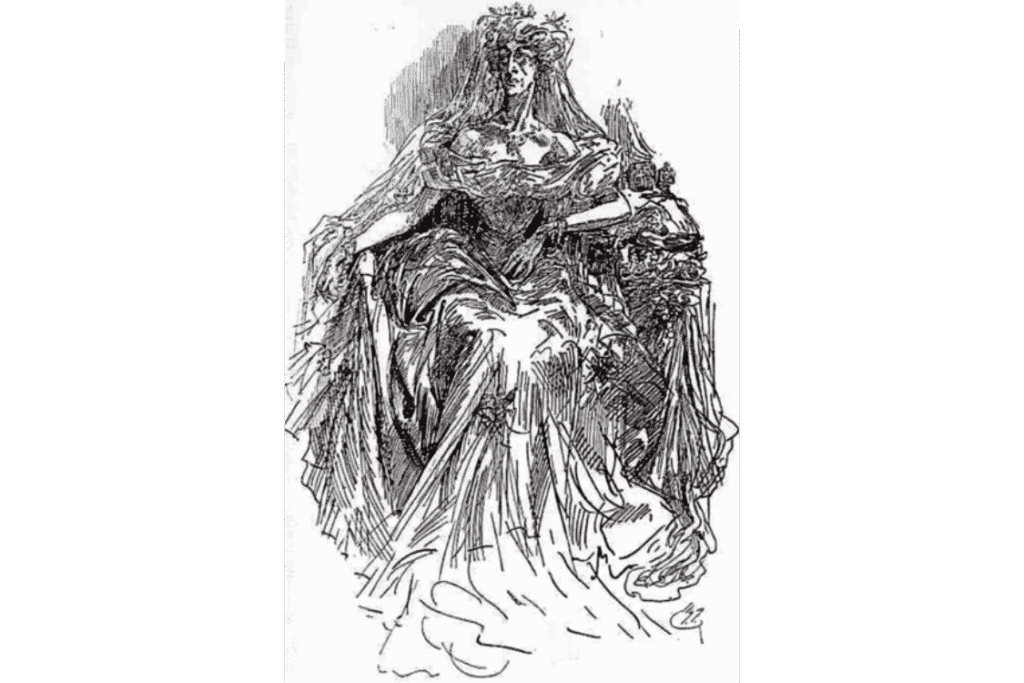
Miss Havisham wants revenge because Compeyson deceives her and abandons her on their wedding day. In Great Expectations, she turns that betrayal into a grievance against men, raising Estella to attract their love while withholding affection. Pip becomes one of the people who suffer for a wrong they never committed.
However, her motives become more complicated as Dickens reveals the difference between what she intended and what she actually did. Through Miss Havisham’s quotes and her exchanges with Pip and Estella, we see how a wish for protection becomes a habit of cruelty, followed by a painful recognition of its consequences.
Spoilers follow for Miss Havisham’s story in Great Expectations.
JUMP TO:
What Happened to Miss Havisham?
Before Pip meets her, Miss Havisham has already suffered the betrayal that will shape the rest of her life. Compeyson courts her for financial gain, takes advantage of her devotion, and sends a letter breaking off their marriage on the wedding morning.
She withdraws into Satis House, stays in her bridal clothes, and stops the clocks at twenty minutes to nine. Her wedding preparations become her permanent surroundings, even as the dress and feast continue to decay. She can stop the clocks, but she cannot persuade the mice to respect the occasion.
A Life Left Waiting
During Pip’s first visit, she makes her suffering part of their introduction.
“Look at me,” said Miss Havisham. “You are not afraid of a woman who has never seen the sun since you were born?”
Miss Havisham, Great Expectations, Chapter 8
The question places years of isolation before a child who barely knows how to behave in her presence. Soon afterward, she directs his attention to her heart and declares it broken.
Nevertheless, the decaying room tells us more than the fact that she is unhappy. By keeping everything connected to the wedding around her, she repeatedly returns to the moment of betrayal. Her wealth gives her the means to maintain that isolation and, eventually, to involve other people in it.
Our collection of Great Expectations book quotes follows the novel’s wider concerns with love, ambition, and mistaken expectations. Miss Havisham’s household brings all three together, with particularly unhappy results for its youngest visitors.
Why Does Miss Havisham Want Revenge on Men?
Miss Havisham extends her anger at Compeyson to men who had nothing to do with his deception. Through Estella, she can watch someone else occupy the position she once held: loving intensely while receiving cruelty in return.
That reversal gives her a form of power. Although she cannot change what Compeyson did, she can encourage Estella to make other men feel helpless.
A Heartbreak Passed On
In Chapter 12, Pip describes Miss Havisham embracing Estella and murmuring something that sounds like:
Break their hearts my pride and hope, break their hearts and have no mercy!
Miss Havisham, as recalled by Pip, Great Expectations, Chapter 12
Pip qualifies what he hears, so the passage should retain that distinction. Even so, the instruction fits the behaviour he witnesses throughout his visits.
The plural “hearts” reveals how widely her revenge has spread. No particular man needs to deserve punishment, because being vulnerable to Estella is enough to make him a target.
Meanwhile, calling Estella her “pride and hope” ties parental approval to the girl’s ability to hurt others. Cruelty becomes something that earns affection from the person raising her.
Dickens therefore gives us a reason for Miss Havisham’s resentment without making it a justification. Compeyson’s betrayal explains her anger, but Pip’s innocence exposes the injustice of what she does with it.
Why Does She Encourage Pip to Love Estella?
Miss Havisham encourages Pip’s attachment because his devotion gives Estella an opportunity to practise the emotional power she has been taught to exercise. His increasing hope also allows Miss Havisham to observe a familiar kind of suffering from a position of control.
As Pip grows older, he mistakenly believes that she is his secret benefactor and intends him to marry Estella. She allows that belief to continue, although she has made no such arrangement.
Love as Self-Surrender
Her advice in Chapter 29 makes the danger especially clear:
Love her, love her, love her! If she favours you, love her. If she wounds you, love her. If she tears your heart to pieces,—and as it gets older and stronger it will tear deeper,—love her, love her, love her!
Miss Havisham, Great Expectations, Chapter 29
The repeated command leaves no room for Pip to consider whether the relationship is good for him. Affection and injury lead to exactly the same instruction.
She then describes love in terms of humiliation and submission, ending with the admission that this is how she loved. Her own experience has become the model she urges Pip to repeat.
Although the speech uses the language of devotion, its context makes it disturbing. Readers can find the exchange in Dickens’s original text of Great Expectations, where Pip observes that her insistence sounds like a curse.
Pip contributes to his own misunderstanding by dismissing Estella’s warnings and imagining a future she has not promised. However, his willingness to believe does not excuse an adult who recognises his hopes and deliberately encourages them.
For a closer look at that imbalance, our discussion of Pip and Estella’s relationship explores why his devotion survives so much evidence against it.
Did Miss Havisham Mean to Protect Estella?
According to Miss Havisham’s later account, she initially wanted to protect Estella from suffering as she had. However, she gradually began treating the girl’s beauty as an opportunity for revenge.
This distinction matters because it shows a change in her purpose. Protection may have been her starting point, but it does not adequately describe the upbringing she eventually provides.
Protection Becomes Control
When she speaks to Pip in Chapter 49, she appeals to him to believe her original intention:
My dear! Believe this: when she first came to me, I meant to save her from misery like my own. At first, I meant no more.
Miss Havisham, Great Expectations, Chapter 49
The phrase “at first” carries much of the confession. Miss Havisham herself recognises that her motives changed, while her plea to be believed reminds us that this is a retrospective explanation.
Pip responds cautiously rather than accepting it without question. By this stage, good intentions offer limited comfort to anyone who has experienced the results.
Miss Havisham then explains how she used praise, jewels, and teaching to shape Estella’s behaviour. Her wedding clothes and ruined surroundings supplied a constant warning about what loving someone might cost.
She summarises the result in a devastating admission:
I stole her heart away, and put ice in its place.
Miss Havisham, Great Expectations, Chapter 49
“Stole” acknowledges responsibility. Miss Havisham no longer describes Estella’s coldness as an admirable defence against danger, but as a deprivation she helped create.
The difference between preparing a child for disappointment and discouraging her capacity for affection is enormous. Miss Havisham pursues safety so completely that she limits the very experiences that could give Estella a fulfilling life.
Estella Answers Her Teacher
Earlier, in Chapter 38, Estella has already confronted her with the consequences:
I am what you have made me. Take all the praise, take all the blame; take all the success, take all the failure; in short, take me.
Estella to Miss Havisham, Great Expectations, Chapter 38
Miss Havisham wants warmth from the person she has trained to withhold it. Estella’s answer refuses that convenient exception.
The balanced pairs of “praise” and “blame,” “success” and “failure” expose the contradiction. Miss Havisham cannot celebrate Estella’s emotional distance when it hurts men and disown the same quality when it hurts her.
Nevertheless, Estella remains more than a passive extension of her adoptive mother. She makes choices of her own, including marrying Bentley Drummle. In Chapter 44, she explicitly tells Pip that Miss Havisham would have preferred her to wait.
Her upbringing helps explain her decisions, but Dickens does not present Miss Havisham as the director of every action she takes.
Why Does Miss Havisham Ask Pip for Forgiveness?
Miss Havisham asks for forgiveness after recognizing her own former anguish in Pip’s suffering. When she witnesses his distress over Estella, the resemblance makes it harder to treat his heartbreak as a satisfying outcome.
Previously, she has understood betrayal primarily through what happened to her. Now she must consider what she has helped inflict on someone else.
Recognising Her Own Pain
She explains the change directly:
Until you spoke to her the other day, and until I saw in you a looking-glass that showed me what I once felt myself, I did not know what I had done. What have I done! What have I done!
Miss Havisham, Great Expectations, Chapter 49
The “looking-glass” is a powerful image because Pip reflects something she already knows intimately. His pain becomes recognizable as the same kind of pain she has spent years preserving.
However, her claim that she did not know what she had done needs careful reading. She has plainly encouraged heartbreak before this moment. What changes is her willingness to recognize its human cost.
For once, another person’s experience interrupts her account of her own suffering. That recognition makes remorse possible, although it arrives after considerable damage.
Regret Requires Something More
Miss Havisham’s repeated cries risk keeping attention fixed on her distress. Pip directs her toward Estella, urging her to repair whatever she can instead of spending another lifetime mourning the past.
This is an important limit on the scene’s sympathy. Feeling terrible about an injury does not, by itself, help the person who received it.
Nevertheless, Miss Havisham does take a practical step by authorising £900 to complete Pip’s arrangement for Herbert’s business partnership. Her money finally supports a useful future without requiring someone to participate in her revenge.
The gift does not restore Estella’s childhood or repay Pip’s emotional losses. However, it shows that her change involves an action as well as an appeal for forgiveness.
Does Dickens Redeem Miss Havisham?
Dickens gives Miss Havisham remorse, compassion, and an opportunity to do good, while leaving the consequences of her behaviour visible. Pip forgives her, but his forgiveness does not settle every question about what she owes Estella.
Her change begins before the fire that severely burns her. This sequence matters because her moral recognition does not depend on treating physical suffering as a payment for wrongdoing.
By the time her dress catches fire, she has already confessed her responsibility and asked for mercy. Pip’s attempt to save her also demonstrates that he can respond to her vulnerability without repeating her habit of retaliation.
Still, her story offers no complete restoration. Estella must live with the effects of her upbringing, and Pip must reconsider the future he built around her.
Miss Havisham becomes capable of recognizing another person’s pain, which is a meaningful change. Whether that amounts to redemption depends partly on whether we expect redemption to include repair, forgiveness, or both.
What Her Revenge Leaves Behind
Miss Havisham wants revenge because she cannot undo Compeyson’s betrayal and comes to believe that making others suffer will answer it. Through Estella, she gains the power to cause heartbreak, but that power gives her neither the affection she wants nor the peace she has lost.
Her eventual remorse matters because she finally accepts that suffering does not make every later action understandable on her terms. Pip and Estella have lives beyond the roles she assigned them.
The question Dickens leaves us with is therefore larger than whether we can pity her. When we recognize our own hurt in someone else, do we use that knowledge to protect them—or to make sure they understand how it felt?
Leave a Reply