
Empathy seems like one of those qualities you can never have too much of. On one hand, suicidal empathy is Gad Saad’s term for compassion that, in his view, becomes harmful when emotion overrides evidence, limits, consequences, or the needs of other people.
Saad applies the idea to immigration, cultural relativism, crime, homelessness, gender policy, and some Western responses to Islam. The term is his own framework, not a recognized psychological diagnosis. Many of his political examples also remain open to debate.
So, what exactly does he mean?
JUMP TO:
- What Does Suicidal Empathy Mean?
- Why Immigration Is One of Saad’s Main Examples
- Why Saad Talks About Islam and Cultural Relativism
- The British Grooming-Gang Scandals
- Crime and the Question of Who Gets Empathy
- Homelessness Creates the Same Conflict
- What Is Adaptive Empathy?
- Gender Policy and Competing Ideas of Fairness
- How This Connects to The Parasitic Mind
- Is Suicidal Empathy a Scientific Term?
- Where Critics Push Back
- Reason and Emotion Do Not Have to Be Enemies
- Final Thoughts
What Does Suicidal Empathy Mean?
Saad does not argue that empathy itself is bad. In fact, he starts from the opposite position.
“Empathy is a perfectly adaptive virtue.”
— Gad Saad, John Anderson Media interview
His concern begins when empathy loses its limits.
Too little empathy or no empathy makes you a psychopath. Too much empathy at the wrong opportunity to the wrong targets can result in a manifestation of suicidal empathy.
Gad Saad, John Anderson Media interview
A personal example makes the idea easier to see.
Imagine someone you love keeps asking to borrow money. You know they are struggling, so you keep helping. Then you learn they are gambling the money away. Giving them another loan may feel kind tonight. It may also make their problem worse next month.
Saad applies the same idea to public policy. Compassion should influence decisions, he argues, but it should not stop us from asking what those decisions will cause.
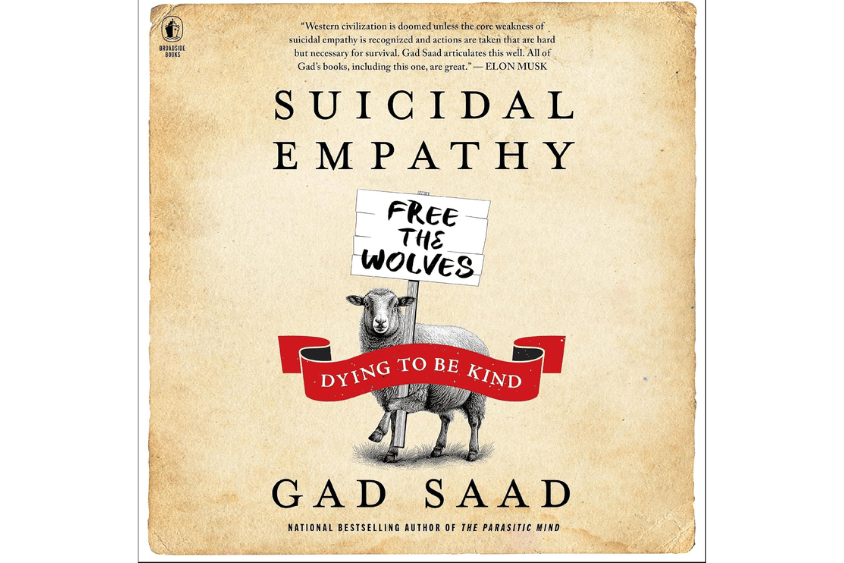
He develops this argument in Suicidal Empathy: Dying to Be Kind. Our collection of suicidal empathy quotes also explores his views on compassion, truth, and consequences.
The question at the center of his argument is simple: Can a compassionate choice still cause harm?
Why Immigration Is One of Saad’s Main Examples
Immigration gives Saad one of his clearest examples because it puts compassion and national responsibility side by side.
He understands why countries want to welcome refugees and migrants looking for safety or a better life. His own family fled Lebanon during the civil war and later settled in Canada. Still, he argues that compassion should not end the discussion.
Governments also have to think about security, housing, public services, integration, and the values newcomers bring with them.
In his interview with John Anderson, Saad says:
“Immigrants might be equal under the law, but they’re not equally likely to assimilate…”
— Gad Saad, John Anderson Media interview
This is Saad’s argument. It should not become a rule for judging individual immigrants.
Two people from the same country can have very different beliefs, education, politics, religious views, and attitudes toward their new home. No passport can tell us exactly how a person will behave.
Still, the policy question is real.
Imagine a country accepts a large number of refugees during a humanitarian crisis. Helping people in danger is a worthy goal. Yet the government still needs housing, schools, jobs, language programs, security checks, and local services.
What happens when those systems cannot keep up?
Saad argues that empathy starts to misfire when leaders treat questions about capacity or integration as morally unacceptable.
People can disagree about where immigration limits should fall. Compassion alone, however, cannot answer every question about how an immigration system should work.
Why Saad Talks About Islam and Cultural Relativism
Saad also links suicidal empathy to cultural relativism, especially when he discusses Islam and immigration from Muslim-majority countries.
His argument goes beyond immigration numbers. He believes Western societies sometimes hesitate to criticize certain beliefs or practices because they fear appearing intolerant.
Cultural relativism renders you impotent to making value judgments about the beliefs and actions of another culture.
Gad Saad, John Anderson Media interview
Saad points to female genital mutilation, child marriage, and honor killings as examples. He argues that Western societies should condemn such practices even when they have cultural or religious roots.
This part of his argument needs an important distinction. Islam includes many cultures, traditions, political views, and interpretations. Islam, political Islam, extremist movements, and individual Muslims are not the same thing.
Nor should harmful practices become shorthand for almost two billion Muslims around the world.
Saad’s argument works better when we focus on specific beliefs and actions rather than entire groups. Suppose a practice violates a child’s safety or another person’s basic rights. Should fear of appearing intolerant stop a society from criticizing it?
Saad says no.
A society can reject a harmful practice without treating everyone from the same religion or culture as responsible for it.
The British Grooming-Gang Scandals
Saad points to Britain’s grooming-gang scandals as one of his strongest examples of misplaced empathy.
He argues that some officials worried so much about being accused of racism or harming community relations that they failed to act firmly enough against abuse.
His focus here is on the victims:
Part of survival is that we have evolved this mechanism to defend the most vulnerable members of our society. They’re called our children.
Gad Saad, John Anderson Media interview
The issue deserves careful wording because political debate has often pushed the facts in different directions.
A 2025 UK government audit of group-based child sexual exploitation found serious failures in the way institutions protected victims and collected information about offenders.
The audit found evidence of disproportionate offending by Asian men in some local areas. At the same time, it warned that national ethnicity data remains too poor to draw firm conclusions about perpetrators across the whole country.
Both points matter.
Institutions failed vulnerable girls in serious ways. Yet incomplete national evidence should not become a reason to judge an entire ethnic or religious group.
For Saad, the larger question concerns priorities. If fear of social tension stops authorities from investigating credible abuse, he sees that as compassion pointed in the wrong direction.
Crime and the Question of Who Gets Empathy
Saad makes a similar argument about criminal justice.
Someone who commits a serious crime may have experienced poverty, addiction, trauma, neglect, or mental illness. Understanding those factors can help explain behavior. It can also help prevent future crimes.
But Saad argues that sympathy for an offender should not push the victim out of the picture. He describes suicidal empathy as directing more concern toward the rapist than the victim.
The wording is harsh on purpose.
His point is not that rehabilitation has no value. Instead, he asks what happens when understanding the person who caused harm becomes more important than protecting the person who suffered it.
A justice system can care about rehabilitation and victims at the same time. The difficult part is finding the balance.
Homelessness Creates the Same Conflict
Saad also uses homelessness and public drug use as examples.
Imagine a city allows open drug use in a public park because officials do not want to punish people struggling with addiction.
The policy may begin with compassion. But families may stop using the park. Nearby residents may feel unsafe. Meanwhile, people with serious addictions may remain on the street without effective treatment.
Who deserves empathy?
The person living outdoors clearly does. So does the parent who wants a safe place for a child to play.
This is one reason Saad’s idea attracts attention. Empathy often has more than one possible target. And a serious policy needs to see all of them.
Compassion for people experiencing homelessness should not mean ignoring public safety. Likewise, concern about public safety should not erase the dignity of someone who needs housing, treatment, or mental health support.
What Is Adaptive Empathy?
Saad contrasts suicidal empathy with what he calls adaptive empathy.
Empathy, when it is applied in the right amount, in the right situation, to the right targets… that is adaptive empathy.
Gad Saad, John Anderson Media interview
This distinction helps clarify his argument. A parent comforting a frightened child shows empathy. So does a doctor listening to a patient or neighbors helping a family after a disaster.
Saad does not object to any of those things. His criticism begins when emotion prevents people from looking at evidence, trade-offs, or the needs of others.
Public policy makes this harder because one decision can affect thousands or even millions of people.
So the question changes. Instead of asking only, “Should we care?” We also have to ask, “What will happen if we act on that feeling?”
Gender Policy and Competing Ideas of Fairness
Saad also applies his argument to debates about sex and gender, including women’s sports.
He accepts that transgender people should live with dignity and without bigotry. However, he argues that concern for transgender athletes does not automatically settle questions about fairness in female competition.
People who support broader transgender inclusion may weigh those interests differently. They often focus on equal participation, dignity, and protection from discrimination.
Both positions make an appeal to fairness.
This shows why public policy becomes difficult when empathy points in different directions. One person may focus on a transgender athlete who wants to compete. Another may focus on female athletes who believe biological differences affect fair competition.
Calling one side compassionate and the other cruel does not answer the underlying policy question. It simply avoids it.
How This Connects to The Parasitic Mind
Saad’s earlier book The Parasitic Mind helps explain where he thinks suicidal empathy begins. He argues that certain ideas can become difficult to question because challenging them carries a social or professional cost.
Suicidal Empathy takes the argument one step further. It asks what happens when emotional pressure joins that pressure to conform.
Our collection of The Parasitic Mind quotes looks more closely at his views on truth, political correctness, ideological conformity, and what he calls “idea pathogens.”
The connection between the books is fairly simple. One focuses on ideas Saad believes can distort reasoning, while the other focuses on compassion that he believes can distort judgment.
Is Suicidal Empathy a Scientific Term?
No. At least, not in the sense of an established psychological diagnosis. Saad uses “suicidal empathy” as a framework for describing what he sees as harmful or badly directed empathy.
He has also brought the concept into his academic work. In 2026, Theory and Society published his theoretical paper on parasitic ideas, suicidal empathy, and the social sciences. Readers can see the paper through Springer Nature.
However, publication in an academic journal does not mean psychologists have accepted suicidal empathy as a standard diagnosis or proven theory. It remains Saad’s framework.
Readers can study it, challenge it, and compare it with the evidence without treating the term as settled science.
Where Critics Push Back
The phrase itself creates one obvious problem. Calling empathy “suicidal” makes a policy sound disastrous before anyone has shown that it actually is.
Saad also relies on dramatic examples. Those examples can reveal real failures, but they can also encourage broad conclusions.
One extremist does not represent every immigrant. A grooming gang does not represent every Muslim. One failed homelessness policy does not prove that helping homeless people causes harm. Other causes can also disappear if we blame every bad result on too much empathy.
Housing shortages, weak policing, addiction, poor government planning, poverty, failed integration programs, and bad incentives can all contribute to social problems.
Still, critics do not completely erase Saad’s central question. Good intentions can produce bad outcomes.
A useful standard should therefore work both ways.
Compassion should not stop us from discussing real risks. Fear should not turn individual cases into assumptions about entire populations either.
Reason and Emotion Do Not Have to Be Enemies
One of Saad’s most useful comments in the John Anderson interview actually places a limit on his argument.
It’s not that reason is always better than emotions. It’s that you need to deploy the right system for the right occasion.
Gad Saad, John Anderson Media interview
Fear can warn us about danger. Compassion can push us to help someone in pain. Anger can tell us when something feels deeply unfair. We need those emotions.
But a national policy cannot depend only on whichever story creates the strongest emotional response. Governments also need evidence, planning, trade-offs, and a clear view of who gains and who bears the costs.
Perhaps the most useful version of Saad’s argument is not to care less, but to care carefully.
Final Thoughts
Suicidal empathy is Gad Saad’s term for compassion that becomes harmful when it loses sight of evidence, consequences, limits, or competing needs. He applies the idea to immigration, cultural relativism, Islam, crime, homelessness, gender policy, and other debates where empathy can point in more than one direction.
Some of his examples are provocative, and many of his conclusions remain open to debate. Yet the question behind the phrase is worth considering.
When helping one person creates serious costs for someone else, how should we decide where empathy should lead us and where judgment needs to step in?
Leave a Reply