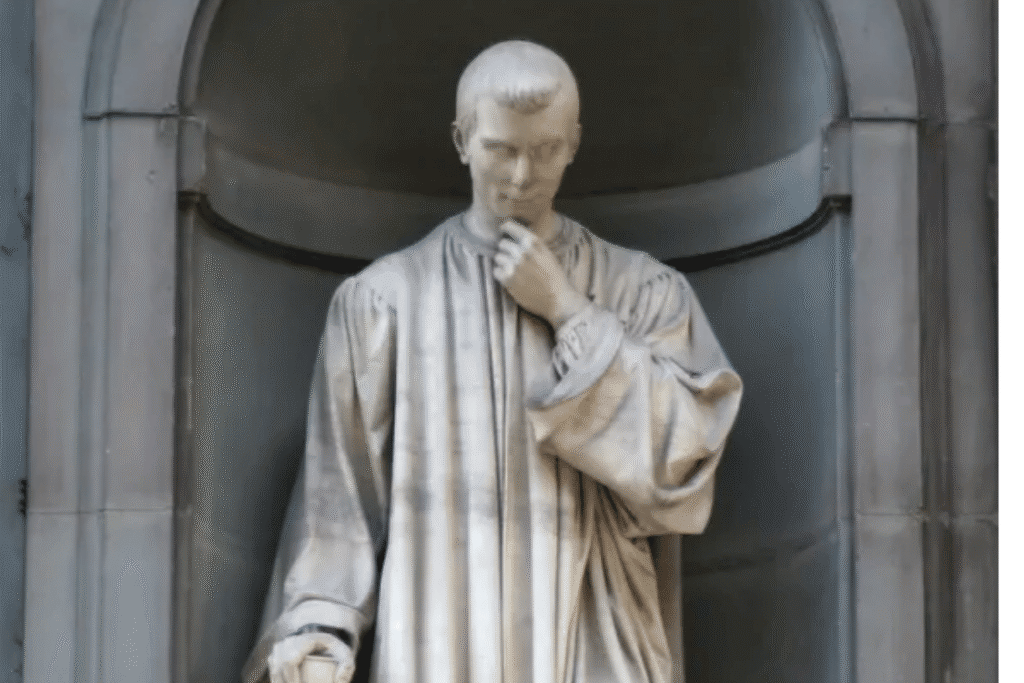
“The ends justify the means” is one of the sayings most closely linked to Niccolò Machiavelli. But Machiavelli never wrote those exact words. Several arguments in The Prince still explain why the phrase became attached to him.
His real position was more specific than the familiar slogan suggests. He believed rulers might need to choose dishonest, cruel, or immoral actions to protect the state. He did not argue that any goal could excuse any behavior.
- Did Machiavelli Say “The Ends Justify the Means”?
- What Did Machiavelli Actually Write?
- Why Was the Saying Attributed to Machiavelli?
- Did Machiavelli Believe Any Means Were Justified?
- What Does “The Ends Justify the Means” Mean Today?
- Is It “The Ends Justify the Means” or “The Means Justify the Ends”?
- Who Really Said “The Ends Justify the Means”?
- Final Thoughts
Did Machiavelli Say “The Ends Justify the Means”?
No, Machiavelli did not write the exact sentence “the ends justify the means” in The Prince or his other major works. The familiar expression is a later summary of his ideas.
However, the connection is not baseless. Machiavelli asks whether people should judge rulers by normal moral standards or by political results. In his view, leaders who always act morally may lose power, endanger the state, or allow greater disorder to spread.
The phrase turns that complex argument into one memorable line. It captures part of Machiavelli’s thinking but removes the limits that make his ideas more interesting.
For a broader look at his views on leadership, reputation, and political survival, explore these Machiavelli quotes on power.
What Did Machiavelli Actually Write?
The closest ideas appear in Chapters 15, 17, and 18 of The Prince. A similar argument appears in Book I, Chapter 9 of Discourses on Livy.
Together, these passages show that Machiavelli cared about necessity, results, reputation, and political survival.
Survival Before Moral Perfection
In Chapter 15 of The Prince, Machiavelli compares how people should behave with how political life actually works.
A ruler may face ambitious rivals, foreign enemies, and unreliable allies. Machiavelli makes his advice clear:
It is necessary for a prince … to learn how not to be good.
Niccolò Machiavelli, The Prince, Chapter 15
He is not telling rulers to be evil. His point is that moral goodness can become dangerous when opponents do not follow the same rules. A leader should still value honesty, mercy, and generosity.
Mercy Can Cause Harm
In Chapter 17, Machiavelli argues that limited severity may sometimes prevent greater violence. Punishing a few people could cause less suffering than allowing crime, conflict, or rebellion to grow.
That does not make cruelty automatically good. Machiavelli warns that a ruler must avoid becoming hated. Excessive or repeated violence creates instability instead of solving it.
The real question is what an action produces. Does it restore order or deepen resentment? Does it protect the community or only the ruler?
Reputation Follows Results
Chapter 18 comes closest to the modern meaning of “the ends justify the means.”
Machiavelli says a ruler may need the strength of a lion and the cunning of a fox. The lion offers force, while the fox recognizes traps. Political survival requires both.
He also argues that rulers cannot always keep their promises. Circumstances may change, or the other side may act dishonestly. A leader who remains too trusting becomes vulnerable.
Near the end of the chapter, Machiavelli observes that people often judge rulers by what they achieve:
Let a prince have the credit of conquering and holding his state, the means will always be considered honest.
Niccolò Machiavelli, The Prince, Chapter 18
People often praise successful rulers even when their methods seem questionable. The same actions may draw harsh criticism if they fail. Machiavelli describes political judgment, not a moral rule for every part of life.
Results Can Excuse Acts
An even closer statement appears in Book I, Chapter 9 of Discourses on Livy.
While discussing Romulus and the founding of Rome, Machiavelli writes:
When the act accuses him, the result should excuse him.
Niccolò Machiavelli, Discourses on Livy, Book I, Chapter 9
On its own, that sentence sounds much like “the ends justify the means.” However, the next lines add a limit. Machiavelli separates destructive violence from violence used to create order.
Readers may not accept that distinction. Still, Machiavelli did not offer a limitless excuse for selfish or destructive acts. Purpose and results both mattered.
Why Was the Saying Attributed to Machiavelli?
The phrase became attached to Machiavelli because it sums up his reputation as a political realist.
Instead of describing how perfect rulers should behave, he studied how power worked in Renaissance Italy. Alliances changed, governments fell, and leaders often used force or deception. Advice based only on ideal behavior would have seemed incomplete in that world.
Machiavelli’s willingness to discuss these harsh realities made The Prince notorious. His name later produced the word “Machiavellian,” which often describes someone who uses cunning or deception for personal gain.
That popular image tells only part of the story. The Stanford Encyclopedia of Philosophy explains his thought through its focus on power, conflict, necessity, and the demands of government.
The saying survived because it turns those complex ideas into an easy sentence. However, it also makes Machiavelli sound more extreme than he was.
Did Machiavelli Believe Any Means Were Justified?
No. Machiavelli did not argue that every goal makes every action acceptable.
The ends he studied were political rather than personal. He focused on protecting the state, preventing disorder, resisting foreign threats, and building strong institutions. Even then, rulers faced practical limits.
Cruelty that creates hatred can weaken a government. Deception that destroys trust can prevent future cooperation. Needless violence can create new enemies. A ruler who cannot keep power has failed by Machiavelli’s standards.
This is also why his claim that it is better to be feared than loved is often misunderstood. Machiavelli does not praise cruelty for its own sake. He advises rulers to avoid hatred, protect people’s property, and use severity with care.
His longer work on Roman government reveals more of these limits. Our guide to Machiavelli’s Discourses on Livy explores his support for laws, civic life, public liberty, and strong institutions. These systems could help control the ambitions of powerful people.
Reducing his argument to “anything is acceptable if you win” leaves out these important limits.
What Does “The Ends Justify the Means” Mean Today?
Today, “the ends justify the means” suggests that a worthy goal can excuse the methods used to reach it. The “end” is the result, while the “means” are the actions.
Someone might use the phrase to defend lying or breaking rules to expose wrongdoing. It may also support harsh action meant to prevent greater harm. The debate is whether a good result can excuse a questionable act.
The ethical problem goes beyond Machiavelli. Good intentions do not promise good results, and success does not erase every cost.
Methods can also damage the goal. A movement seeking justice may weaken its cause through injustice. A leader seeking stability may create disorder by destroying trust.
Machiavelli forces readers to take results seriously. But we must also ask who benefits, who pays the price, and whether less harmful choices were available. Was the goal worth pursuing at all?
Is It “The Ends Justify the Means” or “The Means Justify the Ends”?
The familiar expression is “the ends justify the means.”
“The means justify the ends” reverses the saying. It is usually a mistake or a deliberate challenge to the original idea. It is not the phrase linked to Machiavelli.
Who Really Said “The Ends Justify the Means”?
There is no clear evidence that Machiavelli created the exact wording. Similar ideas existed before him. The familiar English sentence later developed as a summary of his political philosophy.
It is more accurate to call it a saying attributed to Machiavelli, not a direct Machiavelli quote.
Final Thoughts
Machiavelli never wrote “the ends justify the means” in those exact words. Yet The Prince asks whether leaders can follow normal moral rules when the state’s survival is at risk.
His answer is uncomfortable. Sometimes, necessity may require actions that people would normally condemn. But he does not say that every goal is worthy or that every method is effective. Nor does he claim that victory erases all wrongdoing.
The phrase remembers Machiavelli’s focus on results but forgets his warnings about hatred, instability, necessity, and the public good.
Perhaps the most important question is not whether an end can justify the means. It is how far we can go before our methods destroy the very thing we hoped to achieve.
Leave a Reply