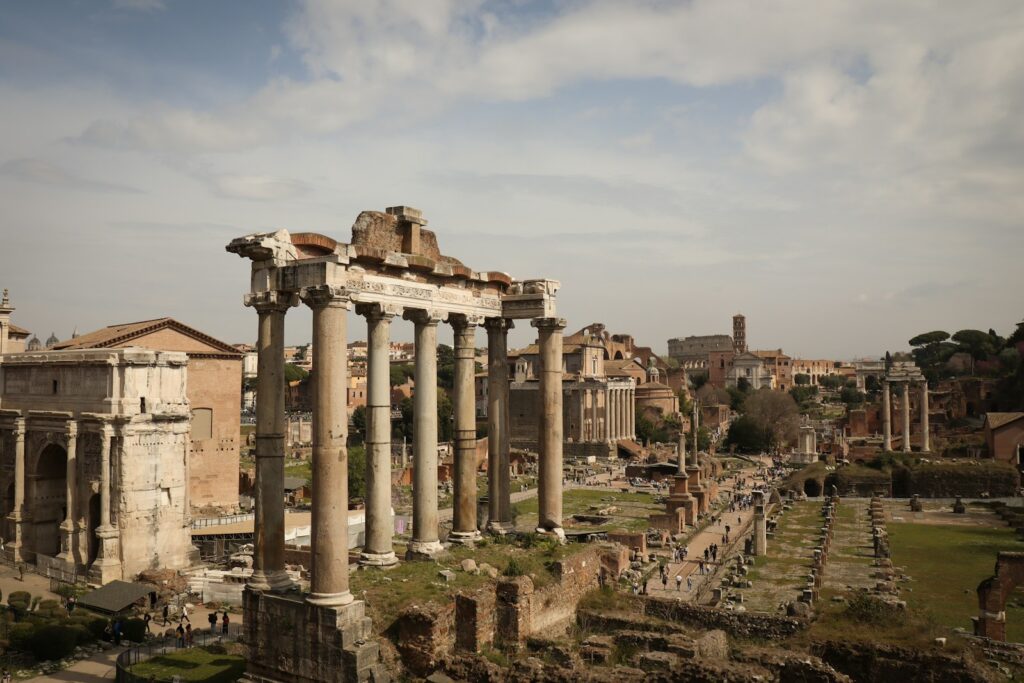
Most people meet Niccolò Machiavelli through The Prince, where rulers worry about fear, loyalty, reputation, and political survival. Discourses on Livy shows a different side of his political thinking.
Here, Machiavelli studies ancient Rome to ask how republics protect liberty, control corruption, handle political conflict, and survive long after individual leaders leave office.
Reading Discourses on Livy makes it much harder to reduce Machiavelli to ruthless advice about gaining power.
What Is Discourses on Livy About?

Those who condemn these dissensions between the nobles and the commons, condemn what was the prime cause of Rome becoming free.
Niccolò Machiavelli, Discourses on Livy, Book I, Chapter IV
Discourses on Livy uses the first ten books of the Roman historian Titus Livy as the starting point for a much broader study of government.
Machiavelli examines political institutions, liberty, class conflict, corruption, military power, civic participation, leadership, and the survival of republics. He keeps returning to one basic question. Why do some political systems preserve freedom while others slide toward instability or domination?
The three books divide the discussion loosely. Book I examines the internal life of republics, Book II looks largely at war and expansion, and Book III explores leadership, change, and political survival.
Despite the title, Machiavelli does not simply comment on Livy. He treats Rome as a political case study.
Why Did Machiavelli Study Ancient Rome?
Whoever wishes to foresee the future must consult the past; for human events ever resemble those of preceding times.
Niccolò Machiavelli, Discourses on Livy, Book III, Chapter XLIII
Livy wrote an enormous history of Rome, but Machiavelli did not study him simply because he enjoyed the ancient world. He thought history could help people understand political problems in their own time.
Rome gave him plenty of evidence. It experienced monarchy, republican government, class conflict, military expansion, institutional reform, corruption, and political decline.
His approach feels familiar today. Governments investigate policy failures. Companies conduct postmortems after failed launches. Cybersecurity teams study previous attacks because an old mistake often reveals where the next weakness lies.
Machiavelli applies the same instinct to politics. Instead of asking only what happened, he asks why it happened and whether the same pressures might appear again under different circumstances.
History, for him, should teach rather than merely entertain.
7 Key Ideas in Machiavelli’s Discourses on Livy
The Discourses often sounds very different from the Machiavelli readers encounter in The Prince. Individual leaders still count, but laws, citizens, institutions, and political disagreement receive far more attention.
1. Conflict Can Protect Liberty
Those who condemn these dissensions between the nobles and the commons, condemn what was the prime cause of Rome becoming free.
Niccolò Machiavelli, Book I, Chapter IV
Machiavelli challenges the assumption that a healthy republic must always look harmonious.
Rome’s conflicts between the Senate and ordinary citizens produced protests, accusations, political pressure, and plenty of noise. They also helped create laws and institutions that limited elite power.
His argument does not celebrate endless political fighting. Conflict helps only when institutions give competing groups a legitimate way to challenge one another.
Modern constitutional systems follow a related principle. The U.S. government deliberately divides authority among different branches rather than trusting one institution to exercise power without restraint. Checks and balances create friction by design.
Machiavelli would probably recognize the logic. Total agreement can look peaceful, but it can also mean that nobody has enough power to push back.
2. Ordinary People Can Guard Freedom
A people is more prudent, more stable, and of better judgment than a prince.
Niccolò Machiavelli, Book I, Chapter LVIII
This is not the Machiavelli most people expect. In The Prince, rulers dominate the discussion. In the Discourses, Machiavelli often gives ordinary citizens much more credit.
He does not claim crowds always make wise decisions. Instead, he argues that citizens operating under good laws can judge public questions as well as, and sometimes better than, a single ruler.
Princes can act emotionally, selfishly, or impulsively too. The difference is that one ruler may have enough authority to turn a personal mistake into a national problem.
Modern participatory budgeting offers a loose comparison. Cities including New York have allowed residents to vote on how portions of public money should be spent. The institutions differ radically from ancient Rome, but the underlying question remains familiar.
Should citizens simply receive decisions, or should they have a role in making them?
3. Institutions Outlast Great Leaders
A commonwealth endures longer, and has a more sustained good fortune than a princedom.
Niccolò Machiavelli, Book III, Chapter IX
Machiavelli respects capable leaders, but he distrusts political systems that depend on finding one exceptional person after another.
He points to Rome’s wars with Hannibal. Fabius Maximus succeeded when Rome needed caution. Scipio later succeeded with a more aggressive approach. A single ruler might struggle to abandon habits that had previously worked, while a republic can choose a different leader for a different moment.
Modern organizations face the same test. A company can thrive under a gifted founder, then struggle as soon as that founder leaves. At that point, everyone discovers whether the organization built durable systems or simply relied on one person’s instincts.
For example, Steve Jobs helped shape Apple, but the company’s success after his death illustrates Machiavelli’s point. Strong organizations cannot depend on one exceptional leader forever.
For more on Machiavelli’s ruler-focused ideas, these Machiavelli quotes on power explore his views on authority, leadership, and political survival.
4. Corruption Can Defeat Good Laws
Laws, that they may be respected, stand in need of good customs.
Niccolò Machiavelli, Book I, Chapter XVIII
Machiavelli does not believe legislation alone can repair a deeply corrupt political culture.
Rules work only when people respect their purpose. Once leaders and citizens learn to treat every rule as an inconvenience to work around, adding more rules may accomplish very little.
Governments offer a clearer example. A country can pass strict anti-corruption laws and require competitive bidding for public contracts, but those safeguards fail when officials steer contracts toward allies or ignore conflicts of interest. The laws may look strong on paper, yet the political habits surrounding them determine whether they actually work.
Machiavelli’s point runs deeper than “corruption is bad.” Institutions rely on habits, expectations, enforcement, and a shared willingness to accept limits.
A rule that nobody seriously expects anyone to follow has very little force.
5. Republics Need Renewal
Machiavelli expects political systems to decay if they never correct themselves.
Institutions age, and procedures designed for one problem can struggle with another. Citizens forget why safeguards existed, while private interests gradually push against rules created for public purposes.
His answer is renewal. Machiavelli often describes renewal as returning to a republic’s beginnings. He does not simply mean recreating the past. He wants political systems to recover the principles that gave their institutions legitimacy in the first place.
Modern governments and organizations attempt something similar after serious failures. They introduce new oversight, rewrite outdated rules, or reform procedures that no longer address current risks.
Stability does not always require resisting change. Sometimes refusing to adapt creates the greater danger.
6. Citizens Need a Stake in the System
Machiavelli distrusted mercenary armies and preferred political communities that could rely on their own citizens for defense.
The military argument reflects a broader principle. People commit differently when they believe they have something of their own to protect.
The idea appears in much less dramatic settings today. Employees often invest more effort when they have some influence over how their teams work. Residents tend to care more about local projects when they help choose them instead of hearing about them after every decision is finished.
Machiavelli’s citizen armies belong to Renaissance politics, not modern management advice. Still, the underlying psychology travels well.
Participation creates investment. People usually defend systems more vigorously when they feel those systems include them.
7. History Should Teach, Not Just Entertain
Whoever wishes to foresee the future must consult the past.
Niccolò Machiavelli, Book III, Chapter XLIII
This idea ties the whole work together.
Machiavelli studies Rome because he believes political behavior follows recurring patterns. Ambition, rivalry, fear, corruption, institutional failure, and competition for power do not disappear simply because the calendar changes.
He does not suggest copying Rome blindly. Circumstances change too much for that. Instead, history can improve the questions we ask.
When a government, company, or institution fails today, we often ask who made the mistake. Machiavelli would push further. Has this type of failure happened before, and what warning signs did people ignore last time?
It is an irritating question, which may explain why it remains useful.
Is Discourses on Livy the Opposite of The Prince?
A people is more prudent, more stable, and of better judgment than a prince.
Niccolò Machiavelli, Book I, Chapter LVIII
Reading The Prince and the Discourses side by side can feel like meeting two versions of Machiavelli.
The Prince concentrates on rulers acquiring and preserving states, highlighting his famous quote that it is better to be feared than loved. The Discourses spends much more time asking how republics protect liberty and distribute political authority.
Scholars have debated this tension for centuries. One interpretation treats the works as contradictory. Another sees Machiavelli addressing different political circumstances. A new or unstable state may require one style of leadership, while an established republic needs laws and institutions capable of surviving individual rulers.
The Discourses does not turn Machiavelli into a modern democrat, however. He admires republican liberty, but he also praises Rome’s military strength, expansion, civic discipline, and willingness to use force when political survival demanded it.
His republic belongs to ancient Rome and Renaissance political thought, not twenty-first-century liberal democracy.
The book complicates Machiavelli’s reputation without neatly reversing it.
Why Discourses on Livy Still Feels Relevant
Machiavelli cannot hand modern democracies a ready-made political manual. Rome operated under very different institutions, assumptions, and social conditions.
The questions he raises travel better than many of his answers.
How much disagreement can a political system absorb? What happens when citizens stop trusting institutions? Can laws restrain corruption when the culture surrounding them has changed? Should a country depend on exceptional leaders, or should its institutions remain strong enough to survive mediocre ones too?
These questions explain why Discourses on Livy still feels current.
Modern democracies continue to argue over concentrated power, institutional checks, public participation, corruption, political polarization, and whether disagreement strengthens accountability or simply drives people further apart.
Machiavelli offers no comfortable formula. He rarely does.
The Idea Worth Remembering
Machiavelli’s most surprising lesson in Discourses on Livy is that disagreement does not automatically weaken a republic. Rome’s conflicts sometimes forced political tensions into the open and helped produce stronger limits on power.
Silence can look stable while hiding deeper problems.
If conflict is inevitable, should we judge a republic by how peaceful it appears, or by how well its institutions handle disagreement?
Leave a Reply