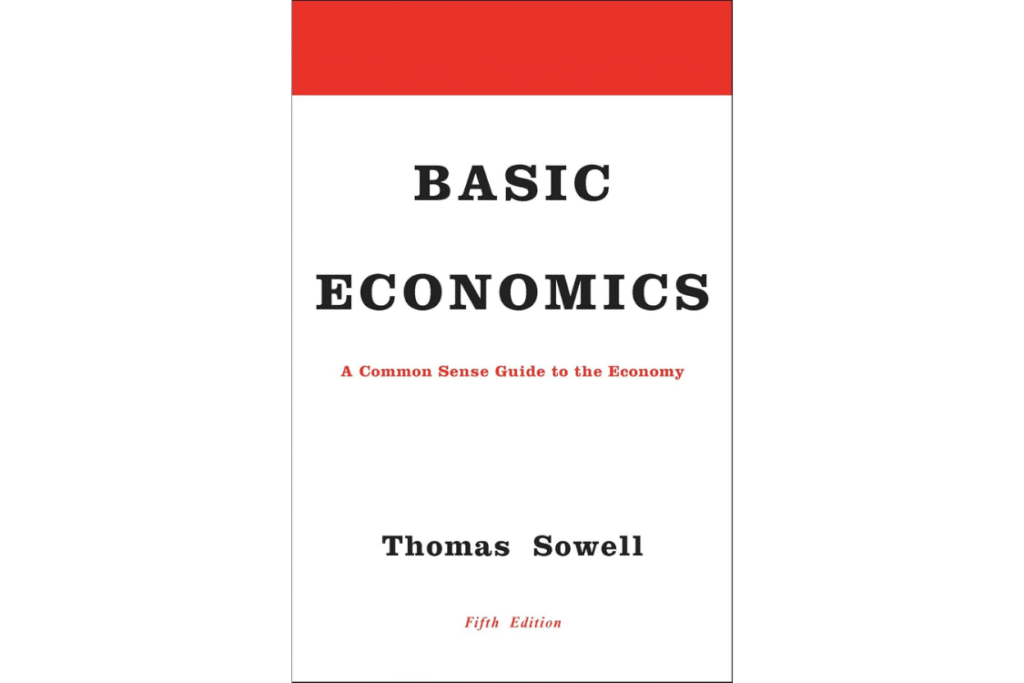
Basic Economics by Thomas Sowell asks a deceptively simple question. What happens after people make economic choices?
A rent cap may lower costs for current tenants but discourage new construction. Higher prices may feel unfair, yet they can also signal that something is scarce. Through examples like these, Sowell argues that intentions tell us less than consequences.
The ten quotes below explain his central ideas without turning a 700-page book into a dry chapter summary.
JUMP TO:
What Is Basic Economics About?
Basic Economics: A Common Sense Guide to the Economy explains how societies use limited resources that could serve many purposes.
Land can hold apartments, grow food, support a factory, or remain untouched. Labor, time, machinery, and money also have competing uses. Choosing one means giving up another, even when nobody writes the sacrifice on a receipt.
Sowell studies how prices, competition, profit, and government policy influence these decisions. He avoids equations and technical language, preferring historical cases and ordinary situations. A shop closes. Rent rises. A popular product sells out. Each event provides a small window into a much larger system.
Readers familiar with Sowell’s arguments about public policy will recognize the same pattern in these Thomas Sowell quotes on social justice. He looks past the promised goal and asks what changed after the policy arrived.
That does not make every conclusion in the book unquestionable.
Economics contains real disagreements. Sowell’s more useful lesson is methodological. Before judging a policy by how compassionate it sounds, follow the incentives and count the costs.
Economics Starts With Consequences
1. More Than an Opinion
Economics is not simply a topic on which to express opinions or vent emotions.
Thomas Sowell, Basic Economics, Chapter 1)
Economic debates often start with a moral reaction. Rent is too high. Wages are too low. Food should cost less. Those concerns may be entirely sincere, but sincerity does not tell us which policy will work.
Suppose a city limits rents to help people remain in their homes. Current tenants may save money, which is a real benefit. The next question is less comfortable. Will developers still build apartments if expected returns fall? Will landlords continue expensive maintenance? What happens to newcomers looking for a place five years later?
Sowell wants the analysis to continue after the appealing first result. Economics is not indifferent to hardship. It simply refuses to treat concern as proof that a particular remedy will help.
2. Follow Cause and Effect
Economics is a study of cause-and-effect relationships in an economy.
Thomas Sowell, Basic Economics, Chapter 4
Imagine that a city has enough money to repair aging school roofs or improve flood drainage in a vulnerable neighborhood. Both projects matter. The budget cannot fully fund both this year.
Economics cannot decide which community value deserves priority. It can show what each choice costs and what risks follow. Repairing the schools means the drainage work waits. Funding flood protection leaves some classrooms dealing with leaks for another rainy season.
This is opportunity cost in plain clothes. The true cost of a decision is not only the money spent. It includes the best alternative that must be delayed or abandoned.
The idea also applies when government announces that a new program is “free.” The people using it may pay nothing at the point of service, but workers, materials, and tax revenue still went somewhere.
Free is often a description of the invoice, not the cost.
Prices Carry Information
3. A Signal About Scarcity
Prices play a crucial role in determining how much of each resource gets used where.
Thomas Sowell, Basic Economics, Chapter 2
A price is more than the amount printed on a label. It carries information about supply, demand, and the alternative uses of a resource.
Suppose frost destroys part of an orange crop. Fewer oranges reach the market, so prices rise. Shoppers may buy less juice or choose another fruit. Restaurants adjust their orders. Suppliers have a stronger reason to move oranges from places with lower demand to places where buyers will pay more.
Nobody needs to telephone every household, supermarket, and grower with detailed instructions. The changing price passes the message through the system.
That message is not necessarily pleasant. Scarcity rarely sends cheerful correspondence. Still, hiding the signal does not restore the missing fruit.
4. Why Demand Responds
People tend to buy more at a lower price and less at a higher price.
Thomas Sowell, Basic Economics, Chapter 2)
This principle sounds obvious until public policy quietly assumes the opposite.
When concert tickets are priced below what thousands of fans will pay, demand does not politely remain unchanged. Tickets disappear quickly. Long digital queues appear, resale prices climb, and people spend hours refreshing a page to no avail.
The same response matters for essential goods. If electricity prices remain unusually low during a severe shortage, households have less financial reason to conserve. Consumption stays high even though the supply cannot easily expand.
Higher prices encourage buyers to economize while giving suppliers a reason to produce or deliver more. That adjustment may take time. A farmer cannot grow next season’s crop by Tuesday afternoon. The incentive still affects what happens next.
5. One Change Travels
The gains and losses are not isolated or independent events.
Thomas Sowell, Basic Economics, Chapter 2
An economy is a web of decisions. Tug one part and something moves elsewhere, though perhaps not where anyone expected.
Consider a sudden increase in the price of fuel. Delivery companies face higher costs, some retailers raise prices, while others accept smaller profits for a while. Commuters may use public transportation more often. Demand for fuel-efficient vehicles could rise months later.
No single reaction tells the whole story. This is why Sowell is suspicious of arguments that stop at the most visible group. A subsidy benefits its recipients, but the money must come from somewhere. An import restriction may protect one domestic industry while raising costs for businesses that use its products.
What Price Controls Can Hide
6. When the Signal Disappears
Nothing shows more vividly the role and importance of price fluctuations in a market economy than the absence of such price fluctuations when the market is controlled.
Thomas Sowell, Basic Economics, Chapter 3
Suppose a storm interrupts fuel deliveries while drivers rush to fill their tanks. If stations cannot raise prices, cheap fuel attracts more buyers even as the available supply shrinks. Some drivers fill extra containers because they fear running out. Stations may soon have nothing left to sell.
The official price remains low. The real cost reappears as time spent waiting, uncertainty, or an empty pump.
A higher price during an emergency can look like exploitation, and genuine price gouging laws raise separate legal and moral questions. Sowell focuses on the economic signal. A rising price tells consumers to conserve and gives suppliers a reason to bring more fuel into the affected area.
Removing the price movement does not remove scarcity, but it changes how people compete for what remains. Instead of money, they may pay with time, connections, luck, or the ability to arrive first.
7. The Second Result Matters
Political ‘solutions’ … turn out to make matters worse.
Thomas Sowell, Basic Economics, Chapter 3
This is one of Sowell’s sharpest recurring arguments. Policy should be judged by its results, including the ones nobody intended.
A minimum wage offers a useful example. Raising the legal wage can increase earnings for workers who keep their jobs and hours. A restaurant facing higher labor costs, however, may reduce shifts. Another employer might favor experienced applicants because hiring someone without a work history now carries a larger financial risk. Automation may also look more attractive.
Economists continue to debate how strongly employment responds under different conditions. The effect can vary by industry, location, and the size of the increase. Sowell takes a more skeptical position than many economists who support moderate wage floors.
The important point is not that every intervention fails. It is that the people a policy intends to help are not guaranteed to receive its benefits. A good goal still has to survive contact with human behavior.
Why Businesses Rise and Fall
8. Let the Idea Compete
You simply compete with them in the marketplace.
Thomas Sowell, Basic Economics, Chapter 5
A business owner does not need every established company to approve a new idea. The market allows the idea to face customers directly.
Picture a small grocery store deciding which products deserve shelf space. Sales reveal that shoppers want one brand and ignore another, so the owner orders more of the popular item. The unwanted product loses its place, even if its manufacturer had a wonderful presentation and extremely confident charts.
Markets are not flawless judges. Consumers can be misled, companies can block competitors, and success does not prove moral virtue. What competition does provide is an ongoing test. Businesses that waste resources eventually face losses unless someone protects them from the result.
Sowell sees this pressure as a way for scattered knowledge to influence production. Millions of buyers do not gather in a stadium and vote on how much oat milk the country needs, but their separate purchases still shape what stores stock.
9. Success Has an Expiry Date
Neither individuals nor companies are successful forever.
Thomas Sowell, Basic Economics, Chapter 5
A famous company can have money, talented employees, and a long history, then misread what customers want. Economic life is rude that way. It does not award permanent tenure for past brilliance.
Consider the companies that once dominated film photography. Their expertise was real, but digital cameras changed what customers valued. Later, smartphones changed the market again. The winning product did not merely come from a company working harder at the old process. It changed the process itself.
Profit rewards a business for directing resources toward something buyers value at that moment. Loss sends the opposite message. Perhaps the product costs too much to make. Maybe customers prefer another option. Either way, resources have a reason to move.
This is why Sowell treats losses as economically useful, however painful they are for the people involved. Without that signal, a failing operation can continue consuming labor and materials while producing something few people want.
Why Middlemen Keep Returning
10. Someone Still Does the Work
The perennial desire to ‘eliminate the middleman’ is perennially thwarted by economic reality.
Thomas Sowell, Basic Economics, Chapter 6
The middleman is an easy villain. He did not grow the coffee, sew the shirt, or manufacture the phone. He appears somewhere between producer and customer, then has the nerve to charge money.
Yet distribution is work. A wholesaler may gather products from many farms, store them safely, absorb the risk of spoilage, and deliver smaller quantities to local shops. If every neighborhood cafe had to negotiate separately with distant growers and arrange international transport, coffee might not become cheaper. It might become a logistical hobby with beverages somewhere near the end.
Digital platforms tell a similar story. A website that connects independent sellers with customers can reduce search costs and handle payments. Its fee may be too high, but removing the company does not remove the tasks it performs.
Sometimes technology replaces an intermediary, but more often, it creates a different one. The relevant question is not whether a middleman exists, but whether the service costs less than the problem it solves.
This idea also helps explain international trade. Importers coordinate transport, regulations, storage, and currency risk. A country could grow tomatoes in heated greenhouses throughout winter, but importing them from a warmer climate may use fewer resources. Local workers can then produce something better suited to local conditions.
Trade does not eliminate cost. Instead, it lets people compare ways of meeting the same need.
Is Basic Economics Good for Beginners?
Yes, Basic Economics is accessible to readers who have never studied the subject. Sowell explains ideas through stories and historical cases instead of graphs. The Hoover Institution’s description of the fifth edition similarly presents it as a guide for readers who want to understand economics without jargon or equations.
Accessible does not mean brief. The fifth edition is more than 700 pages and covers prices, business, labor, risk, national output, money, government finance, and international trade. It works better as a book to read in sections than something to race through over a weekend.
Readers should also know that Sowell writes from a strongly market-oriented perspective. He pays close attention to government failure and often gives less space to cases where regulation may correct market failures. Reading him critically is not a betrayal of the book. It is probably a better use of it.
A reader might pair Basic Economics with an introductory textbook that presents a broader range of economic models and evidence. Sowell supplies the questions that make policy debates harder to oversimplify. Other sources can test how well his conclusions hold in specific markets.
His method is especially relevant to debates over fairness. The TQC guide to Thomas Sowell on equality of outcome examines how he applies similar reasoning to unequal social results.
What Readers Can Take From the Book
The central lesson of Basic Economics is not that markets always produce perfect outcomes. Sowell’s deeper point is that every economic arrangement uses some method to decide who receives scarce resources.
Prices make many of those decisions in a market economy. Governments make others through laws, taxes, spending, or regulation. Tradition and personal relationships matter too. None of these systems makes scarcity disappear.
When judging an economic policy, ask what incentives it changes. Then look beyond the first group affected. Who adjusts next? What alternative use was displaced? If the policy succeeds today, will people behave differently tomorrow?
Those questions do not automatically lead to Sowell’s preferred answer. They do make shallow answers harder to maintain, which is no small achievement.
Final Thoughts
The best quotes from Basic Economics interrupt comfortable reasoning. Sowell asks readers to separate a policy’s purpose from its actual results and to notice costs that have slipped out of view.
A price increase may carry useful information even when nobody enjoys paying it. Profit can guide resources without proving that a company is admirable. A well-meaning rule can help one person now while making the same problem harder for someone else later.
Economics cannot tell us everything society should value. It can make us more honest about what our choices require. Before calling any policy compassionate, efficient, or free, perhaps the fairest question is also the simplest. What happens next?
Leave a Reply