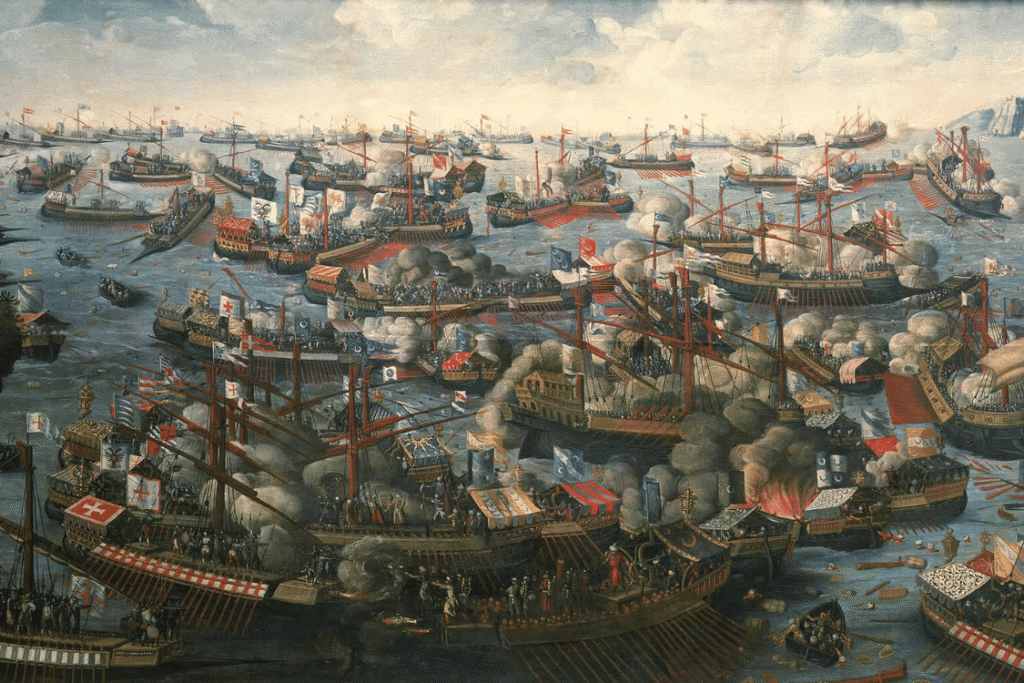
Before the ships collide, Chesterton makes us hear the drums. His Lepanto poem celebrates the Christian Holy League’s victory over the Ottoman fleet in 1571, with Don John of Austria at its center. Yet the poem reaches beyond the battle itself, linking military courage with faith, the release of captives, and the enduring appeal of chivalry.
Its rushing rhythm makes an immediate impression, though the historical names and religious imagery can be harder to follow. Understanding those references also brings the ending into focus, when the noise of battle gives way to Cervantes and a vision of the knight he would later create.
What is Chesterton’s Lepanto poem about?
Lepanto is a narrative poem about a naval victory, told from an openly Christian perspective. Chesterton presents Don John as a young champion who acts while other rulers hesitate, withdraw, or concern themselves with their own affairs. The movement from danger to resistance gives the poem its dramatic force.
Readers familiar with our G. K. Chesterton quotes will recognize his admiration for courage and his defense of apparently unfashionable ideals. Here, however, he develops those concerns through a sustained heroic story.
The poem invites readers to admire conviction and action. At the same time, its fierce treatment of religious opponents calls for careful reading. Appreciating its language does not require accepting its portrayal of every person or belief.
The history behind the poem
The Battle of Lepanto took place on October 7, 1571, in the Gulf of Patras, off western Greece. Don John of Austria commanded the Holy League, an alliance that included Spain, Venice, and the Papal States. Its forces defeated the Ottoman fleet under Ali Pasha.
The Ottoman attack on Venetian Cyprus helped bring the alliance together. At sea, cannon fire and boarding assaults turned the encounter into close fighting between crowded ships. The Holy League won a major victory, although its members did not convert that success into lasting control of the eastern Mediterranean.
As EBSCO’s historical overview explains, the Ottomans rebuilt their fleet and retained Cyprus. The battle damaged their reputation for naval invincibility, but it did not end Ottoman power.
This distinction helps when reading Chesterton. He concentrates on the victory’s spiritual and imaginative significance, leaving much of the complicated aftermath outside the poem.
A short summary of Lepanto
The opening presents an Ottoman ruler enjoying the apparent strength of his position while the Pope calls for help. Chesterton contrasts this danger with European rulers who appear distracted or unwilling to respond. Don John then enters through the gathering sound of drums and trumpets.
The poem expands into a supernatural conflict before returning to divided Christian Europe. While other figures remain enclosed in palaces or arguments, Don John moves toward the fleet. His preparations eventually give way to cannon fire.
Near the climax, attention shifts beneath the decks to Christian captives forced to row. Their release supplies the victory with a human purpose beyond military glory. Finally, Chesterton turns to Cervantes, imagining the future author looking toward the wandering figure of Don Quixote.
You can read the complete poem in its 1915 collection alongside the explanations below. Its shifts between earthly scenes and imagined visions are easier to follow once that broad sequence is clear.
Why does Chesterton make Don John the hero?
Chesterton introduces Don John as a figure whose courage exceeds his formal position. Around him stand rulers with established power, but he receives the energy of the poem. His arrival interrupts a world that seems to have accepted its own helplessness.
The contrast depends on movement. Don John rides, calls, fires, and breaks through, while the surrounding rulers look inward or remain still. Even before the battle begins, the language has separated those who possess authority from the person willing to act.
His laughter also contributes to this portrait. Chesterton gives him an eagerness that makes courage appear joyful rather than merely dutiful. The young commander resembles a knight from romance, drawn toward an undertaking because he believes it deserves the risk.
That portrayal is selective. Historical commanders make difficult decisions within alliances, and their motives rarely fit a single heroic pattern. Chesterton’s Don John serves the poem’s argument about action and belief; he is not a complete biographical portrait.
How rhythm and repetition drive the poem
Strong gongs groaning as the guns boom far,
Don John of Austria is going to the war,G. K. Chesterton, “Lepanto,” Poems (1915), p. 22
The repeated hard sounds make the approach almost physical. Gongs and guns seem to answer one another, while the second line directs that noise toward a person with a clear destination. Read aloud, the passage gathers force without requiring the reader to understand every historical reference.
Throughout the poem, Don John’s name returns with changing actions. At first he is traveling toward the conflict; later he commands the ships, enters the fighting, and completes the rescue. The refrain therefore works as a thread through scenes that otherwise move rapidly across places and imagined worlds.
Chesterton also alternates long, crowded lines with much shorter bursts. The longer lines accumulate detail, while brief cries give the voice room to strike harder. That variation helps explain why the poem can feel both elaborate and easy to remember.
Rather than treating it as a steady march from beginning to end, listen for changes in pace. The movement from distant preparations to close violence, and finally to the quieter ending, gives the sound a narrative purpose.
Faith and conflict in Lepanto
Christian imagery shapes the poem from its opening appeal for aid. The cross, the Pope’s prayer, and the vision of Saint Michael place the battle within a spiritual struggle. Chesterton asks readers to see more than rival fleets competing for territory.
However, he also criticizes Christians. His scenes of religious division suggest that bitter disputes have weakened their ability to respond together. Don John’s forward movement offers a dramatic contrast to that inward conflict.
The supernatural portrayal of the opposing side is especially important to distinguish from history. Chesterton introduces Mahound, a hostile literary representation of Muhammad, surrounded by fantastic beings. This scene is a polemical invention, not an account of Islamic belief or of events at Lepanto.
Within that imagined scene, the enemy fears a spirit that refuses to submit to fate. The poem thus associates its hero with the freedom to resist an apparently settled outcome. That is a claim Chesterton builds into the story, rather than a fair description of the beliefs held by everyone on either side.
A careful reading can acknowledge both the poem’s artistic energy and the distortion involved in turning religious opponents into supernatural enemies. Otherwise, its most vivid imagery risks being mistaken for factual explanation.
Why the captives change the poem
For much of Lepanto, readers encounter rulers, banners, and weapons. Then Chesterton directs attention below the ships, where people endure forced labor far from the splendid scenes above them.
Christian captives sick and sunless, all a labouring race repines
Like a race in sunken cities, like a nation in the mines.G. K. Chesterton, “Lepanto,” Poems (1915), p. 27
The contrast makes the fleet’s grandeur harder to admire without qualification. Above deck, power displays itself through wealth and military strength. Below, exhausted captives sustain that power through their bodies.
Chesterton gives their imprisonment the scale of an entire buried society. The images of mines and sunken cities suggest lives cut off from ordinary human contact, while the absence of sunlight prepares for the shock of release.
Their emergence from the holds provides the poem’s clearest answer to what Don John’s courage achieves. The victory allows suffering people to return to the world. This is the emotional center of Chesterton’s celebration, although its focus remains specifically on the Christian captives rather than every victim of the conflict.
The meaning of the Cervantes ending
After the rescue, the poem could finish with Don John’s triumph. Instead, Chesterton turns to Cervantes aboard his galley and imagines him looking beyond the scene before him.
And he sees across a weary land a straggling road in Spain,
Up which a lean and foolish knight for ever rides in vain,G. K. Chesterton, “Lepanto,” Poems (1915), p. 28
The knight is Don Quixote. Chesterton places the future literary creation inside the soldier’s imagined vision, joining the world of battle with the world of fiction. This is poetic anticipation, not evidence that Cervantes conceived his novel during the fighting.
The change in scale is striking. Don John has commanded ships and secured a victory; Don Quixote will wander a road with little power over the world he hopes to improve. One receives public honor, while the other repeatedly invites laughter.
Nevertheless, Chesterton places them close enough for readers to consider what they share. Both pursue an ideal of chivalry, though the results differ sharply. Through that contrast, the ending raises a question the earlier celebration scarcely pauses to consider: does an ideal retain value when the person defending it fails?
Cervantes’ smile leaves room for affection as well as amusement. We can read it as recognition of human folly without assuming that every generous ambition deserves contempt. The poem does not abandon its heroism; it brings that heroism into contact with irony.
The final return to Don John preserves the victory, but Don Quixote remains in the reader’s imagination. Chesterton has made space for the successful champion and the unsuccessful dreamer within the same closing scene.
Reading beyond the victory
Lepanto gains much of its force from certainty. Its rhythms carry readers toward a victory that the narrator regards as both just and glorious. Yet its most rewarding moments allow a more searching response, particularly when attention passes from the commander to the captives and then to Cervantes.
Read it for the force of its language, while keeping its historical limits in view. At the end, the ships have won their battle, but the lonely knight continues along his road.
Leave a Reply