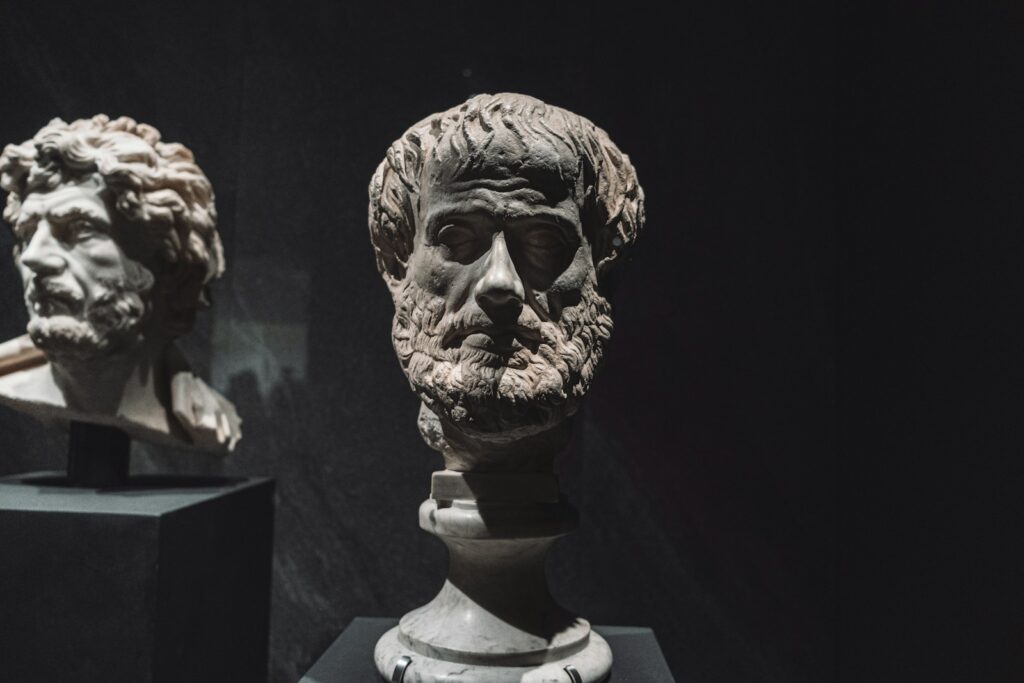
A good life requires more than good intentions. That question runs through these famous Aristotle quotes, whether he is considering the friendships we cultivate, the habits we acquire, or the difference between feeling pleased and living well. His observations remain compelling because they ask us to examine what our choices amount to over time.
The selections below include recognizable passages from Aristotle’s works and three well-known sayings preserved by his ancient biographer, Diogenes Laërtius. Each quotation identifies its source and translator. Excerpts retain the original translated wording, while reported sayings are labeled separately.
JUMP TO:
- Aristotle Quotes on Happiness and Living Well
- Aristotle Quotes on Habits and Character
- Aristotle Quotes on Friendship
- Aristotle Quotes on Knowledge and Education
- Aristotle Quotes on Society and Art
- Famous Sayings Reported About Aristotle
- Did Aristotle Say “We Are What We Repeatedly Do”?
- Reading Aristotle Beyond the Quote
Aristotle Quotes on Happiness and Living Well
For Aristotle, happiness concerns how a life is lived, reaching beyond a pleasant mood or a fortunate afternoon. His place among the greatest philosophers of all time owes much to this sustained inquiry into human flourishing.
1. The Aim of Living
“Happiness, then, is something final and self-sufficient, and is the end of action.”Aristotle, Nicomachean Ethics, Book I, chapter 7. Translated by W. D. Ross.
Here, “end” means an ultimate aim. We seek many things for the sake of something else, but happiness is something we desire for its own sake.
Aristotle’s idea of happiness, often discussed as flourishing, concerns the quality of an entire life. It includes worthwhile activity and the exercise of good judgment. Nor does “self-sufficient” mean living without others. Immediately before this passage, he includes family, friends and fellow citizens in his account of a desirable life.
The question becomes more demanding than “What would make me feel better today?” It asks what kind of life would remain worth choosing when considered as a whole.
2. One Swallow, One Summer
“For one swallow does not make a summer, nor does one day; and so too one day, or a short time, does not make a man blessed and happy.”Aristotle, Nicomachean Ethics, Book I, chapter 7. Translated by W. D. Ross.
A single sign cannot establish the arrival of a season. Aristotle uses that familiar observation to explain why a brief experience of happiness cannot settle whether someone has lived well.
The image also gives us a useful perspective on achievement. One generous act deserves appreciation, but a generous character requires more. A successful day can encourage us without carrying the burden of proving that everything is finally in order.
3. Wealth Needs a Purpose
“wealth is evidently not the good we are seeking; for it is merely useful and for the sake of something else.”Aristotle, Nicomachean Ethics, Book I, chapter 5. Translated by W. D. Ross. Excerpt.
Money is valuable partly through what it makes possible. Aristotle’s question concerns the purpose beyond its accumulation.
His argument leaves us with an uncomfortable test. If we keep postponing the life we want until we have earned more, we may lose sight of what the earning was meant to support. Financial security has practical importance, but it cannot answer every question about how to spend our days.
Aristotle Quotes on Habits and Character
Aristotle’s account of character begins with practice, then asks what guides that practice. Repetition can strengthen a virtue or deepen a fault, depending on the actions we rehearse and the reasons we choose them.
4. Learning Through the Work
“For the things we have to learn before we can do them, we learn by doing them”Aristotle, Nicomachean Ethics, Book II, chapter 1. Translated by W. D. Ross. Excerpt.
Aristotle follows this observation with examples of building and playing the lyre. Instruction helps, but competence requires participation.
The same difficulty accompanies many worthwhile beginnings. We want enough confidence to start, although some of that confidence can come only from attempting the work. His words encourage practice while leaving room for guidance, correction and the awkwardness of being new.
5. Courage Through Brave Actions
“we become just by doing just acts, temperate by doing temperate acts, brave by doing brave acts.”Aristotle, Nicomachean Ethics, Book II, chapter 1. Translated by W. D. Ross. Excerpt.
Character develops through conduct. Each time we act fairly or face an appropriate fear, we participate in forming the disposition that makes such actions more dependable.
This passage is the stronger source to use when discussing Aristotle and habits. In Book II of the Nicomachean Ethics, he explains that good action also involves knowledge, deliberate choice and an established character. Virtue requires more than mechanically repeating a behavior.
For courage, that means learning to judge what deserves fear and what is worth facing it for. Recklessness can resemble bravery from a distance, but its reasons and consequences may be very different.
6. Habits Begin Their Work
“It makes no small difference, then, whether we form habits of one kind or of another from our very youth; it makes a very great difference, or rather all the difference.”Aristotle, Nicomachean Ethics, Book II, chapter 1. Translated by W. D. Ross.
The emphatic ending gives this passage its force. What we repeatedly practice can influence what eventually feels natural.
Aristotle’s attention to youth also places responsibility on the people who guide children. Patience, fairness and restraint are learned partly through the examples surrounding them. The adult who demands honesty while rewarding convenient dishonesty teaches a lesson, though perhaps not the intended one.
7. Anger Requires Good Judgment
“any one can get angry—that is easy—or give or spend money; but to do this to the right person, to the right extent, at the right time, with the right motive, and in the right way, that is not for every one, nor is it easy”Aristotle, Nicomachean Ethics, Book II, chapter 9. Translated by W. D. Ross. Excerpt; dash typography normalized.
Aristotle includes anger within a broader argument about acting appropriately. The difficult work lies in judging the circumstances.
An angry response might defend someone against mistreatment, or it might punish a person who happens to be nearby. Even a justified grievance can be expressed cruelly. His questions about motive, degree and timing ask us to examine the response as carefully as the injury.
The passage offers a demanding alternative to both constant outrage and automatic silence. We remain responsible for what we do with a feeling, however understandable its arrival.
Aristotle Quotes on Friendship
Aristotle gives friendship substantial attention in his ethics. His discussion considers the pleasure of companionship alongside a harder question: whether we value another person for their own sake.
8. A Life With Friends
“For without friends no one would choose to live, though he had all other goods”Aristotle, Nicomachean Ethics, Book VIII, chapter 1. Translated by W. D. Ross. Excerpt.
Prosperity cannot supply everything that makes life desirable. Aristotle observes that even people with wealth and influence need friends, including people with whom they can share their good fortune.
Friendship belongs within a flourishing life rather than appearing as a consolation when other ambitions fail. The person who knows us well may contribute something that another achievement never could.
9. Goodwill for Their Sake
“Now those who wish well to their friends for their sake are most truly friends”Aristotle, Nicomachean Ethics, Book VIII, chapter 3. Translated by W. D. Ross. Excerpt.
Aristotle distinguishes friendships grounded in usefulness or pleasure from those rooted in an appreciation of another person’s character. In the strongest friendship, we want the other person to fare well for their own sake.
That distinction can be revealing when someone’s circumstances change. A friendship built around access or convenience may weaken when those advantages disappear. Affection for the person gives us a more lasting reason to remain.
It also asks something generous of us. A friend’s good fortune deserves our welcome even when it brings us no benefit, or takes their life in a direction we would not have chosen.
10. Friendship Takes Its Time
“a wish for friendship may arise quickly, but friendship does not.”Aristotle, Nicomachean Ethics, Book VIII, chapter 3. Translated by W. D. Ross. Excerpt.
An immediate connection can be delightful. Aristotle nevertheless gives trust the time it needs.
The surrounding passage emphasizes familiarity and experience. We learn how someone responds when plans change, when disagreement arises, or when kindness requires effort.
Friendship acquires depth through those encounters, including the ordinary ones that never seem memorable enough to photograph.
Aristotle Quotes on Knowledge and Education
Aristotle’s interest in learning extends from the pleasure of discovery to the discipline of judging well. Curiosity begins the inquiry; careful reasoning helps it proceed.
11. The Desire to Know
“All men by nature desire to know.”Aristotle, Metaphysics, Book I, chapter 1. Translated by W. D. Ross.
This opening sentence is among Aristotle’s most recognizable statements. He begins with the pleasure people take in their senses, particularly sight, before considering experience and the search for causes.
Knowledge has an attraction beyond immediate usefulness. We follow a question simply because we want to understand it. Aristotle gives that familiar impulse a distinguished place at the beginning of philosophy.
12. Wonder Begins the Inquiry
“For it is owing to their wonder that men both now begin and at first began to philosophize”Aristotle, Metaphysics, Book I, chapter 2. Translated by W. D. Ross. Excerpt.
Wonder interrupts the assumption that we already understand what we see. Something familiar suddenly presents a difficulty, and we begin asking for an explanation.
Aristotle connects that experience with an awareness of ignorance. Admitting we do not know can be intellectually productive, especially when certainty would spare us further effort.
Plato explores a related connection between wonder and philosophy. Our collection of famous Plato quotes considers that idea through the conversations of his dialogues.
13. Knowing How Much Precision
“it is the mark of an educated man to look for precision in each class of things just so far as the nature of the subject admits”Aristotle, Nicomachean Ethics, Book I, chapter 3. Translated by W. D. Ross. Excerpt.
This is Aristotle’s sourced observation about an educated person. It concerns the kind of certainty a subject can reasonably provide.
A mathematical demonstration and a judgment about human conduct do not operate in exactly the same way. Expecting an ethical decision to offer the precision of arithmetic can lead us to reject sound reasoning simply because it leaves room for circumstances.
Aristotle asks for disciplined expectations. We should pursue the clarity available without pretending that every difficult question has a perfectly exact answer.
Aristotle Quotes on Society and Art
Questions about living well eventually reach beyond the individual. Aristotle examines how people share a political community and how imaginative works represent human action.
14. Our Shared Political Nature
“man is by nature a political animal.”Aristotle, Politics, Book I, chapter 2. Translated by Benjamin Jowett. Excerpt.
“Political” here concerns life in the polis, or city-state. Aristotle connects human community with speech and our ability to discuss justice, advantage and the good.
The statement reaches beyond an interest in elections or public office. It asks us to understand human life through shared institutions and relationships.
His political thought also contains serious exclusions, including defenses of hierarchy and slavery. Reading this famous line thoughtfully requires recognizing those limits while examining the continuing question of what people owe one another.
15. Justice Holds Communities Together
“justice is the bond of men in states”Aristotle, Politics, Book I, chapter 2. Translated by Benjamin Jowett. Excerpt.
A community needs some account of what is just and how disputes should be settled. Aristotle treats that judgment as fundamental to political order.
The line invites us to consider what holds a society together beyond force or convenience. People must live with decisions that affect one another, and the fairness of those decisions influences whether shared life feels bearable.
16. Poetry Reaches Beyond Events
“Poetry, therefore, is a more philosophical and a higher thing than history: for poetry tends to express the universal, history the particular.”Aristotle, Poetics, chapter 9. Translated by S. H. Butcher.
Aristotle distinguishes an account of what happened from an imaginative representation of what could happen according to probability or necessity. His discussion of poetry includes dramatic works, rather than only the shorter poems we may think of today.
A fictional character can reveal a recognizable pattern of jealousy, ambition or loyalty without corresponding to one historical person. That is part of what Aristotle means by the universal.
His comparison gives literature an intellectual purpose. A story can help us understand human action through the relationships among its events, even when those events were invented.
Famous Sayings Reported About Aristotle
The following sayings come from Diogenes Laërtius’s Lives of the Eminent Philosophers, written centuries after Aristotle. They have an ancient textual source, but they are reported remarks rather than passages from Aristotle’s surviving works.
17. Education’s Bitter Roots
“The roots of education are bitter, but the fruit is sweet.”Attributed to Aristotle by Diogenes Laërtius, Lives of the Eminent Philosophers, Book V, section 18. Translated by R. D. Hicks; the reporting phrase is omitted.
The image acknowledges the effort involved in learning. Difficulty arrives early, while the satisfaction of understanding often takes longer.
It offers encouragement without making suffering a measure of educational worth. Confusion and practice may belong to learning, but humiliation need not. The sweetness lies in the ability or insight eventually gained.
18. One Soul, Two Bodies
“A single soul dwelling in two bodies.”Aristotle’s reported answer to “What is a friend?” in Diogenes Laërtius, Lives of the Eminent Philosophers, Book V, section 20. Translated by R. D. Hicks.
This familiar image is often circulated as a romantic quotation. In the ancient account, it answers a question about friendship.
Its appeal lies in the feeling of being understood so thoroughly that another person’s concerns seem close to our own. Taken as an image, it celebrates mutual recognition. A friendship can have that intimacy while still allowing two people their differences and separate lives.
19. Hope While We Wake
“It is a waking dream.”Aristotle’s reported definition of hope in Diogenes Laërtius, Lives of the Eminent Philosophers, Book V, section 18. Translated by R. D. Hicks.
Hope allows us to imagine something beyond present circumstances while remaining awake to the world around us.
Diogenes supplies the saying without an extended explanation, so it deserves a light interpretive touch. We can appreciate its picture of possibility without turning it into a promise that everything we imagine will happen.
Did Aristotle Say “We Are What We Repeatedly Do”?
The familiar formulation “We are what we repeatedly do. Excellence, then, is not an act, but a habit” belongs to Will Durant’s summary of Aristotle in The Story of Philosophy. It should be credited to Durant rather than presented as a direct quotation from Aristotle.
For Aristotle’s own discussion, return to the passage about acquiring virtues through corresponding actions in Nicomachean Ethics II.1. His fuller argument also considers choice and judgment, which give the idea more substance than repetition alone.
The popular “educated mind” saying about entertaining a thought without accepting it is likewise not the wording of Nicomachean Ethics I.3. The sourced passage above concerns how much precision different subjects permit.
Reading Aristotle Beyond the Quote
These famous Aristotle quotes lead toward questions that resist quick answers. What makes a friendship lasting? Which habits deserve our loyalty? What would justify calling a whole life happy?
A memorable line can begin that inquiry, but Aristotle asks more of us than agreement. The harder work is deciding what we will do differently when the book is closed.
Leave a Reply