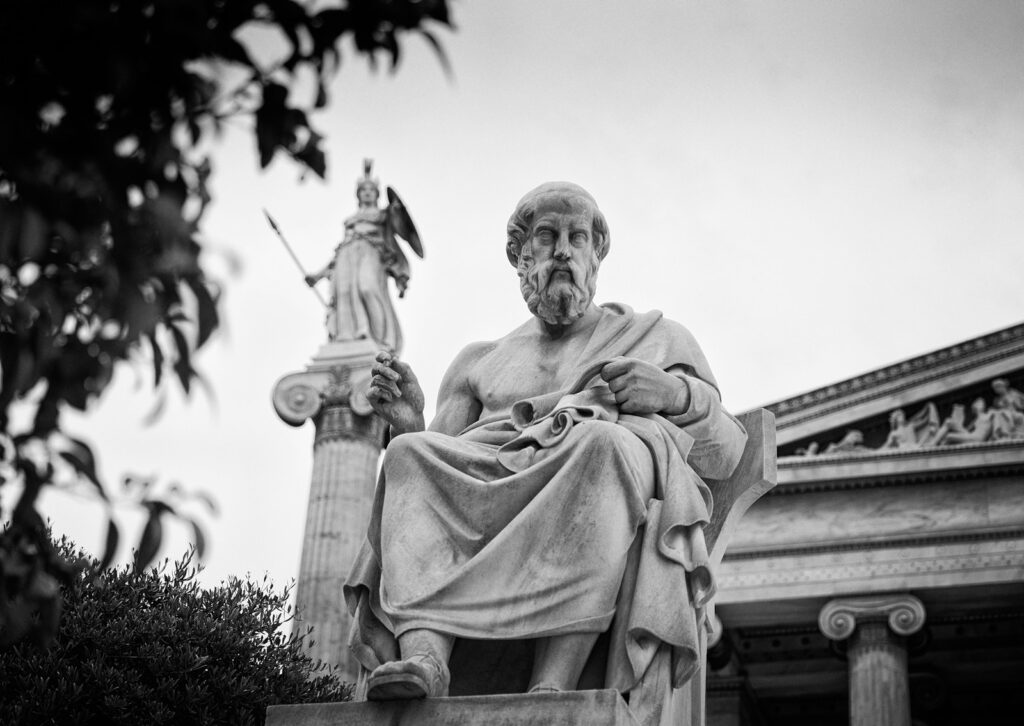
In The Republic, Plato’s philosopher king is a ruler trained to judge what is good for the whole city, even when the right decision is unpopular. One of the strongest reasons to trust such a person with power, Plato suggests, is that they already know a life they would rather lead.
This preference creates a problem. A philosopher who has spent years learning to think freely has good reason to go on doing so. What right does the city have to call that person away from a life they love?
JUMP TO:
What Did Plato Mean by a Philosopher King?
Plato introduces the idea in Book V of The Republic. Socrates and his companions have been imagining a just city when Glaucon presses him on a practical point. Could such a place ever exist? Socrates hesitates because he knows how his answer will sound. Political power and philosophy, he finally says, would have to come together.
There are two ways this could happen. Philosophers could take office, or people who already hold power could begin to practice philosophy in earnest.
The second possibility is easy to miss in the phrase philosopher king. It asks something demanding of a sitting ruler: the willingness to examine a cherished belief and discover that a subject with less power has the better argument.
The passage appears among these famous Plato quotes on wisdom and democracy. In the dialogue, Glaucon’s immediate response is to imagine outraged listeners ready to have a go at Socrates. Before anyone hands a philosopher the city, he had better explain what qualifies one for the job.
Why Should Philosophers Rule?
For Socrates, ruling requires some knowledge of what makes a decision just. Suppose a city has enough grain to feed its citizens through a poor harvest, but only if it rations the supply.
Arithmetic can tell the rulers how long the grain will last. It takes a different kind of judgment to decide what each household may fairly claim, especially when the people with the largest storehouses also have the most influence.
Plato calls the highest object of a philosopher’s education the Good. A ruler needs some standard for judging whether a law serves the city, including people who lack the power to shape it. Otherwise, a policy that pleases the assembly today might look wise for no better reason than the applause it receives.
In Book VI, Socrates asks his listeners to picture a ship. The sailors quarrel over who should take the helm, although none has learned navigation. Meanwhile, the person who studies the seasons, winds, and stars strikes them as a useless stargazer.
From the deck, their judgment almost makes sense. Everyone else is busy trying to win command, and the navigator appears to be doing nothing to get it.
The sea will eventually expose the difference. The sailor who wins over the crew must still bring the ship safely into port. Plato thinks a city makes a similar mistake when it treats skill at gaining office as proof that someone can govern well.
How Does Plato’s Philosopher King Earn the Right to Govern?
Plato gives his prospective rulers a long education, followed by years in public life. Mathematics teaches them to follow an argument beyond what first appears obvious. Later, philosophical debate puts their assumptions under pressure. Someone who can expose a flaw in another person’s reasoning must also learn to recognize one in their own.
Then the candidates return to practical duties. The city has time to see whether someone who speaks convincingly about courage can act courageously under pressure. Only around the age of fifty do those who have passed through study and service take their turns at the highest responsibilities.
Despite the familiar title, Plato allows qualified women to receive the guardians’ education and to govern. Nor does the position pass automatically to a ruler’s child. In the city Socrates describes, a young person’s abilities and conduct must justify the trust that governing requires.
Why Must the Philosopher Return to the Cave?
In Book VII, a prisoner leaves a cave where people have spent their lives watching shadows. Outside, his eyes gradually adjust until he can see the things that cast them.
Glaucon understands why the prisoner would want to remain there. What troubles him is the demand that he go back. If the city can offer someone a better life, how can it be just to make that life worse?
Socrates imagines the city’s founders addressing the philosophers they have educated:
“Wherefore each of you, when his turn comes, must go down to the general underground abode, and get the habit of seeing in the dark.”Socrates, in Plato’s Republic, Book VII, 520c, translated by Benjamin Jowett
The words when his turn comes give the demand a limit. Each philosopher shares the work of government and can return to study when another takes over. The city asks for this service because it made that philosophical life possible. Other citizens sustained the community while its future guardians had the freedom to spend years learning.
Socrates even makes an exception that gives his answer some force. A philosopher who grew up in a city that offered no such education has a different claim to independence. The obligation arises from a particular relationship between these rulers and the people who helped educate them.
There is also humility in that last phrase about getting used to the dark. Coming in from sunlight, the returning prisoner can scarcely see.
Education may qualify the philosopher to govern, but the people who stayed in the cave have lived there all along. Before the philosopher can judge their affairs, his own eyes need time to adjust.
Who Decides Which Rulers Are Wise?
Plato’s strongest insight concerns ambition. Someone who has never wanted anything more than public office has a great deal to lose by leaving it. A ruler who values another life can afford an unpopular decision and, when the time comes, can afford to step aside.
The harder question belongs to the citizens. On a ship, even a passenger who knows nothing about navigation can recognize the harbor when the vessel arrives. In politics, people may reasonably disagree about whether a law was just, especially if some enjoyed its benefits while others bore its cost.
Years of training give a ruler grounds for a judgment. They also give citizens grounds to expect a good explanation.
That is the lasting challenge of Plato’s philosopher king. Plato asks what a ruler must learn before the city can trust them with power. A citizen is entitled to ask the question from the other side: when the ruler gets it wrong, whose judgment will they trust?
Leave a Reply