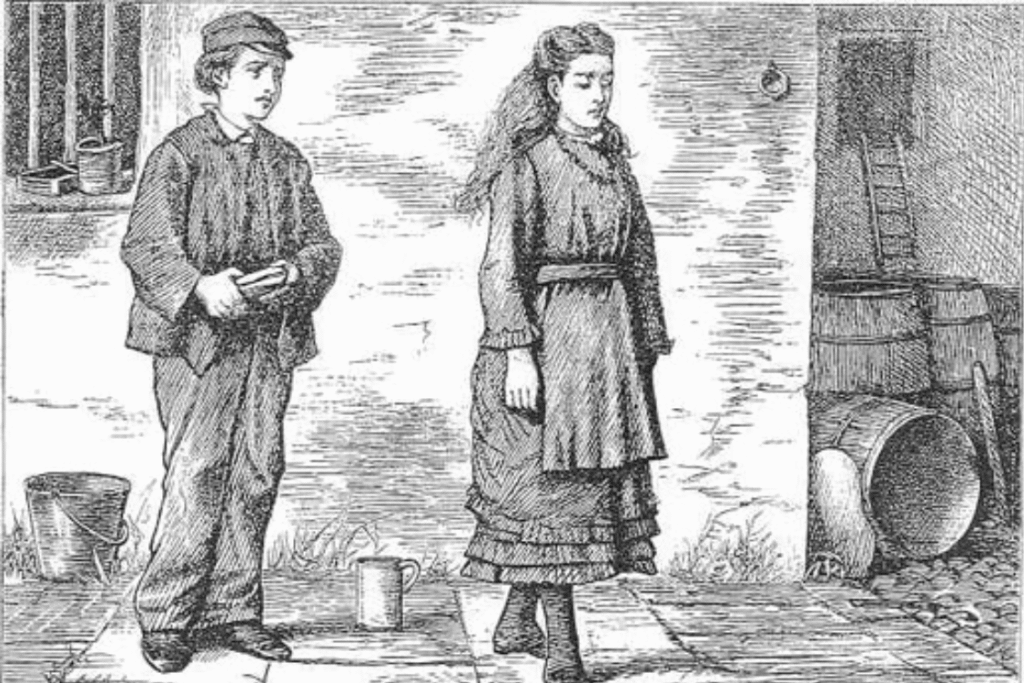
Estella in Great Expectations is Miss Havisham’s adopted daughter, Pip’s great romantic obsession, and one of Charles Dickens’s most complicated characters. Raised to distrust love and break men’s hearts, she can seem proud and unfeeling at first. Yet Dickens gradually shows readers how deeply her upbringing has shaped her.
Through Estella’s relationship with Pip, her life at Satis House, and the truth about her birth, Dickens explores class, identity, love, and the harm caused when adults build a child’s future around their own desires.
Who Is Estella in Great Expectations?
Pip first meets Estella as a child at Satis House, where she lives with Miss Havisham. She is beautiful, confident, and far more polished than Pip, something she makes sure he notices. Miss Havisham encourages the difference between them and quietly watches as Pip grows fascinated by her adopted daughter.
From that first meeting, Estella occupies an unusual place in Pip’s imagination. When she approaches through the dark house, Dickens gives us an image that will follow her throughout the novel.
Her light came along the dark passage like a star.
Pip, Great Expectations, Chapter 8
The comparison suits Estella remarkably well. She draws Pip’s attention like something bright and beautiful, yet she always seems just beyond his reach. Her name reinforces the image too, since Estella echoes the Latin stella, meaning star.
As the story unfolds, however, the elegant young woman Pip admires turns out to have a far more complicated history. Miss Havisham adopted Estella as a child and raised her at Satis House, teaching her to protect herself from love. Later, Pip discovers that her biological parents are Abel Magwitch and Molly, a revelation that challenges much of what he once believed about class and refinement.
Dickens often reveals these truths through sharp conversations rather than long explanations. You can see the same approach throughout our collection of Great Expectations book quotes, where a handful of words can expose an entire relationship.
Estella Character Analysis
Estella is often described as proud, cold, and cruel. Those descriptions are not entirely wrong, especially when we first meet her, but they feel increasingly incomplete once Dickens shows us how she was raised.
Proud and Distant
Young Estella wastes little time making Pip feel inferior. During their first card game, she mocks the visible signs of his working-class upbringing.
And what coarse hands he has! And what thick boots!
Estella, Great Expectations, Chapter 8
Until then, Pip had never thought his hands were something to be ashamed of. They are simply the hands of a boy growing up around a forge. Estella’s judgement changes the way he sees them, and soon he starts looking at himself through her eyes.
He later admits just how quickly her contempt took hold.
Her contempt for me was so strong, that it became infectious, and I caught it.
Pip, Great Expectations, Chapter 8
That reaction reaches far beyond one humiliating afternoon. Pip’s embarrassment spreads to his education, his home, and eventually even Joe. His desire to live as a gentleman starts to feel connected with escaping everything Estella has taught him to regard as common.
Dickens therefore gives her influence more weight than simple childhood cruelty. Estella hurts Pip, certainly, but her words also show how easily social shame can take root when someone we admire suggests that we should be embarrassed by who we are.
More Honest Than She Seems
As Estella grows older, she remains emotionally guarded. However, she is also remarkably direct about what Pip can expect from her.
When he continues to place romantic hopes in her, she gives him a warning that could hardly be clearer.
“You must know,” said Estella, “that I have no heart—if that has anything to do with my memory.”
Estella, Great Expectations, Chapter 29
Estella later explains that she means she has no softness or romantic sympathy to offer. In other words, she understands something about her own emotional limitations, even if Pip refuses to accept them.
That gives their relationship a more uncomfortable edge than the familiar story of a cruel woman and a devoted man. Estella repeatedly tells Pip not to expect love from her, while Pip keeps imagining that another version of her must exist beneath the surface.
He sees her beauty and assumes tenderness must somehow be hidden inside it. As a result, he falls in love not only with Estella herself but also with the woman he hopes she might one day be.
Estella, Pip, and the Love He Imagines
Pip’s feelings for Estella sit at the heart of Great Expectations, although Dickens never treats them as a simple romance. His attachment to her gradually mixes with ambition, class, and his desire to leave his old life behind.
An Unreachable Star
The early image of Estella appearing “like a star” takes on greater meaning as Pip grows older. He can admire her, follow her, and build much of his imagined future around her, yet she remains emotionally out of reach.
Miss Havisham does little to discourage the fantasy. Instead, she encourages Pip’s devotion and allows him to suspect that his new prospects may somehow lead back to Estella.
Soon, Estella represents more than the woman he loves. She comes to stand for the entire life he thinks he wants.
If Pip can grow refined enough, wealthy enough, and gentlemanly enough, perhaps he can escape everything that once made him feel ashamed. Winning Estella would seem to prove that he had successfully left the forge behind.
The trouble is that Pip increasingly loves what Estella represents almost as much as he loves the actual woman.
Against Reason and Hope
Pip eventually recognizes how irrational his obsession is. Still, knowing that does little to loosen its grip.
I loved her against reason, against promise, against peace, against hope, against happiness, against all discouragement that could be.
Pip, Great Expectations, Chapter 29
That is hardly the language of a comfortable love story. Pip knows his attachment brings him little peace or hope, yet he continues to organize much of his emotional life around Estella.
By this point, she is tied to beauty, status, acceptance, and his desire to escape the forge. Loving Estella is now woven into his attempt to reinvent himself.
This is why their story cannot be reduced to whether she eventually returns his feelings. Our closer look at Pip and Estella’s relationship follows their connection from those painful childhood meetings at Satis House to their final encounter.
Estella and Miss Havisham
To understand Estella, we also have to look closely at the woman who raised her. Miss Havisham’s influence does not excuse every cruel thing Estella says or does. However, it helps explain why emotional distance feels almost natural to her.
Raised for Revenge
Miss Havisham adopts Estella after her own romantic betrayal leaves her bitter and obsessed with revenge. Rather than teaching the child how to form healthy relationships, she encourages her to attract men while withholding affection.
In other words, Estella grows up inside someone else’s unfinished heartbreak.
Miss Havisham treats beauty and emotional detachment as weapons. Estella learns those lessons so thoroughly that eventually they turn back on her adoptive mother.
For readers who want to revisit these scenes in full, Project Gutenberg’s complete public-domain text of Great Expectations includes the Satis House conversations and the later confrontation between Estella and Miss Havisham.
The irony becomes especially painful when Miss Havisham starts demanding tenderness from the very person she trained to withhold it.
Made to Be Hard
Their confrontation in Chapter 38 gives Estella some of her most revealing dialogue. When Miss Havisham condemns her emotional coldness, Estella points directly to its source.
“You should know,” said Estella. “I am what you have made me.”
Estella, Great Expectations, Chapter 38
The response lands because Estella is applying Miss Havisham’s own logic. She was raised to resist vulnerability and to attract affection without returning it. Miss Havisham can hardly act shocked when those lessons shape the adult standing before her.
Estella drives the point home when Miss Havisham complains about her pride.
“Who taught me to be proud?” returned Estella. “Who praised me when I learnt my lesson?”
Estella, Great Expectations, Chapter 38
Miss Havisham wants Estella to break other people’s hearts while somehow preserving a separate supply of tenderness for her adoptive mother. Estella exposes the contradiction. Years of emotional training cannot simply be switched off when Miss Havisham wants affection for herself.
This scene gives us a much richer way to read Estella. She has agency and makes choices, but those choices developed within an emotional education carefully designed by someone else.
Interestingly, Estella seems to understand the consequences of that upbringing before Miss Havisham is willing to face them.
What Does Estella Represent in Great Expectations?
Estella represents Pip’s idealized vision of love and social advancement, but Dickens uses her for far more than romance. Through her, the novel questions class assumptions, examines how identity can be shaped, and shows the consequences of adults forcing their own ambitions onto younger lives.
Class and Illusion
To Pip, Estella initially appears naturally superior. She speaks differently, dresses differently, and moves through a world that feels impossibly refined compared with the forge.
Those differences feed Pip’s shame about his background. Yet Dickens eventually reveals that Estella is the daughter of Magwitch and Molly. By the social standards Pip once accepts, her birth should place her nowhere near the world he associates with Satis House.
That revelation quietly undermines the idea that Estella’s refinement comes from some innate superiority. Her education, speech, manners, clothing, and surroundings create the impression that Pip mistakes for high birth.
The irony is wonderfully Dickensian. Pip spends years thinking he must rise above his origins to deserve Estella, only to discover that the woman he associates with social superiority comes from origins Victorian society would hardly consider distinguished.
Through her, appearance and reality collide. Dickens does not need to stop the story for a lecture on class because Estella herself demonstrates how easily social identity can be constructed.
Her background also challenges one of Pip’s deepest assumptions. If gentility can be taught, displayed, and mistaken for birth, then social rank cannot tell us much about a person’s real worth.
By this stage of the novel, Dickens has given us plenty of evidence that character counts for far more than pedigree.
Two Shaped Lives
Estella and Pip also have more in common than either initially realizes.
Both lose their parents at an early age, and both later find themselves caught inside another adult’s ambitions. Magwitch uses his fortune to create the gentleman Pip. Miss Havisham raises Estella to serve as an instrument of revenge against men.
Neither plan is truly centered on the child.
Magwitch wants Pip to prove that he can create a gentleman from a poor boy. Meanwhile, Miss Havisham wants Estella to make other people suffer as she suffered. In each case, an adult designs a young person’s future around a deeply personal dream.
The outcomes differ, but the parallel is difficult to ignore. Pip eventually discovers that true gentility has far less to do with money or status than he once believed. Estella, meanwhile, has to confront how deeply Miss Havisham’s bitterness shaped the way she understands intimacy.
Both spend part of their lives carrying expectations that began with somebody else.
That parallel also gives the novel’s title another layer. The “great expectations” do not belong only to Pip. Throughout the story, characters impose hopes, ambitions, and plans on one another, and Estella carries some of the heaviest consequences.
How Estella Changes
Estella’s development becomes clearest later in the novel, after she marries Bentley Drummle. Her choice frustrates Pip, who cannot understand why she would choose a man he sees as coarse, arrogant, and undeserving.
Marriage to Drummle
Estella does not marry Drummle because she has suddenly discovered romantic love. By this point, she has already told Pip that she cannot offer him the kind of relationship he wants.
Instead, the marriage reinforces how detached she remains from Pip’s idea of love. Unfortunately, the relationship proves deeply unhappy, and Drummle treats her badly.
The years that follow bring Estella a kind of suffering that Miss Havisham’s controlled upbringing never prepared her to understand.
However, it would be unfair to treat that suffering as punishment for rejecting Pip. Estella does not owe him romantic love simply because he loves her. Dickens instead uses her later experiences to show how dramatically her understanding of pain and compassion shifts.
By the time Estella sees Pip again, she can recognize emotions that the younger woman understood only from a distance.
Bent Into Better Shape
Their final conversation shows that change clearly.
I have been bent and broken, but—I hope—into a better shape.
Estella, Great Expectations, Chapter 59
It is a short line, but it carries the weight of everything Estella has experienced since leaving Satis House.
The younger Estella could recognize Pip’s feelings without fully understanding them. The older Estella has lived through enough pain to appreciate the compassion he once offered, and she can finally look back on their relationship with greater self-awareness.
Still, Dickens does not simply transform her into the softer woman Pip always hoped to find. Estella has her own history, regrets, and hard-earned understanding. She is no longer merely the distant figure he once placed on a pedestal.
Their final meeting remains open enough to invite different interpretations, which is why we explore it more fully in our guide to the Great Expectations ending. What matters here is that Pip and Estella meet again only after many of the illusions that once shaped their lives have fallen away.
What Estella Leaves Behind
Estella begins Great Expectations as Pip’s distant star, beautiful enough to admire and far enough away to carry all his fantasies. Dickens gradually replaces that image with a far more human character who is proud, perceptive, wounded, and capable of change.
That is part of what keeps Estella so interesting. She is more than the woman Pip cannot have. Her story asks what happens when someone spends years living according to another person’s expectations, then finally has to discover who remains underneath them.
Leave a Reply