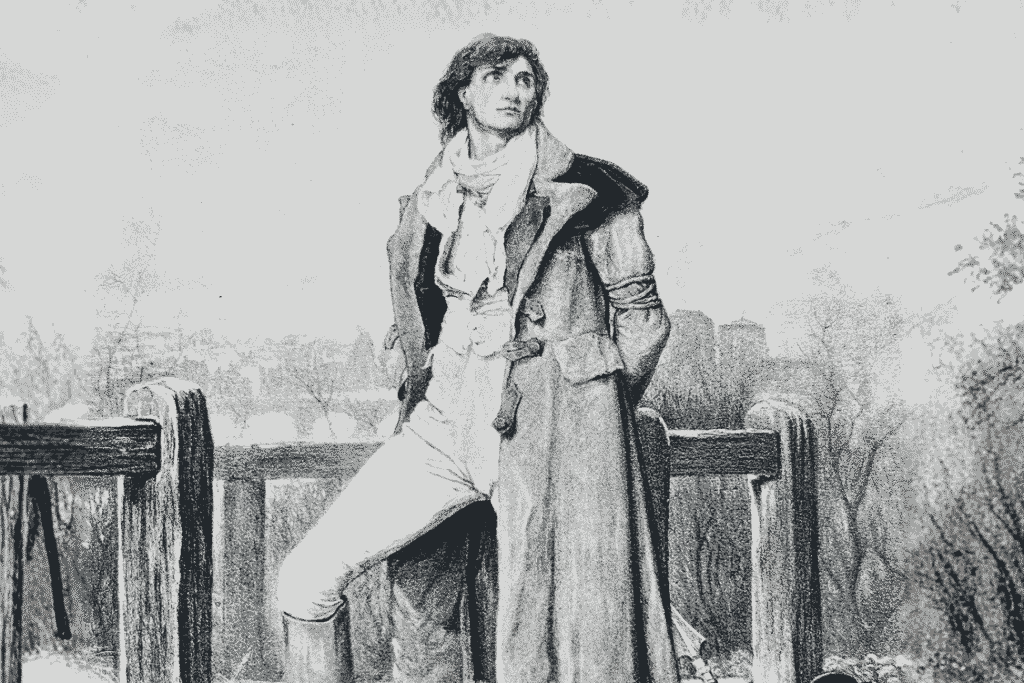
Sydney Carton is a gifted lawyer who sees little worth in himself, even when his actions give readers reasons to disagree. In A Tale of Two Cities, he wastes his talent but often notices when other people need help. His final sacrifice forces us to look again at the man he claims to be.
This Sydney Carton character analysis follows his development through key quotes, from his bitter talks with Charles Darnay to his promise to Lucie Manette. Read together, these passages reveal how his choices challenge his view of himself.
Spoilers follow for the novel’s ending.
JUMP TO:
Who Is Sydney Carton?
Carton is an English lawyer who helps Mr. Stryver defend Charles Darnay against a charge of treason. He looks so much like Darnay that a witness can no longer be sure he has identified the right man. This helps secure Darnay’s release. Although Carton seems uninterested, he pays closer attention than his manner suggests.
For a broader look at Dickens’s language, our collection of A Tale of Two Cities quotes and their meanings explores the novel’s love, injustice, and regret. Carton brings several of those concerns together in one troubled life.
| Trait | Evidence in the novel | Location |
|---|---|---|
| Intelligent and observant | Helps weaken the case against Darnay and prepares legal work for Stryver | Book II, Chapters III–V |
| Harshly self-critical | Describes himself as uncared for and dismisses his prospects | Book II, Chapters IV and XIII |
| Capable of loyalty | Promises to help Lucie and those she loves | Book II, Chapter XIII |
| Compassionate under pressure | Comforts the seamstress as they face execution | Book III, Chapter XV |
We cannot neatly divide Carton’s life into a selfish beginning and a generous ending. Long before his final sacrifice, he struggles with despair while also caring about other people.
Why Does Carton Waste His Talent?
After the court clears Darnay, Carton drinks with him and offers a bleak view of himself.
“I am a disappointed drudge, sir. I care for no man on earth, and no man on earth cares for me.”Sydney Carton to Charles Darnay, A Tale of Two Cities
The sentence sounds final, as though he has weighed his entire life and found nothing worth keeping. Yet it comes from a man who has just helped save someone. His words describe how he feels about his place in the world, but they do not explain everything he does within it.
Dickens makes the difference clearer in Book II’s “The Jackal”. The narrator observes that “although Sydney Carton would never be a lion, he was an amazingly good jackal,” referring to the work he performs for Stryver.
Stryver enjoys the public success, while Carton does much of the thinking and preparation. Calling him simply lazy therefore misses something important. He works hard to help another man succeed while neglecting his own future.
However, Dickens never fully explains this pattern. We learn a little about Carton’s schooldays and early losses, but not enough to know why he lives this way. We can see that he wastes his talent without knowing exactly why. The novel leaves room for questions rather than naming one event that explains his whole life.
What Lucie Recognizes in Him
With Lucie, Carton briefly drops the cold manner he uses to keep people at a distance. He tells her that knowing her has stirred hopes he thought he had lost.

“I wish you to know that you have been the last dream of my soul.”Sydney Carton to Lucie Manette, A Tale of Two Cities
In the full speech, Carton describes more than his love for Lucie. He imagines beginning again, breaking harmful habits, and making something of himself. Her home and her bond with her father help him picture a life shaped by love and purpose.
Even so, he doubts that he can live such a life. He lets himself imagine a better future, then insists it is beyond his reach. Lucie encourages him to try, but he warns her not to expect lasting change.
Later, after her marriage, she asks Darnay to treat Carton with greater understanding.
“I would ask you to believe that he has a heart he very, very seldom reveals, and that there are deep wounds in it. My dear, I have seen it bleeding.”Lucie to Charles Darnay, A Tale of Two Cities
Lucie asks Darnay to look beyond Carton’s manners. Where her husband sees carelessness, she has seen pain. Her kindness does not make her responsible for Carton’s choices, though. She offers him a different view of himself, and he must decide what to do with it.
Sydney Carton and Charles Darnay
Carton’s likeness to Darnay helps drive the plot, but it also draws attention to their differences. Looking at Darnay reminds Carton of the life he believes he could have had.
| Point of comparison | Sydney Carton | Charles Darnay |
|---|---|---|
| Public impression | Careless and disreputable | Courteous and respectable |
| Working life | Uses his ability largely in Stryver’s service | Earns his living teaching French in England |
| Relationship with Lucie | Loves her without expecting marriage | Marries her and builds a family |
| Response to responsibility | Often dismisses himself, then acts decisively in the crisis | Rejects his family’s cruelty and returns to France to help Gabelle |
In literary terms, they act as foils, characters whose differences help us understand each more clearly. Darnay seems to have his life in order, which deepens Carton’s disappointment in himself. Yet Carton’s quick thinking reminds us that good manners and social standing do not tell us everything about a person’s abilities.
It would be too simple, though, to say Darnay never acts. Returning to France to help Gabelle takes courage, even if he misjudges the danger. Both men accept risks for other people, but they differ in how well they understand and handle those risks.
Carton eventually uses their likeness to preserve the life he once resented. The feature that encouraged comparison also makes the rescue possible.
Why Carton Sacrifices Himself
Carton’s final choice fulfils a promise made well before Darnay’s death sentence.
“For you, and for any dear to you, I would do anything.”Sydney Carton to Lucie Manette, A Tale of Two Cities
The words “any dear to you” are essential. His promise includes the people Lucie loves, even when helping them offers him no chance of winning her love. Saving Darnay allows Lucie to keep her husband and their daughter to keep her father.
The rescue also takes careful planning. Carton gets Barsad to help him enter the prison, where he uses his likeness to Darnay to switch places with him. He drugs Darnay and sends him out of the prison, then stays behind to face execution.
These actions give his intelligence a purpose he accepts as his own. Earlier, he used his abilities to support Stryver’s career without building a future for himself. Now he directs them toward protecting people he loves.
His despair remains part of the story, but it cannot explain the whole decision. The plan requires attention, courage, and concern for lives beyond his own. Dickens asks readers to consider both Carton’s suffering and the care expressed through his choice.
Compassion Beyond His Promise
Carton’s meeting with the seamstress takes that care beyond Lucie’s family. As they face execution, he helps her cope with her fear.
“Keep your eyes upon me, dear child, and mind no other object.”Sydney Carton to the seamstress, A Tale of Two Cities
He cannot rescue her, but he can give her attention and reassurance. The scene reveals a kind of generosity that needs no grand plan. Beside someone frightened and vulnerable, Carton chooses to be present.
It also answers his earlier claim that he cares for nobody. Whatever he once believed about himself, the man comforting the seamstress is capable of tenderness toward a stranger.
What His Final Words Actually Mean
The novel closes with the passage most closely associated with Carton.
“It is a far, far better thing that I do, than I have ever done; it is a far, far better rest that I go to than I have ever known.”The narrator’s imagined words for Carton, Book III, Chapter XV, “The Footsteps Die Out For Ever.”
Dickens does not present this as a speech delivered at the guillotine. Instead, the narrator imagines what Carton might have said if he had spoken his thoughts and could see the future. We are reading an imagined farewell, not words someone heard him say.
The “better thing” refers to his sacrifice, while the “better rest” suggests peace after years of inner struggle. By repeating “better,” the passage places his final act beside the life he believes he has wasted.
Before those closing lines, the imagined vision reaches into the future. It pictures Lucie’s family living peacefully, a child carrying Carton’s name, and Paris emerging from revolutionary violence. His death therefore connects with the novel’s larger concern with renewal after suffering.
Resurrection does not mean Carton returns from the dead. Dickens connects the Christian hope of life beyond death with the lives Carton saves and the people who will remember him. The passage gives him a lasting place in a future he will not see.
Does Carton Change or Reveal His Character?
Carton both changes and reveals qualities he has kept hidden. His final actions demand a steadiness we rarely see earlier, but his intelligence and tenderness are not new. Lucie sees some of that goodness before he can trust it himself.
His story can therefore be read as one of redemption, or finding goodness after failure. However, the ending does not resolve every problem in his life. He does not overcome each harmful habit or make an ordinary fresh start. Instead, he makes a choice that challenges his belief that nothing good can come from him.
His early words invite readers to accept his low opinion of himself, while his later actions ask us to reconsider. By the final chapter, we know his failures are real. We also know they never told his whole story.
Leave a Reply