Charles Dickens knew how to make a sentence do several things at once. These A Tale of Two Cities quotes explore love, sacrifice, injustice, and the uneasy distance between who people are and who they might still choose to be.
Charles Dickens gives us a famous opening, an unforgettable ending, and plenty of sharp observations in between. Each quote below includes a brief explanation of its context and meaning.
Set against the French Revolution, the novel moves between London and Paris as private loyalties collide with public violence. Some lines offer hope, while others sound reassuring only until you discover who says them. We’ll look at both, including the choices that make Sydney Carton’s story so difficult to forget.
Explore more of his writing through our Charles Dickens collection.
IN THIS POST
What is A Tale of Two Cities About
A Tale of Two Cities follows Charles Darnay, a French aristocrat who rejects his family’s cruelty, and Sydney Carton, a disillusioned English lawyer whose life becomes intertwined with his.
Set in London and Paris before and during the French Revolution, the novel explores how love, injustice, and revenge shape their lives. Both men love Lucie Manette, whose father spent eighteen years imprisoned in the Bastille.
As revolutionary violence threatens the family, Dickens asks whether people can escape the damage of the past and choose a different future. Those questions give the novel’s famous passages their emotional force, from its opening contradictions to Carton’s final sacrifice.
Dickens explores class, ambition, and personal change in another novel too. Our Great Expectations book quotes offer a closer look.
A Tale of Two Cities Quotes About Life and Human Nature
Some of Dickens’ most memorable observations arrive before the guillotine, romance, and rescue plots fully take over. He is interested in the strange contradictions people carry: hope beside despair, intimacy beside mystery, and crowded lives that can still feel profoundly lonely.
1. The Best and Worst
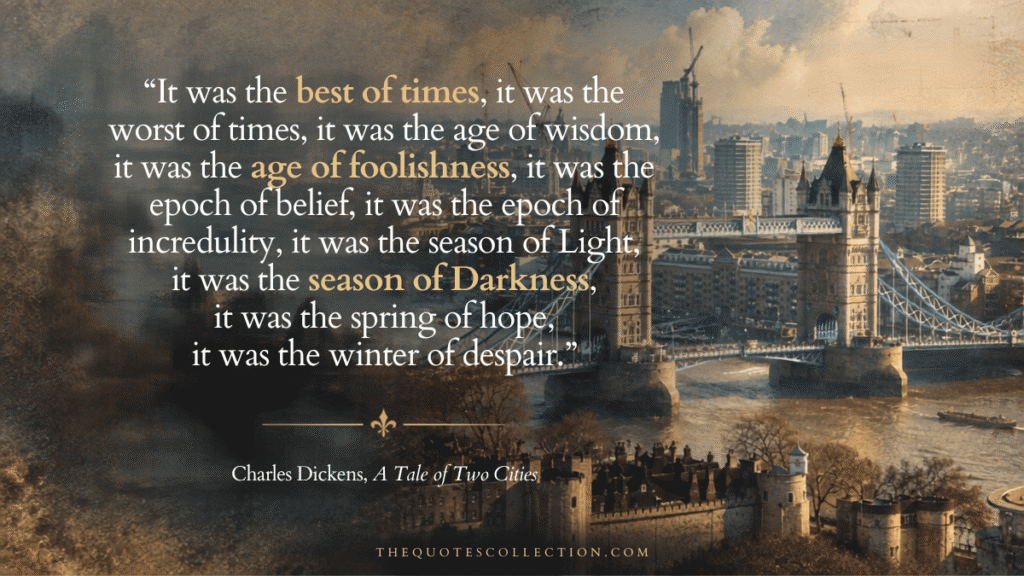
It was the best of times, it was the worst of times, it was the age of wisdom, it was the age of foolishness, it was the epoch of belief, it was the epoch of incredulity, it was the season of Light, it was the season of Darkness, it was the spring of hope, it was the winter of despair…
Charles Dickens, A Tale of Two Cities
Few opening lines announce themselves quite this confidently.
Dickens opens with opposites because the world of the novel contains progress and cruelty, hope and despair at the same time. People who believe they are building a better society can also commit terrible violence. The contradictions prepare us for a story in which promises of freedom collide with revenge.
For a closer look at the opening, explore the meaning of “the best of times, the worst of times”.
2. Everyone Is a Mystery
A wonderful fact to reflect upon, that every human creature is constituted to be that profound secret and mystery to every other.
Charles Dickens, A Tale of Two Cities
We can know someone for years and still never have complete access to what they fear, remember, regret, or hide.
That idea runs throughout the novel. Doctor Manette carries trauma his daughter cannot fully enter, while Sydney Carton hides far more tenderness than his careless exterior suggests. Even among people who love one another, Dickens leaves room for private worlds.
Perhaps knowing someone well does not mean solving them completely.
3. Crowded and Alone
A multitude of people and yet a solitude!
Charles Dickens, A Tale of Two Cities
Darnay says this while listening to the sounds of people moving through the streets below the Manettes’ home.
The contradiction is simple, but Dickens lets it do plenty of work. A crowd can surround us without creating connection, just as a quiet room can hold deep companionship. Later, the footsteps also foreshadow the many lives that will eventually cross this peaceful household.
For a Victorian novel, it is a surprisingly modern description of loneliness.
4. Strength in Sorrow
There is prodigious strength…in sorrow and despair.
Charles Dickens, A Tale of Two Cities
Doctor Manette records these words while describing suffering so severe that the human body somehow keeps enduring it.
Dickens is not romanticizing pain here. Instead, the line recognizes how much people can survive even when survival seems unlikely. Throughout the novel, suffering leaves damage behind, yet it can also reveal reserves of endurance that nobody knew were there.
Strength, unfortunately, does not always arrive under pleasant circumstances.
5. Losing Yourself
Not knowing how he lost himself, or how he recovered himself, he may never feel certain of not losing himself again.
Charles Dickens, A Tale of Two Cities
Miss Pross is talking about Doctor Manette and the lasting effects of his imprisonment.
His freedom does not magically erase eighteen years in the Bastille. Although he has rebuilt a life with Lucie, the possibility of slipping back into his old mental state remains frightening precisely because he cannot fully control it.
Dickens gives recovery a realistic uncertainty. Getting better and never struggling again are not necessarily the same thing. That fragile recovery is central to Dickens’s idea of being recalled to life, or finding a way back to yourself after suffering has nearly erased the person you were.
6. Life in the Moonlight
In the moonlight which is always sad, as the light of the sun itself is—as the light called human life is—at its coming and its going.
Charles Dickens, A Tale of Two Cities
This line appears on the eve of Lucie’s marriage, when happiness and separation are sitting unusually close together.
That mixture suits the novel. Beginnings carry the possibility of endings, while joy often arrives with the knowledge that nothing stays unchanged forever.
Dickens can be rather dramatic about moonlight, admittedly, but in this case he earns it.
Quotes About Love and Sacrifice
The love in A Tale of Two Cities is not limited to romance. Lucie’s devotion to her father, Miss Pross’ fierce loyalty, and Sydney Carton’s feelings for Lucie all ask a harder question: what are we willing to give when we genuinely care about another person?
Some of these lines also sit comfortably beside our collection of romantic quotes from classic literature, although Carton’s version of romance comes with considerably higher stakes.
7. The Last Dream

I wish you to know that you have been the last dream of my soul.
Charles Dickens, A Tale of Two Cities
Sydney Carton knows Lucie will not love him the way he loves her. Even so, meeting her awakens the possibility of a different life in a man who had almost stopped expecting one.
That is what makes the confession more than an unrequited-love line. Lucie represents a version of Carton himself that he wishes he had managed to become.
He cannot build that life with her, but the dream does not disappear without leaving something behind.
8. Ashes Into Fire
You kindled me, heap of ashes that I am, into fire.
Charles Dickens, A Tale of Two Cities
Carton does not flatter himself in this conversation. He sees his life as wasted and expects little from his future.
Yet Lucie makes him feel something he thought had gone out completely. The fire does not immediately transform him, and Carton knows that. However, it proves there is still enough feeling left in him to want something better.
Much later, that spark matters.
9. A Promise of Sacrifice
Think now and then that there is a man who would give his life, to keep a life you love beside you!
Charles Dickens, A Tale of Two Cities
At first, this sounds like the kind of grand promise people make when emotion gets ahead of practicality.
Then Carton actually does it.
The line is powerful because Dickens plants the ending long before it arrives. Carton cannot give Lucie the life he imagines with her, so eventually he gives her something else: the life of the man she loves.
His promise stops being romantic language and becomes a decision.
10. Service of the Heart
There is nothing in it better than the faithful service of the heart.
Charles Dickens, A Tale of Two Cities
Dickens writes this while describing Mr. Lorry’s admiration for Miss Pross, whose devotion to Lucie has no financial motive or social ambition attached to it.
That distinction matters in a novel filled with inherited privilege, political power, and people calculating what others owe them.
By contrast, genuine loyalty asks for very little attention. It simply keeps showing up.
11. The Heart Carton Hides
I would ask you to believe that he has a heart he very, very seldom reveals, and that there are deep wounds in it. My dear, I have seen it bleeding.
Charles Dickens, A Tale of Two Cities
Lucie says this to Charles Darnay after he speaks dismissively about Carton.
She sees something other characters often miss. Carton may act cynical, careless, and self-destructive, but those habits do not tell the whole story.
More importantly, Lucie does not excuse his flaws. She simply refuses to reduce him to them. That compassion becomes one of the quiet forces behind his final transformation.
12. A Far Better Thing
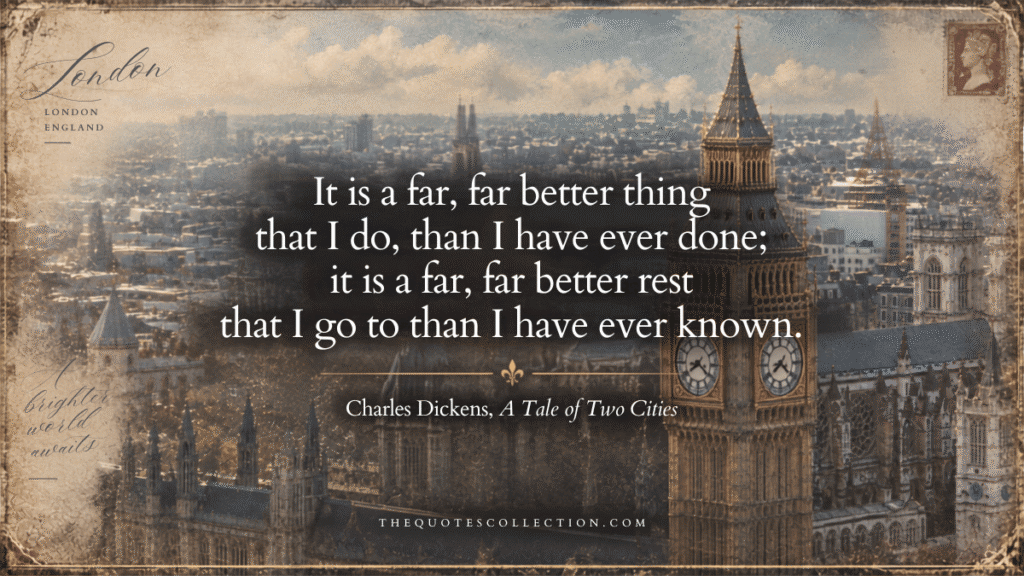
It is a far, far better thing that I do, than I have ever done; it is a far, far better rest that I go to than I have ever known.
Charles Dickens, A Tale of Two Cities
The “far, far better thing” is Sydney Carton’s decision to take Charles Darnay’s place at the guillotine, allowing Lucie and her family to escape. The “better rest” suggests the peace he imagines finding in death after years of disappointment and wasted potential.
Dickens presents these words as Carton’s imagined final thoughts, rather than dialogue spoken aloud. They complete the contrast between the man who believes his life has achieved nothing and the man whose sacrifice gives others a future.
Quotes About Revolution, Justice, and Revenge
A Tale of Two Cities does not pretend the French aristocracy was innocent. Dickens shows poverty, exploitation, hunger, and cruelty creating enormous pressure long before the Revolution explodes.
However, he is equally suspicious of what happens when justice turns into indiscriminate revenge. The Dickens Project at UC Santa Cruz highlights revolution, political change, sacrifice, secrecy, and identity among the novel’s central concerns.
13. What Oppression Creates
Crush humanity out of shape once more, under similar hammers, and it will twist itself into the same tortured forms.
Charles Dickens, A Tale of Two Cities
By the final chapters, the Revolution has produced horrors of its own. Dickens nevertheless refuses to treat that violence as something that appeared from nowhere.
People who are crushed for generations do not emerge untouched. Abuse changes individuals and societies, sometimes in frightening ways.
The warning runs in both directions: oppression is destructive, but suffering does not automatically make its victims merciful.
14. Sow the Same Seed
Sow the same seed of rapacious license and oppression over again, and it will surely yield the same fruit according to its kind.
Charles Dickens, A Tale of Two Cities
This follows the previous warning and makes the cycle even clearer.
If the same conditions are recreated, Dickens argues, we should not be surprised when similar anger follows. Changing who holds the power is not enough if the new system repeats the cruelty of the old one.
Revolutions may replace rulers quickly. Human habits are less cooperative.
15. Revenge Takes Time
Vengeance and retribution require a long time; it is the rule.
Charles Dickens, A Tale of Two Cities
Madame Defarge is patient because her hatred has been growing for years.
To her, vengeance is not a sudden emotional outburst. It is something stored, fed, and prepared until the opportunity finally arrives. Dickens uses that patience to make her more frightening, but it also mirrors the larger Revolution gathering beneath years of inequality.
By the time the lightning strikes, the storm has been forming for a very long while.
16. Nothing Done in Vain
Nothing that we do, is done in vain. I believe, with all my soul, that we shall see the triumph.
Charles Dickens, A Tale of Two Cities
Taken alone, this sounds wonderfully motivational.
Context complicates things.
Madame Defarge says it while discussing revolutionary vengeance, convinced that every small act is moving them closer to victory. Her determination is impressive, yet the cause she serves increasingly loses any boundary between justice and bloodlust.
Sometimes conviction is powerful because it is right. Sometimes it is simply powerful.
17. The Mirage of Doing Good
That glorious vision of doing good…is so often the sanguine mirage of so many good minds.
Charles Dickens, A Tale of Two Cities
Darnay returns to France partly because he imagines he may be able to help during the Revolution. The impulse is generous, but the timing is disastrous.
Dickens understands how easily good intentions can create confidence that the situation itself does not justify. Wanting to help is admirable, but it does not make us immune to misjudgment.
Darnay learns that particular lesson somewhere between London and a Paris prison cell.
18. Caught by the Fever
In seasons of pestilence, some of us will have a secret attraction to the disease—a terrible passing inclination to die of it.
Charles Dickens, A Tale of Two Cities
Dickens compares revolutionary frenzy to an infection spreading through the public mind.
People do not always behave as isolated, rational individuals when fear, violence, and excitement sweep through a crowd. Instead, they can be pulled toward actions they might never have considered alone.
It is one of the novel’s darker observations about human nature: sometimes danger becomes more attractive simply because everyone else is rushing toward it.
Quotes About Loneliness and Regret
Not every memorable Dickens line carries a revolution, a doomed romance, or the weight of civilization on its shoulders. Some simply reveal how observant he could be about work, loneliness, regret, and the odd ways people protect themselves.
19. Second-Hand Cares
Perhaps second-hand cares, like second-hand clothes, come easily off and on.
Charles Dickens, A Tale of Two Cities
Dickens is describing the clerks at Tellson’s Bank, who spend their working lives handling other people’s problems without necessarily carrying those troubles home.
It is a wonderfully dry observation about professional concern. We can care deeply about a problem while it is in front of us and then, sometimes mercifully, take it off at the end of the day.
Apparently, work-life boundaries existed before anyone called them that.
20. Carton at His Lowest
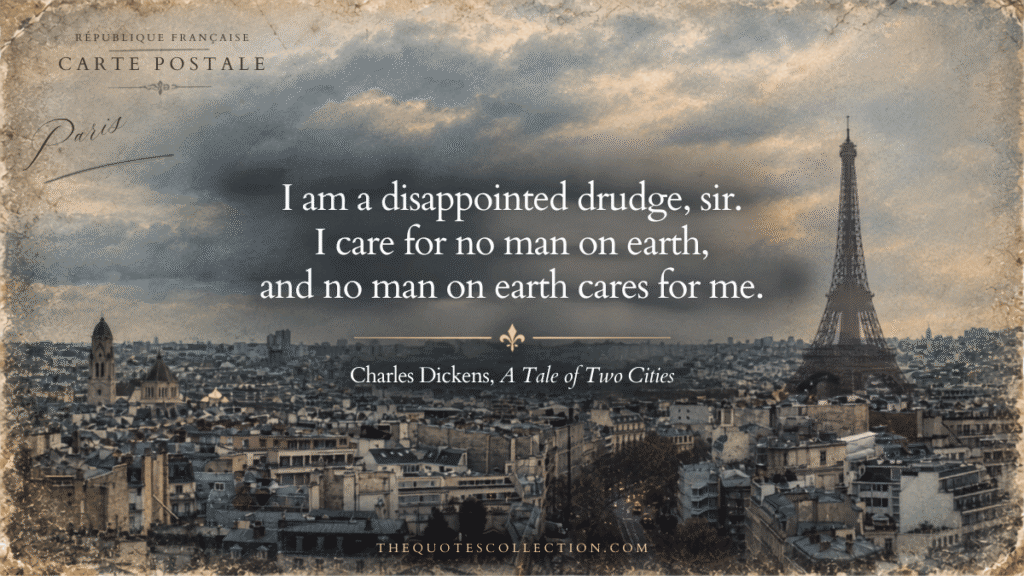
I am a disappointed drudge, sir. I care for no man on earth, and no man on earth cares for me.
Charles Dickens, A Tale of Two Cities
Early Carton has already decided what kind of person he is.
That certainty is part of his tragedy. He is intelligent enough to recognize his wasted potential but too defeated to imagine himself doing anything about it.
Later events make the line almost painful to revisit because we know he is wrong about at least one thing: people do care for him. Eventually, he learns to care enough to act on it too.
21. A Dream That Ends
A dream, all a dream, that ends in nothing, and leaves the sleeper where he lay down, but I wish you to know that you inspired it.
Charles Dickens, A Tale of Two Cities
Carton believes the better life Lucie briefly makes him imagine will never happen.
In one sense, he is right. He does not reform conventionally, marry, settle down, and start over. Yet his conclusion that the dream “ends in nothing” turns out to be wrong.
The possibility of becoming better stays with him long enough to shape what he eventually chooses.
22. A Young Road Going Nowhere
I am not old, but my young way was never the way to age.
Charles Dickens, A Tale of Two Cities
Near the end, Carton speaks with Mr. Lorry about aging, memory, and the lives they have led.
His own line carries a quiet awareness that he never expected to grow old. Years of self-neglect have made the future feel almost unnatural to him.
Soon afterward, he chooses exactly how his life will end. Yet instead of treating that ending as another waste, Dickens transforms it into the first decision Carton makes with complete purpose.
What Dickens Leaves Us With
The most memorable Charles Dickens quotes in A Tale of Two Cities rarely offer easy comfort. Love can go unanswered. Suffering can strengthen people or harden them. Political injustice can create righteous anger, while that same anger can eventually become another form of cruelty.
Yet Dickens keeps making room for choice.
Doctor Manette rebuilds a life after imprisonment. Lucie chooses compassion even when others see only Carton’s failures. And Carton, who spends years convinced that he has wasted himself beyond repair, ultimately discovers that his next decision matters more than his previous ones.
Perhaps that is why the novel’s final sacrifice lands so powerfully. Dickens does not ask us to believe people are always good. He gives us something more interesting: the possibility that they are not finished yet.
Leave a Reply