“Recalled to life” sounds almost supernatural, and Dickens wants it to. In A Tale of Two Cities, the phrase first refers to Dr. Manette returning to the world after eighteen years in the Bastille, but its meaning expands as the novel unfolds.
Dickens uses it for physical freedom, emotional recovery, second chances, and finally sacrifice. Characters repeatedly escape one kind of death only to discover that being alive is not quite the same as having a life worth living.
- What Does “Recalled to Life” Mean?
- Dr. Manette Has Been “Buried” for Eighteen Years
- Lucie Helps Restore Her Father
- Jerry Cruncher Gives the Phrase a Dark Joke
- Charles Darnay Is Recalled to Life More Than Once
- Sydney Carton Changes the Meaning of Resurrection
- Why Is Book One Called “Recalled to Life”?
- Is “Recalled to Life” About Resurrection or Redemption?
- What “Recalled to Life” Adds to the Novel
- Final Thoughts
What Does “Recalled to Life” Mean?
In its simplest sense, “recalled to life” means being brought back from a state that resembles death. Dickens first uses it as a coded message about Dr. Alexandre Manette, who has survived eighteen years of secret imprisonment and is finally free.
Mr. Lorry receives a message telling him to wait at Dover for Lucie Manette. His reply is deliberately cryptic:
“Jerry, say that my answer was, Recalled to life.”Mr. Jarvis Lorry, A Tale of Two Cities
At this point, neither Jerry Cruncher nor the reader fully understands what the words mean. Dickens lets the mystery linger because Manette has not simply been released from prison. He has spent so long cut off from ordinary life that returning to it will require far more than opening a door.
The phrase is one of several examples of Dickens packing a larger theme into a memorable line. Our collection of Charles Dickens quotes explores more of the passages where a few words carry much of the novel’s emotional weight.
Dr. Manette Has Been “Buried” for Eighteen Years
Dickens pushes the image further in the next chapter, when Mr. Lorry imagines speaking with the man he is traveling to recover. The conversation sounds less like someone discussing a former prisoner and more like someone standing beside a grave.
“Buried how long?”
“Almost eighteen years.”
“You know that you are recalled to life?”
“They tell me so.”
– Mr. Lorry’s imagined conversation with Dr. Manette, A Tale of Two Cities, Book the First, Chapter III, “The Night Shadows”
The language turns imprisonment into a kind of living burial. Dr. Manette has survived physically, but eighteen years in isolation have stripped away much of his former identity. When Lorry imagines asking whether he cares to live, the answer is painfully uncertain: “I can’t say.”
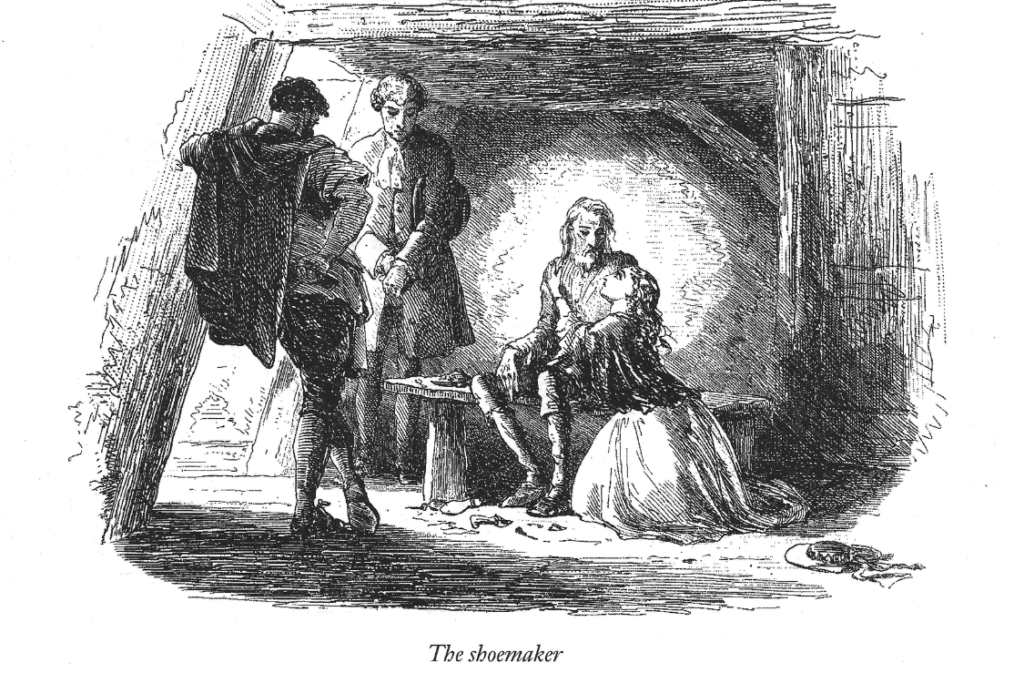
That reply is important because Dickens does not treat freedom as an instant cure. Manette has left the Bastille, yet part of him remains trapped there. His compulsive shoe-making, confusion, and later relapses reveal how deeply imprisonment has marked him.
Being recalled to life, then, is not a single event. For Manette, it is a slow return to identity, relationships, purpose, and ordinary human connection.
Lucie Helps Restore Her Father
Lucie Manette gives the resurrection theme its emotional center. Before she meets her father, Mr. Lorry explains that their journey to Paris is not merely about finding him. Lucie is going there, he says, to restore her father to “life, love, duty, rest, comfort.”
The wording tells us what Manette has lost. His imprisonment did not only take away his freedom. It separated him from affection, responsibility, rest, and the relationships through which he once understood himself.
Lucie cannot erase what happened to him, and Dickens does not pretend that she can. Manette later suffers a serious relapse and returns to shoe-making when old trauma overwhelms him. His recovery is therefore less like waking from a long sleep and more like rebuilding a life after years of damage.
Readers can check the original wording and surrounding chapters in Project Gutenberg’s A Tale of Two Cities. The repeated burial and resurrection language begins early and continues across the novel.
Jerry Cruncher Gives the Phrase a Dark Joke
Jerry Cruncher hears “recalled to life” very differently.
After carrying Mr. Lorry’s message, Jerry worries about what would happen if recalling people to life became fashionable. The joke makes more sense once Dickens reveals Jerry’s secret occupation. By night, he works as a “resurrection man,” digging up recently buried bodies and selling them for medical study.
Suddenly the phrase has two meanings. Dr. Manette is metaphorically being raised from a living grave, while Jerry makes money by quite literally removing dead people from theirs.
Dickens often places comedy beside darker ideas, and Jerry’s reaction gives the resurrection theme an almost grotesque edge. Life and death are never very far apart in this novel, whether the setting is a graveyard, a prison cell, a courtroom, or eventually the guillotine.
Charles Darnay Is Recalled to Life More Than Once
The phrase does not remain tied to Dr. Manette. Dickens brings it back when Charles Darnay narrowly escapes death.
After Darnay is acquitted of treason in London, Jerry receives the news and immediately recognizes the pattern:
“If you had sent the message, ‘Recalled to Life,’ again… I should have known what you meant, this time.”Jerry Cruncher, A Tale of Two Cities, Book the Second, Chapter III
Darnay has not risen from a literal grave, but the verdict returns him from the edge of execution. Later, the same idea reaches its most dramatic form when he is condemned to the guillotine in Paris.
This time, Sydney Carton gives Darnay his life back by taking his place.
The repetition matters. Dickens gradually moves “recalled to life” away from one man’s release from prison and toward a broader idea of people receiving another chance when death, despair, or the consequences of the past seem final.
Sydney Carton Changes the Meaning of Resurrection
Sydney Carton makes the resurrection theme more complicated because saving another person costs him his own life.
For much of the novel, Carton believes he has wasted his abilities. He sees what he could have been, yet he has little faith in his ability to change course. His love for Lucie does not lead to the life he once imagined, but it eventually gives him a reason to act beyond himself.
Our Sydney Carton character analysis looks more closely at how Dickens develops that movement from self-contempt to deliberate sacrifice.
As Carton prepares to save Darnay, biblical words about resurrection repeatedly return to his mind:
“I am the resurrection and the life…”
The words come from Scripture, remembered by Carton after having heard them at his father’s grave. Dickens repeats them as Carton walks through Paris and again near the guillotine, tying his final decision directly to death, renewal, and the possibility that a life can gain meaning through sacrifice.
Carton does not escape death in the way Darnay does. His renewal is different. By choosing to save Darnay and protect Lucie’s family, he turns a life he regarded as wasted into one that leaves a lasting good behind.
Why Is Book One Called “Recalled to Life”?
Dickens names the entire first book “Recalled to Life” because Dr. Manette’s return establishes one of the novel’s central patterns.
The title first points to Manette, but it also prepares us to notice similar reversals throughout the story. Prisoners return to freedom, men escape death sentences, damaged identities are rebuilt, and people who have lost hope discover reasons to act again.
Yet Dickens rarely makes resurrection easy. Manette struggles after his release, Darnay repeatedly finds himself in danger, and Carton reaches renewal through sacrifice rather than rescue. A second chance may open the door, but what someone does with that chance gives it meaning.
This distinction keeps the theme from turning sentimental. Dickens is interested in restoration, but he does not ignore the suffering that makes restoration necessary.
Is “Recalled to Life” About Resurrection or Redemption?
It is about both, although the two ideas are not identical.
Resurrection describes the repeated movement from death, imprisonment, despair, or condemnation back toward life. Dr. Manette emerges from the Bastille, while Darnay twice escapes situations that could have killed him.
Redemption is especially important for Carton. He cannot reclaim the years he feels he wasted, nor does Dickens suddenly transform him into a different person. Instead, Carton makes one choice that gives those years a different ending.
His sacrifice also recalls Darnay to life in the most direct sense. One man walks toward the guillotine so another can return to his wife, child, and future.
Dickens therefore connects resurrection with responsibility. A renewed life is valuable not simply because it continues, but because of what can be done with it.
What “Recalled to Life” Adds to the Novel
The phrase begins as a mysterious message on a dark road, but Dickens keeps widening its meaning. What first describes Dr. Manette eventually reaches Darnay, Carton, Jerry Cruncher, and the novel’s larger fascination with burial, memory, sacrifice, and renewal.
More importantly, A Tale of Two Cities refuses to treat resurrection as a magical reset. Manette carries his prison with him, Darnay cannot entirely escape his family history, and Carton finds redemption without escaping death.
To be “recalled to life” is therefore more than surviving. Dickens uses the phrase for the difficult possibility of returning to love, purpose, identity, or hope after something has nearly destroyed them.
Final Thoughts
“Recalled to life” begins as a secret message about a man released from the Bastille, but it grows into one of the ideas holding A Tale of Two Cities together. Dr. Manette must rebuild himself after imprisonment, Darnay repeatedly escapes death, and Sydney Carton finds purpose by giving another man the future he cannot have.
Dickens’s point is not simply that people can survive terrible things. His characters suggest something harder and more hopeful: even a broken life may find meaning when given another chance.
Leave a Reply