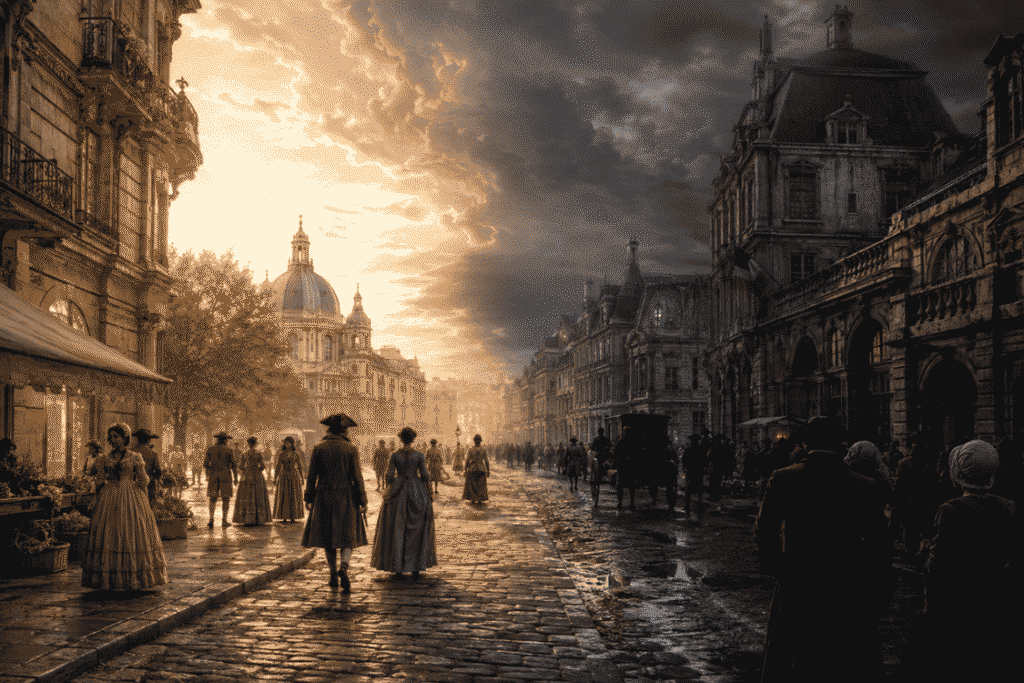
“It was the best of times, it was the worst of times” means that hope and suffering can exist at the same time. Charles Dickens opens A Tale of Two Cities with a world full of contradictions, where progress sits beside inequality and optimism exists alongside fear.
However, the famous line does more than describe one turbulent period. It quietly introduces the pattern Dickens follows throughout the entire novel.
JUMP TO:
- The Quote in Context
- What Does “It Was the Best of Times, It Was the Worst of Times” Mean?
- Why Does Dickens Use So Many Opposites?
- How the Opening Connects to the Rest of the Novel
- What Was Happening in France?
- Why the Best Times Can Also Be the Worst
- The Opening Foreshadows the Whole Story
- Why the Quote Still Feels So Modern
- Final Thoughts
The Quote in Context
Charles Dickens published A Tale of Two Cities in 1859, although the story begins in 1775 and moves toward the French Revolution. Much of the novel takes place between London and Paris, following characters whose lives become tangled in political unrest, revenge, love, and sacrifice.
Dickens begins with one of literature’s most recognizable passages:
It was the best of times, it was the worst of times, it was the age of wisdom, it was the age of foolishness…
Charles Dickens, A Tale of Two Cities
He continues by pairing belief with disbelief, light with darkness, and hope with despair. Readers who want to see the passage in its original setting can read A Tale of Two Cities through Project Gutenberg.
From the first paragraph, Dickens makes one thing clear. This will not be a story where history can easily be divided into good times and bad times.
What Does “It Was the Best of Times, It Was the Worst of Times” Mean?
At its simplest, the quote means that a period can be wonderful for some people and terrible for others. Even the same person can experience hope and hardship at once.
Dickens is describing a society filled with extremes. Some people enjoy wealth and privilege, while others struggle with poverty and oppression. Meanwhile, political change creates hope for a fairer future, but it also brings fear, instability, and eventually violence.
Another line from the same opening makes the contrast even clearer:
“It was the spring of hope, it was the winter of despair.”
Spring suggests renewal and possibility. Winter suggests hardship and darkness. By placing the two images together, Dickens shows how contradictory the period feels.
In other words, he refuses to give history a simple label. A society can make progress while still failing many of its people.
Why Does Dickens Use So Many Opposites?
Dickens could have told readers that the period was complicated. Instead, he builds the opening almost entirely from opposites.
We get the best and the worst, wisdom and foolishness, belief and disbelief, light and darkness, hope and despair. This literary technique is called antithesis, where contrasting ideas appear side by side to make their differences more striking.
At the same time, Dickens uses parallelism. Each phrase follows a similar structure, which gives the passage a strong rhythm and makes it unusually memorable.
The repetition also creates tension. With every new pair, the world seems to pull further in two directions. As a result, readers feel the instability of the period before Dickens has even introduced the main characters.
How the Opening Connects to the Rest of the Novel
The opening does not simply describe the historical background. It gives us a preview of the contrasts that will shape the entire story.
For example, London stands beside Paris. Love exists beside hatred, while sacrifice repeatedly confronts selfishness. Even justice becomes complicated when the desire to correct oppression starts turning into revenge.
Sydney Carton and Charles Darnay provide perhaps the clearest example. Darnay appears respectable and purposeful, while Carton initially seems cynical, unhappy, and convinced that he has wasted his life. However, their roles become much less simple as the novel continues.
If you want to explore more of these ideas through Dickens’s own words, our collection of A Tale of Two Cities quotes looks at Carton, Darnay, sacrifice, love, and other memorable passages from the novel.
What Was Happening in France?
The historical background helps explain why Dickens begins with such extreme contrasts.
Before the French Revolution, France faced severe social and economic inequality. The aristocracy enjoyed privileges that ordinary people did not, while many families struggled under poverty, taxation, and rising food costs. Consequently, resentment toward the ruling classes continued to grow.
Dickens clearly sympathizes with people who suffered under the old system. However, he does not turn the Revolution into a simple story of heroic rebels defeating cruel rulers.
Instead, he shows how anger can become revenge. Once violence takes over, people who once demanded justice can begin creating new victims.
Because of this, A Tale of Two Cities repeatedly asks whether injustice can truly be corrected through more injustice.
Why the Best Times Can Also Be the Worst
The opening still feels modern because contradictory experiences are hardly unique to eighteenth-century France.
Technology can make everyday life easier while leaving people anxious about jobs and privacy. Medical discoveries can save lives during periods of political instability. Likewise, a strong economy can exist while individual families still struggle with rent, food, or debt.
The contradiction can be personal too. Someone might finally get the job they wanted while grieving someone they love. A family can celebrate a new baby during an otherwise difficult year.
Therefore, calling something “the best” does not mean the painful parts disappear. The opposite is also true. Difficult times can still contain moments of love, hope, and progress.
Dickens leaves room for both realities, and that is life in a nutshell for most of us.
The Opening Foreshadows the Whole Story
As the novel develops, Dickens keeps returning to the same pattern he introduces in the first paragraph.
Love and Sacrifice
Sydney Carton begins as someone who seems to have given up on himself. Yet his love for Lucie Manette eventually gives his life a purpose he did not believe it had.
By the end, the character who appeared most wasted becomes capable of the novel’s greatest sacrifice.
Justice and Revenge
The Revolution begins with legitimate anger toward an abusive system. However, Dickens writes about how quickly justice can turn into vengeance when hatred becomes its driving force.
Madame Defarge represents this darker side of the Revolution. Her anger comes from real suffering, but over time, revenge consumes almost everything else.
Death and Renewal
Finally, images of death and resurrection appear throughout the story. Dr. Manette returns to life after years of imprisonment, while Carton’s final act transforms what looks like defeat into something meaningful.
His famous closing thought captures this final reversal:
“It is a far, far better thing that I do, than I have ever done…”
The novel begins with opposites and ends with one more. Death becomes sacrifice, and an ending creates the possibility of a better future.
Why the Quote Still Feels So Modern
More than 160 years after the novel was published, people still borrow Dickens’s opening whenever the world feels difficult to describe.
Part of its power comes from its refusal to choose one extreme. Human beings naturally want simple stories about whether things are improving or getting worse. Yet reality rarely cooperates.
A period can contain extraordinary scientific progress and deep social anxiety. People can have more information than ever while struggling to agree on basic facts. Likewise, societies can become wealthier while debates over inequality grow louder.
Perhaps this is why Dickens’s line never seems to age. Every generation finds reasons to recognize itself in those contradictions.
Final Thoughts
The meaning of “it was the best of times, it was the worst of times” goes far beyond the French Revolution. Dickens uses the line to show readers that progress and suffering, hope and despair, and love and violence can exist in the same moment.
More importantly, the opening teaches us not to judge an era too quickly. History becomes much more complicated when we look beyond the label.
If Dickens were describing our own time today, would he call it the best of times, the worst of times, or once again somehow both?
Leave a Reply