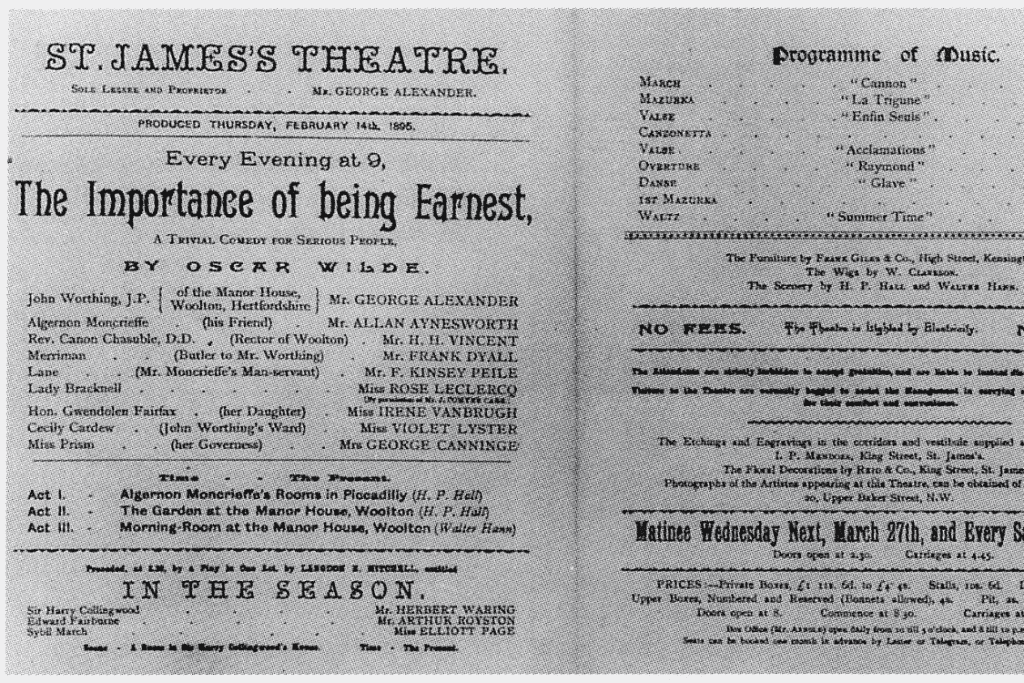
Oscar Wilde puts one of his sharpest lines about truth in the mouth of a practiced liar.
When Algernon Moncrieff says, “The truth is rarely pure and never simple,” he is responding to Jack Worthing’s confession that he leads a double life. The joke is clever on its own, but the surrounding scene gives it much more bite. Wilde is poking at the idea that honesty arrives neatly packaged, especially when people have motives, reputations, and social expectations to protect.
By the end of The Importance of Being Earnest, even Jack’s elaborate lie turns out to contain an absurd amount of truth.
What Does “The Truth Is Rarely Pure and Never Simple” Mean?
“The truth is rarely pure and never simple.”Algernon Moncrieff, The Importance of Being Earnest, Act I
Algernon means that truth is rarely untouched by conflicting motives or human self-interest. Even when the facts themselves are clear, the reasons behind what people do can be far more complicated.
Wilde turns the idea into a paradox. We tend to associate truth with clarity, yet Algernon suggests that real life refuses to cooperate with such tidy expectations. People omit details, justify themselves, soften uncomfortable facts, and tell stories in ways that protect the version of themselves they prefer.
This is not a solemn philosophical lecture. Algernon is joking with Jack, and the comedy matters because both men are already experts at bending reality when it suits them.
The Lie Behind the Famous Line
The exchange begins after Algernon presses Jack to explain why he is known as Ernest in London but Jack in the country. Jack finally admits that he invented a reckless younger brother named Ernest, giving himself an excuse to escape his responsibilities whenever country life feels too restrictive.
After revealing the arrangement, Jack announces:
“That, my dear Algy, is the whole truth pure and simple.”Jack Worthing, The Importance of Being Earnest, Act I
Algernon immediately replies with the famous line.
The timing gives the joke its edge. Jack has just spent several sentences explaining an elaborate deception, then describes the confession as “pure and simple.” Algernon hears the contradiction and pounces on it.
He is hardly in a position to claim moral superiority, either. Algernon has invented an invalid friend called Bunbury so he can escape social obligations whenever necessary. Two men who routinely create fictional people for their own convenience are now discussing the nature of truth.
Wilde clearly knew what he was doing.
For more of his humor, our collection of funny Oscar Wilde quotes gathers verified lines from across his plays and fiction.
Why “Pure and Simple” Is Part of the Joke
The phrase “pure and simple” normally means something is exactly what it appears to be, without qualification or complication. Jack uses it to assure Algernon that his confession is finally straightforward.
Algernon takes the familiar expression apart. Jack offers a truth that is “pure and simple.” Algernon replies that truth is rarely pure and never simple. Instead of merely disagreeing, he turns Jack’s own language against him.
The wordplay also fits the larger comedy. Almost nothing in The Importance of Being Earnest is as straightforward as it seems at first.
Names are invented, identities shift, engagements multiply, and respectable people hide behind elaborate social performances. Wilde takes an ordinary phrase and turns it into a summary of an entire play.
Why Algernon Thinks Simple Truth Would Be Boring
Algernon does not stop after the famous first sentence. He continues by joking that modern life would be terribly dull if truth were pure or simple, while modern literature would hardly be possible at all.
He has a point, at least where stories are concerned.
Fiction thrives on secrets, misunderstandings, divided loyalties, hidden motives, and people pretending to be someone they are not. The Importance of Being Earnest contains all of them. Jack invents Ernest. Algernon invents Bunbury. Gwendolen is determined to marry a man called Ernest, while Cecily develops feelings for an Ernest who initially exists only as Jack’s imaginary brother.
A perfectly uncomplicated truth would ruin most of the fun before Act II.
Wilde is also making a joke about literature itself. If every character said exactly what they meant, wanted only one thing, and never concealed anything, many stories would be over remarkably quickly.
Truth, Deception, and Respectability
Jack’s double life is not simply a prank. He creates Ernest because his role as Cecily’s guardian requires him to maintain an image of moral seriousness in the country. His imaginary brother gives him a respectable excuse to leave.
The deception exposes one of Wilde’s favorite targets: social respectability.
Jack is expected to behave according to a rigid public role, so he invents another identity that allows him more freedom. Algernon does much the same with Bunbury. Rather than openly refusing obligations they dislike, both men create socially acceptable excuses.
Later, Jack admits that truth is not always the sort of thing one tells to a refined young woman, another joke that places sincerity below social convenience.
Wilde is not simply saying that people lie because they are dishonest. In this comedy, deception often grows out of the pressure to appear respectable. The characters maintain polished public identities while privately looking for ways around the rules.
That tension gives Algernon’s remark more substance than a generic quote about life being complicated.
Is Wilde Saying Truth Does Not Exist?
It would be easy to turn the quote into a modern claim that everyone has their own truth or that facts are entirely subjective, but the scene does not require that interpretation. Algernon is talking about the messy way human beings handle truth, not denying that reality exists.
People can agree on what happened while disagreeing about why it happened, whether it was justified, or which details deserve attention. Motives can also overlap. Someone may leave a job for better pay while also feeling overlooked, exhausted, and ready for a change.
None of those complications erase the facts. They simply make the full explanation harder to squeeze into one clean sentence.
Algernon himself is also an unreliable philosopher. He invents Bunbury whenever social obligations interfere with his plans, so readers are meant to enjoy his cleverness without treating every epigram as Wilde’s personal creed.
The Ending Brings the Joke Back
Wilde gives the idea one final twist in Act III.
Jack eventually learns that the identity he invented was not entirely invented after all. His real name is Ernest, which means years of pretending to be Ernest in London accidentally placed him closer to the truth than he realized.
“It is a terrible thing for a man to find out suddenly that all his life he has been speaking nothing but the truth.”Jack Worthing, The Importance of Being Earnest, Act III
The joke completes the circle. Jack begins the play carefully managing a lie and ends it horrified to discover that the lie contained an unexpected truth.
Wilde could hardly have found a better demonstration of Algernon’s earlier claim. Truth in this play is certainly not simple, and it has a mischievous habit of appearing in places where nobody intended to put it.
Why the Quote Still Feels Familiar
Most people rarely explain themselves with complete simplicity because human motives tend to arrive in clusters. We make decisions for practical reasons, emotional reasons, selfish reasons, generous reasons, and sometimes reasons we understand only after the fact.
Consider a relationship that supposedly ended because of “one argument.” The argument may have been real, but years of resentment, mismatched expectations, poor communication, or changing priorities may sit behind it. A simple explanation can be accurate without being complete.
Wilde’s line captures that difference neatly. Complexity does not automatically make something false. Sometimes the truth becomes more accurate when we stop demanding that it fit into a convenient little box.
Is “The Pure and Simple Truth Is Rarely Pure and Never Simple” Correct?
No. The popular wording reverses part of the original exchange. The authentic line spoken by Algernon is:
“The truth is rarely pure and never simple.”
Jack is the character who uses the phrase “the whole truth pure and simple” immediately beforehand. Over time, the two lines appear to have been blended into the familiar variation, “The pure and simple truth is rarely pure and never simple.” Wikiquote also identifies that wording as a commonly circulated variant rather than the original text.
Readers who want to check the scene can find the original play through Project Gutenberg’s edition of The Importance of Being Earnest.
Final Thoughts
“The truth is rarely pure and never simple” gives a complicated idea an effortless punchline. Algernon is teasing Jack, yet the rest of the play keeps proving his joke surprisingly useful as identities, motives, and outright inventions collide.
By the final scene, Jack discovers that even his carefully constructed false identity carried an inconvenient piece of truth. Wilde’s joke was never simply that people lie. It was that truth has a habit of being far stranger, messier, and more entertaining than the tidy version we expect.
Leave a Reply