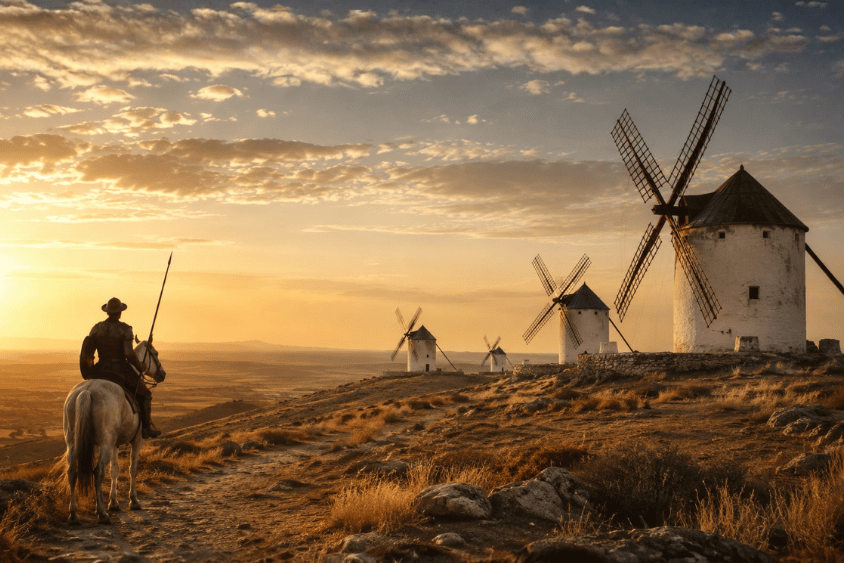
Some battles look heroic right up until you realize the giant was a windmill. “Tilting at windmills” means fighting an imagined enemy, chasing an unrealistic cause, or wasting effort on a problem that is not what you think it is.
The phrase comes from Miguel de Cervantes’s Don Quixote, where the title character mistakes ordinary windmills for giants and charges at them anyway. More than 400 years later, the scene remains meaningful because people remain remarkably good at fighting the wrong battle with complete confidence.
JUMP TO:
- What Does “Tilting at Windmills” Mean?
- Where Does “Tilting at Windmills” Come From?
- What Happens in the Don Quixote Windmill Scene?
- Why Is It Called “Tilting” at Windmills?
- What Do the Windmills Symbolize?
- What Does Tilting at Windmills Look Like Today?
- Is Tilting at Windmills Always a Bad Thing?
- Why the Phrase Still Works Today
- Final Thoughts
What Does “Tilting at Windmills” Mean?
Today, people use “tilting at windmills” when someone spends time and energy fighting something imaginary or nearly impossible to defeat.
For example, maybe you have spent months trying to fix a friendship that has already changed. You keep sending messages and wondering what else you can do, even though the other person has made it clear they no longer want the same closeness.
At that point, the real struggle may not be saving the friendship. It may be accepting that it has changed. You are not wrong for caring. But you may be tilting at a windmill if you keep fighting for something that no longer exists in the way you remember it.
The phrase can also describe someone who refuses to accept evidence. Maybe you spend years arguing with the same relative about the same subject, even though neither of you has changed your mind since 2018. At some point, courage and persistence start looking suspiciously like a refusal to recognize reality.
However, the idiom carries more nuance than “doing something pointless.” Don Quixote’s courage is genuine. His judgment is the problem.
Where Does “Tilting at Windmills” Come From?
The expression comes from Don Quixote, Miguel de Cervantes’s famous novel about a Spanish gentleman who reads so many tales of knights and heroic adventures that he starts treating those stories as reality.
Cervantes tells us early on:
“Finally, from so little sleeping and so much reading, his brain dried up and he went completely out of his mind.”
— Miguel de Cervantes, Don Quixote, Part I, Chapter
Don Quixote does not simply enjoy stories about knights. He decides to become one himself. Soon, ordinary inns become castles, farm girls become noble ladies, and a perfectly normal landscape fills with adventures waiting for him.
If you enjoy Cervantes’s mix of humor and wisdom, our collection of Don Quixote quotes explores more memorable lines about truth, madness, and life.
What Happens in the Don Quixote Windmill Scene?
The famous moment arrives in Part I, Chapter VIII. Don Quixote and his practical squire, Sancho Panza, come across dozens of windmills on the plains of La Mancha.
Don Quixote sees something very different.
“Look there, friend Sancho Panza, where thirty or more monstrous giants present themselves.”
— Don Quixote, Don Quixote, Part I, Chapter VIII
He immediately decides that fighting the “giants” will be a noble act. Sancho, meanwhile, has the slight advantage of looking at what is actually there.
“What we see there are not giants but windmills.”
— Sancho Panza, Don Quixote, Part I, Chapter VIII
The Instituto Cervantes offers extensive material on Cervantes, Don Quixote, and the landscape of Castilla-La Mancha, the region forever linked with the famous windmill episode.
Sancho warns him clearly, yet Don Quixote refuses to reconsider:
“Those are giants.”
— Don Quixote, Don Quixote, Part I, Chapter VIII
Then he charges.
A windmill sail catches his lance, breaks it, and sends both knight and horse crashing to the ground. Even then, Don Quixote does not admit that Sancho was right. Instead, he claims an enemy magician transformed the giants into windmills to rob him of victory.
Reality hits him quite literally, and he still finds a way around it.
Why Is It Called “Tilting” at Windmills?
The word tilting can sound strange if you picture someone leaning a windmill to one side.
In this expression, though, “tilting” refers to charging or fighting with a lance, much like a knight competing in a joust. Don Quixote rides toward the windmills with his lance ready because he believes he is entering combat with enormous enemies.
So the phrase does not mean tipping over windmills. It means attacking them like a knight attacking an opponent.
Knowing this makes the image even better. Don Quixote is not merely annoyed by the windmills. He launches a full heroic charge against machinery that has no idea it is involved in a fight.
What Do the Windmills Symbolize?
The windmills represent the gap between what Don Quixote believes and what exists in front of him. Sancho sees ordinary machinery. Don Quixote sees evil giants. Both men stand on the same plain, yet imagination completely changes one man’s version of reality.
Still, Cervantes does not make Don Quixote easy to dismiss. His imagination causes ridiculous mistakes, but it also gives him purpose, bravery, and a stubborn belief that the world could be more heroic than it appears.
This tension helps explain the word quixotic, which now describes ideas or plans that are highly idealistic but often unrealistic.
Don Quixote can be foolish and admirable in the same scene. He attacks the wrong enemy, but nobody could accuse him of lacking nerve. At some point in our lives, we are quite quixotic too.
What Does Tilting at Windmills Look Like Today?
We no longer need a horse and lance to find imaginary giants.
Someone might spend months blaming one coworker for a failing project when poor planning caused the real trouble. Another person may keep trying to repair a friendship after the other person has made it clear they no longer want one.
Social media provides endless windmills. You can spend an entire evening correcting strangers, defending yourself against people who misunderstood you, or arguing over a post everyone will forget by breakfast.
Sometimes the issue itself is real, but our target is wrong. For instance, a family might keep arguing about household spending while avoiding the deeper problem: nobody has agreed on shared financial priorities.
In each case, effort is not the issue. Misplaced effort is.
Is Tilting at Windmills Always a Bad Thing?
Usually, people use the phrase critically. They mean someone is wasting energy on an impossible or imaginary fight.
Yet not every unlikely cause is a windmill.
Many worthwhile goals look unrealistic at first. Starting a business, pursuing a difficult creative project, changing an unfair policy, or returning to school later in life can all invite skepticism. Sometimes persistence is exactly what a situation needs.
The difference lies in whether the obstacle is real and whether your actions have a reasonable chance of changing something.
Don Quixote’s mistake was not dreaming big. He saw clear evidence that the “giants” were windmills and chose his preferred story anyway.
Why the Phrase Still Works Today
Cervantes published the first part of Don Quixote in 1605, yet the psychology behind the windmill scene feels remarkably current. Once people invest pride, time, or identity in an idea, admitting they misread the situation can become harder than defending the original mistake.
As a result, we may invent new explanations rather than reconsider what we believe. Don Quixote blames an enchanter. We might blame an algorithm, a coworker, bad luck, or anyone except the assumption that sent us charging forward.
Perhaps this is why the scene remains funny and uncomfortable at the same time. Most of us have met a windmill or two, and some of us probably challenged it to battle.
Final Thoughts
The meaning of tilting at windmills is simple on the surface: fighting an imagined enemy, chasing an unrealistic cause, or directing your energy toward the wrong target. Cervantes makes the idea memorable because Don Quixote brings real courage to a battle that exists only in his mind.
Persistence can be admirable, but persistence without perspective can take us surprisingly far in the wrong direction.
Before choosing your next battle, how sure are you that you are looking at a giant and not another windmill?
Leave a Reply