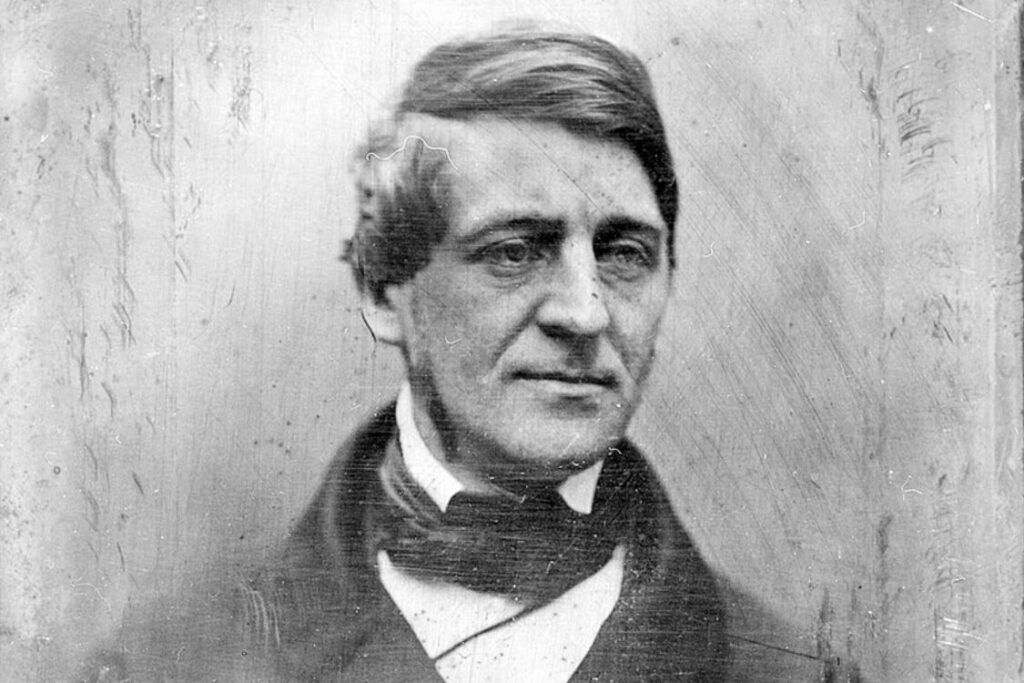
How much of the life we lead truly belongs to us? These Ralph Waldo Emerson quotes invite us to examine whether our ambitions reflect our own convictions or the expectations of others.
Emerson believed that wisdom begins with trusting our own experience and paying attention to the world around us. His essays, poems, and letters offer a thoughtful perspective on what it means to live well.
JUMP TO:
- Famous Ralph Waldo Emerson Quotes
- Quotes About Life
- Quotes on Success and Meaningful Work
- Quotes From Self-Reliance
- Quotes About Nature and the Human Spirit
- Quotes on Friendship and Love
- Quotes on Wisdom and Personal Growth
- Quotes Misattributed to Ralph Waldo Emerson
- Living With Greater Purpose and Self-Trust
Famous Ralph Waldo Emerson Quotes
As a leading figure in American Transcendentalism, Emerson placed great value on individual experience. His most famous words challenge our understanding of greatness and the possibilities within an ordinary life.
1. The Courage to Be Misunderstood
“To be great is to be misunderstood.”Ralph Waldo Emerson, “Self-Reliance,” Essays: First Series (1841).
Emerson recalls great thinkers whose ideas challenged the beliefs of their time. Being misunderstood does not necessarily mean you are right, but the fear of misunderstanding should never prevent you from expressing a carefully considered belief.
For more thoughtful reflections on human experience, explore our collection of inspiring book quotes about life.
2. The Power of Enthusiasm
“Nothing great was ever achieved without enthusiasm.”Ralph Waldo Emerson, “Circles,” Essays: First Series (1841).
In “Circles,” Emerson describes life as a continual movement beyond familiar boundaries. When you care deeply about your work, enthusiasm gives you the energy to explore possibilities that routine and obligation might otherwise discourage.
3. Becoming a True Friend
“The only way to have a friend is to be one.”Ralph Waldo Emerson, “Friendship,” Essays: First Series (1841).
We often think about friendship in terms of what another person brings into our lives. Emerson turns our attention toward what we offer in return, reminding us that the qualities we seek in others deserve a place in our own character.
4. The Beauty of an Ordinary Day
“Write it on your heart that every day is the best day in the year.”Ralph Waldo Emerson, “Works and Days,” Society and Solitude (1870).
How often do we reserve our happiness for a distant occasion while ordinary days pass almost unnoticed? Emerson invites us to appreciate the present, recognizing that even an unremarkable morning holds possibilities that will never return in quite the same form.
5. The Promise Within Small Beginnings
“The creation of a thousand forests is in one acorn.”Ralph Waldo Emerson, “History,” Essays: First Series (1841), excerpt.
Emerson uses the acorn to illustrate how something vast may exist within a single beginning. His image offers encouragement when our efforts seem insignificant, for we cannot yet know everything that might grow from them.
Ralph Waldo Emerson Quotes About Life
Emerson valued life as something to experience rather than observe from a comfortable distance. His reflections offer much to consider when we find ourselves longing for a different life.
6. Making Peace With Yesterday
“Finish every day and be done with it. For manners and for wise living it is a vice to remember.”Ralph Waldo Emerson, letter to his daughter Ellen, as reproduced in James Elliot Cabot’s A Memoir of Ralph Waldo Emerson (1887).
Emerson wrote these words to his daughter, encouraging her to move beyond the mistakes of the previous day. His advice carries the warmth of a father who understands how easily regret can consume our thoughts.
If you have spent an evening replaying an awkward conversation, learn what you can from the experience and allow yourself the freedom to begin again.
7. Remembering to Live
“We are always getting ready to live, but never living.”Ralph Waldo Emerson, journal, April 1834.
Preparation can gradually become a substitute for living. We postpone the things that bring us happiness until our circumstances improve, overlooking the experiences already within our reach.
8. Welcoming the Unexpected
“Life is a series of surprises, and would not be worth taking or keeping, if it were not.”Ralph Waldo Emerson, “Experience,” Essays: Second Series (1844).
Much of our anxiety comes from wanting life to unfold according to plan. Yet Emerson recognizes that uncertainty also gives rise to discovery, opening possibilities we might never have considered.
9. Appreciating the Life We Have
“Every ship is a romantic object, except that we sail in.”Ralph Waldo Emerson, “Experience,” Essays: Second Series (1844).
Other people’s lives often appear more interesting because we see them from a distance. Before envying another person’s circumstances, consider how little you know about their journey. Someone watching from another shore may find your life just as remarkable.
10. Carrying Beauty Within Us
“Though we travel the world over to find the beautiful, we must carry it with us, or we find it not.”Ralph Waldo Emerson, “Art,” Essays: First Series (1841).
Emerson suggests that beauty depends partly on the person who perceives it. We may travel to extraordinary places without feeling moved by them, while someone with a receptive mind finds wonder in familiar surroundings.
11. Treating Life as an Experiment
“All life is an experiment. The more experiments you make the better.”Ralph Waldo Emerson, journal, November 1842.
An experiment holds value because it teaches us something, even when the outcome differs from what we expected. If you are considering a new pursuit, give yourself room to learn before deciding whether you are suited to it.
12. Recognizing What Each Day Offers
To each they offer gifts after his will,
Bread, kingdom, stars, and sky that holds them all.Ralph Waldo Emerson, “Days,” May-Day and Other Pieces (1867).
Emerson personifies the passing days as mysterious figures bearing gifts. Distracted from his morning wishes, the speaker realizes too late how little he has received.
The poem leaves us wondering how much we overlook simply because our attention is elsewhere.
Ralph Waldo Emerson Quotes on Success and Meaningful Work
Emerson’s understanding of success extends beyond wealth and recognition. He believed that achievement holds greater meaning when our work reflects our abilities without compromising our principles.
13. Success Begins With Self-Trust
“Self-trust is the first secret of success.”Ralph Waldo Emerson, “Success,” Society and Solitude (1870), excerpt.
Emerson believed that each person possesses abilities suited to a particular purpose. Self-trust begins with recognizing what you can contribute and giving yourself a genuine opportunity to develop that ability.
14. Finding Satisfaction in Honest Work
“The reward of a thing well done, is to have done it.”Ralph Waldo Emerson, “New England Reformers,” Essays: Second Series (1844).
There is a quiet satisfaction in completing something to the best of your ability. You may reasonably hope for recognition, but its absence need not diminish your pride in honest work.
15. Character Before Career
“A little integrity is better than any career.”Ralph Waldo Emerson, “Behavior,” The Conduct of Life (1860).
Professional ambition sometimes places us in situations where doing what is right may cost us an opportunity. Emerson understood that a successful career loses much of its value when we can no longer respect the person we have become.
16. Setting Our Sights Higher
“Hitch your wagon to a star.”Ralph Waldo Emerson, “Civilization,” Society and Solitude (1870).
This familiar expression originally refers to humanity’s ability to work with the forces of nature. Emerson admires the wisdom of drawing upon powers greater than our own.
His metaphor also encourages us to pursue ambitions beyond immediate rewards. A worthy purpose can give direction to even the most ordinary work.
17. Finding People Who Bring Out Our Abilities
“Our chief want in life, is somebody who shall make us do what we can.”Ralph Waldo Emerson, “Considerations by the Way,” The Conduct of Life (1860).
Sometimes another person recognizes an ability in us before we recognize it ourselves. A good mentor helps us discover our strengths without demanding that we become a reflection of their own ambitions.
18. Discovering Strength Through Work
“Do your work, and you shall reinforce yourself.”Ralph Waldo Emerson, “Self-Reliance,” Essays: First Series (1841).
Confidence often grows through action rather than contemplation. If you are waiting until you feel entirely prepared, consider whether beginning the work might offer the reassurance you seek.
19. Rethinking the Meaning of Wealth
“He only is rich who owns the day.”Ralph Waldo Emerson, “Works and Days,” Society and Solitude (1870).
A person may possess considerable wealth while having little freedom to enjoy the hours that make up a life. Financial security matters, but what would success mean to you if the freedom to enjoy your days were part of its definition?
Ralph Waldo Emerson Quotes From Self-Reliance
Published in 1841, Self-Reliance remains one of Emerson’s most influential essays. Its central argument concerns the freedom to think and live according to convictions we have formed for ourselves.
20. Learning to Trust Yourself
“Trust thyself: every heart vibrates to that iron string.”Ralph Waldo Emerson, “Self-Reliance,” Essays: First Series (1841).
Emerson believed that individual intuition could reveal truths meaningful to others. If you frequently seek reassurance before making decisions, remember that advice can clarify your judgment without permanently taking its place.
21. The Courage to Resist Conformity
“Whoso would be a man, must be a nonconformist.”Ralph Waldo Emerson, “Self-Reliance,” Essays: First Series (1841).
Emerson questions our willingness to surrender independent thought for the sake of belonging. We need not disagree with others merely to prove our individuality, but we should understand why we believe what we do.
22. Giving Yourself Permission to Change Your Mind
“A foolish consistency is the hobgoblin of little minds, adored by little statesmen and philosophers and divines.”Ralph Waldo Emerson, “Self-Reliance,” Essays: First Series (1841).
Emerson criticizes the refusal to change an opinion when new knowledge gives us reason to reconsider it. He regarded such stubbornness as an obstacle to intellectual growth.
You may feel embarrassed about abandoning a belief you once defended passionately. Yet there is greater wisdom in acknowledging what you have learned than remaining loyal to an opinion you no longer consider true.
23. The Freedom of Originality
“Insist on yourself; never imitate.”Ralph Waldo Emerson, “Self-Reliance,” Essays: First Series (1841).
We can learn much from people whose abilities we admire, but admiration need not lead to imitation. The qualities that distinguish your work may ultimately contribute something that copying another person’s achievements never could.
24. Finding Peace Through Conviction
“Nothing can bring you peace but yourself. Nothing can bring you peace but the triumph of principles.”Ralph Waldo Emerson, “Self-Reliance,” Essays: First Series (1841).
These closing words of Emerson’s essay express his belief that inner peace depends upon our relationship with our conscience. Although we cannot control every circumstance affecting our well-being, there is comfort in knowing that our decisions reflect what we sincerely believe to be right.
25. Looking Beyond Public Opinion
“What I must do is all that concerns me, not what the people think.”Ralph Waldo Emerson, “Self-Reliance,” Essays: First Series (1841).
There is a difference between considering thoughtful criticism and living in constant anticipation of other people’s reactions. One can sharpen your judgment, while the other may gradually weaken it.
26. Remaining Yourself in the Company of Others
“It is easy in the world to live after the world’s opinion; it is easy in solitude to live after our own; but the great man is he who in the midst of the crowd keeps with perfect sweetness the independence of solitude.”Ralph Waldo Emerson, “Self-Reliance,” Essays: First Series (1841).
Emerson’s ideal of independence does not require us to withdraw from society. Its greater test lies in remaining true to ourselves among people whose beliefs differ from our own.
Notice his reference to “perfect sweetness.” We can hold our convictions firmly without treating others with hostility.
27. The Folly of Envy
“There is a time in every man’s education when he arrives at the conviction that envy is ignorance; that imitation is suicide;”Ralph Waldo Emerson, “Self-Reliance,” Essays: First Series (1841), excerpt.
Emerson uses forceful language to describe the cost of constantly comparing ourselves with others. The wider passage compares personal effort to cultivating a plot of ground. Rather than longing for someone else’s harvest, we might discover what can grow from the ground entrusted to us.
You can explore these ideas further in the complete Self-Reliance essay, available through the University of Virginia.
Ralph Waldo Emerson Quotes About Nature and the Human Spirit
Emerson believed that nature offered more than beauty or temporary relief from our troubles. Through its mysteries, we could encounter a deeper understanding of ourselves and our place in the world.
28. Seeing Nature Through the Heart
“Nature always wears the colors of the spirit.”Ralph Waldo Emerson, Nature, Chapter I (1836).
The same landscape may appear beautiful one morning and strangely indifferent the next. After a painful experience, familiar places can seem altered, although it is our inner world that has changed.
29. Discovering the Spiritual in Nature
“Nature is the symbol of the spirit.”Ralph Waldo Emerson, Nature, Chapter IV, “Language” (1836).
Emerson believed that physical objects could express spiritual truths. A river might suggest the passage of time, while a growing tree could reveal something about the development of human character.
This understanding of nature lies at the heart of his Transcendentalist philosophy.
30. Finding Renewal in the Woods
“In the woods, we return to reason and faith.”Ralph Waldo Emerson, Nature, Chapter I (1836).
Emerson finds renewal in the freedom nature offers from social expectations. You may recognize something of this experience after a quiet walk, when the problems awaiting your return remain unchanged but seem easier to face.
31. Looking at the Stars With Wonder
“The stars awaken a certain reverence, because though always present, they are inaccessible;”Ralph Waldo Emerson, Nature, Chapter I (1836), excerpt.
The stars are familiar enough to greet us every clear night, yet their distance preserves a sense of mystery. Looking into the night sky reminds us how much existence extends beyond the boundaries of our daily concerns.
32. Beauty Needs No Justification
Tell them, dear, that if eyes were made for seeing,
Then Beauty is its own excuse for being:Ralph Waldo Emerson, “The Rhodora,” Poems (1847).
Emerson encounters a flowering shrub in a secluded woodland and questions why its beauty should require any explanation. In a world that places great value on usefulness, the rhodora reminds us that some things are precious simply because they exist.
33. The Connection Between All Things
All are needed by each one;
Nothing is fair or good alone.Ralph Waldo Emerson, “Each and All,” Poems (1847).
Emerson describes hearing a sparrow sing in its natural surroundings. When he brings the bird home, its song loses much of its charm because he has separated it from the landscape.
Although individuality matters deeply to Emerson, this poem recognizes that beauty also arises from the relationships between things.
Ralph Waldo Emerson Quotes on Friendship and Love
Emerson’s belief in self-reliance did not diminish his appreciation for companionship. He valued relationships that allowed affection and individuality to flourish together.
34. Friendship as a Masterpiece
“A friend may well be reckoned the masterpiece of nature.”Ralph Waldo Emerson, “Friendship,” Essays: First Series (1841), excerpt.
Emerson marvels at finding something familiar in another person who remains wonderfully distinct. If you have ever met someone with whom conversation felt effortless, you may understand the delight behind his words.
35. The Freedom to Think Aloud
“A friend is a person with whom I may be sincere. Before him I may think aloud.”Ralph Waldo Emerson, “Friendship,” Essays: First Series (1841).
How precious it is to speak without constantly arranging our thoughts for another person’s approval. With a trusted friend, we have the freedom to express ideas we have not fully formed, knowing that uncertainty will not diminish their affection.
36. The Generosity of True Friendship
“The essence of friendship is entireness, a total magnanimity and trust.”Ralph Waldo Emerson, “Friendship,” Essays: First Series (1841).
By magnanimity, Emerson means a generous spirit capable of looking beyond petty disagreements. There is a wonderful freedom in caring for someone without keeping account of what we receive in return.
37. Giving Something of Ourselves
“The only gift is a portion of thyself.”Ralph Waldo Emerson, “Gifts,” Essays: Second Series (1844).
Perhaps you still treasure a handwritten letter or something a loved one made especially for you. Emerson recognizes that the lasting value of such gifts lies in the presence of another person within them.
38. The Transforming Nature of Love
“All mankind love a lover.”Ralph Waldo Emerson, “Love,” Essays: First Series (1841).
Emerson observes how love brings a new radiance to familiar surroundings. His essay also considers how affection for one person can deepen our connection with humanity, awakening a tenderness that extends beyond the relationship itself.
Ralph Waldo Emerson Quotes on Wisdom and Personal Growth
For Emerson, wisdom meant developing our understanding rather than accumulating information. His writings encourage us to remain curious, even about matters we believe we already understand.
39. The Difficulty of Thinking Independently
“What is the hardest task in the world? To think.”Ralph Waldo Emerson, “Intellect,” Essays: First Series (1841).
We encounter countless opinions expressed with remarkable confidence. Taking the time to examine an idea and form a judgment of our own may require considerably more effort than accepting the nearest available explanation.
40. Understanding What We Fear
“Fear always springs from ignorance.”Ralph Waldo Emerson, “The American Scholar” (1837).
The unfamiliar often seems more threatening when we cannot make sense of it. While some fears warn us of genuine danger, others lose much of their power once we understand what concerns us.
41. Reading Without Surrendering Our Judgment
“Books are the best of things, well used; abused, among the worst.”Ralph Waldo Emerson, “The American Scholar” (1837).
For someone whose writings have inspired generations, Emerson offers a surprisingly critical view of books. He warns that excessive reverence for other thinkers can discourage us from developing our own ideas.
A valuable book should awaken questions and help you recognize something in your experience that you had previously overlooked.
42. Developing Wisdom Before Seeking Power
“Before we acquire great power we must acquire wisdom to use it well.”Ralph Waldo Emerson, “Demonology,” published in Lectures and Biographical Sketches (1884).
Emerson’s observation feels particularly relevant in an age of remarkable technological advances. The question is no longer merely what we can accomplish, but whether our understanding has grown enough to guide us.
43. Discovering a Personal Spiritual Life
“Dare to love God without mediator or veil.”Ralph Waldo Emerson, “The Divinity School Address” (1838), excerpt.
Speaking to theology students at Harvard, Emerson encouraged a direct and personal experience of the divine. Whether or not we share his theological views, his words invite us to examine beliefs we may have inherited without question.
44. Recognizing Our Shared Humanity
“The civility of no race can be perfect whilst another race is degraded.”Ralph Waldo Emerson, “Emancipation in the British West Indies” (1844), excerpt.
Emerson delivered these words in an address commemorating emancipation in the British West Indies. His abolitionist convictions reveal that individual freedom, in his philosophy, carried a broader moral responsibility.
A society’s achievements mean considerably less when they depend upon the suffering of those it refuses to regard as equals.
45. Thinking Beyond Famous Quotations
“I hate quotation. Tell me what you know.”Ralph Waldo Emerson, journal, May 1849.
There is a delightful irony in ending a collection of Ralph Waldo Emerson quotes with these words. In his journal, Emerson questioned the value of secondhand testimony when discussing profound subjects.
Even his finest quotations deserve to be examined rather than simply admired.
Famous Quotes Often Misattributed to Ralph Waldo Emerson
Several popular quotations resemble Emerson’s philosophy but have no confirmed source in his writings. Others belong to authors whose contributions deserve recognition.
Did Emerson Write the Famous Success Poem?
Many readers searching for Emerson’s quotes on success encounter a passage beginning with “To laugh often and much.” It also expresses the familiar thought about knowing that even one life has breathed easier because you have lived.
The passage is a later adaptation of a definition of success written by Bessie Anderson Stanley in 1905. Research published by Quote Investigator traces the altered version attributed to Emerson to decades after his death.
Stanley’s message about a life of kindness deserves appreciation in its own right.
What Lies Behind Us and What Lies Before Us
This famous quotation suggests that the events behind and ahead of us are insignificant compared with what lies within us.
Its earliest documented source is Meditations in Wall Street (1940), a book by Henry Stanley Haskins, originally published anonymously. Its resemblance to Emerson’s philosophy may explain the mistaken attribution.
To Be Yourself in a World That Is Constantly Trying to Make You Something Else
Although this statement captures the spirit of Self-Reliance, no reliable source establishes that Emerson wrote it. His authentic words about nonconformity offer a more faithful expression of his views on individuality.
Did Emerson Write Finish Each Day and Be Done With It?
Unlike the previous examples, this quotation has a genuine foundation in Emerson’s correspondence. He wrote a longer version in a letter to his daughter Ellen on April 8, 1854.
The familiar wording has undergone changes through later publications. Emerson’s original advice was more personal, encouraging his daughter to leave yesterday’s mistakes behind and approach another day with confidence.
Living With Greater Purpose and Self-Trust
As you reflect on these Ralph Waldo Emerson quotes, consider whether the beliefs guiding your life still hold true for you. Emerson’s greatest gift may be his encouragement to seek answers within ourselves rather than borrow them from others.
There is little wisdom in becoming someone the world admires if you lose sight of the person you might have been.
Leave a Reply