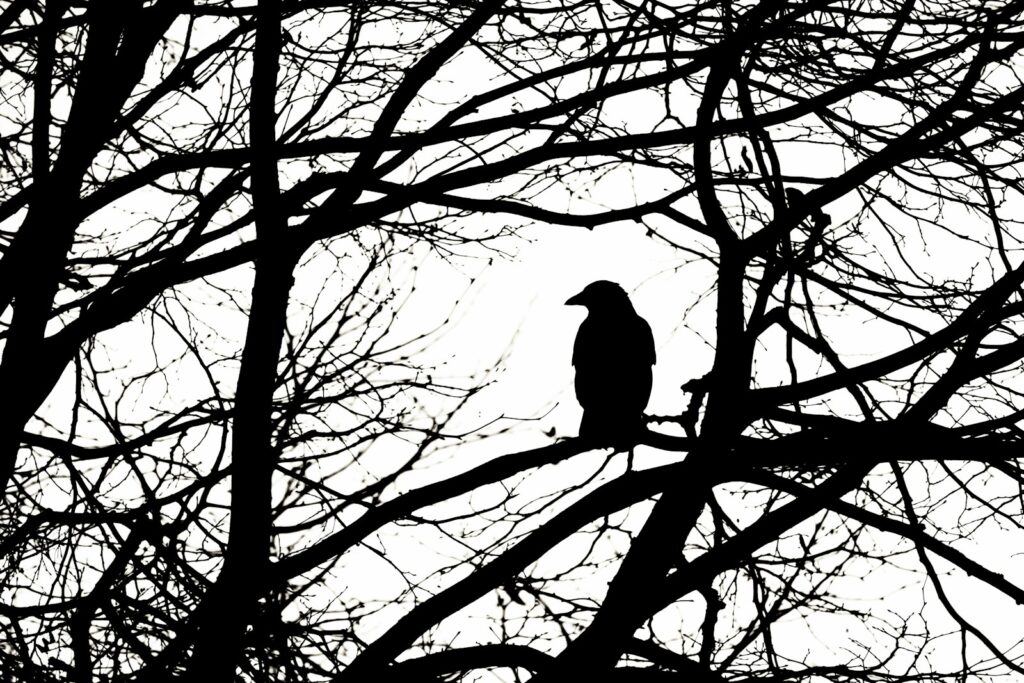
Have you ever missed someone so deeply that even the quietest moments brought back painful memories? Edgar Allan Poe captures this experience in The Raven, a haunting poem set on a bleak December night.
The meaning of The Raven reaches beyond the mysterious bird that visits a grieving man. It explores what happens when we long for someone death has taken away, yet cannot find comfort in remembering them.
Beneath its Gothic imagery lies a painfully human struggle with love, loss, and the fear of never feeling whole again.
JUMP TO:
- What Is The Raven Poem About?
- The Raven Poem Meaning and Analysis
- What Does the Raven Symbolize in the Poem?
- Why Does the Raven Keep Saying Nevermore?
- Major Themes in The Raven
- How Poe Creates the Poem's Haunting Atmosphere
- Why Did Edgar Allan Poe Write The Raven?
- The Meaning Behind The Raven's Ending
- The Haunting Nature of Remembrance
What Is The Raven Poem About?
The Raven is a narrative poem about an unnamed man mourning the death of his beloved Lenore. While reading alone at midnight, he receives an unexpected visit from a raven that can utter only one word: “Nevermore.”
Although the bird initially amuses him, its repeated answer soon takes on a disturbing significance. The narrator begins asking questions about his grief, the possibility of finding comfort, and whether he will ever see Lenore again.
Each answer deepens his despair until he believes his suffering will never end. The poem examines how grief can cloud one’s judgment, turning even an innocent encounter into a source of torment.
Poe explores a similar connection between love, death, and remembrance in Annabel Lee.
The Raven Poem Meaning and Analysis
Across 18 stanzas, Poe transforms an unusual encounter with a bird into a disturbing study of grief. The narrator’s emotional decline unfolds gradually, taking him from restless curiosity to a state of utter despair.
A Lonely December Night (Stanzas 1–6)
Ah, distinctly I remember it was in the bleak December;
And each separate dying ember wrought its ghost upon the floor.
Eagerly I wished the morrow; — vainly I had sought to borrow
From my books surcease of sorrow — sorrow for the lost Lenore —Edgar Allan Poe, “The Raven” (1845), excerpt.
The opening stanzas establish a world already touched by death. Outside, the December night is cold and stormy, while the dying fire casts strange shadows across the chamber floor.
The narrator has turned to his books in the hope of finding relief from his sorrow. His weariness suggests that grief has kept him company for some time, although Poe never reveals how long Lenore has been dead.
When he hears a tapping at his door, he repeatedly assures himself that an ordinary visitor must be waiting outside. But when he opens it, he finds only darkness.
And the only word there spoken was the whispered word, “Lenore?”
This I whispered, and an echo murmured back the word, “Lenore!” —
Merely this and nothing more.Edgar Allan Poe, “The Raven” (1845), excerpt.
For a fleeting moment, he seems to entertain the possibility that Lenore has returned. His own voice comes back to him through the darkness, leaving him with nothing but the silence he had hoped to break.
The Arrival of the Raven (Stanzas 7–9)
Open here I flung the shutter, when, with many a flirt and flutter,
In there stepped a stately Raven of the saintly days of yore;
Not the least obeisance made he; not a minute stopped or stayed he;Edgar Allan Poe, “The Raven” (1845), excerpt.
The mystery appears to resolve when the narrator opens his window and admits a raven. Its dignified manner strikes him as amusing, offering a brief distraction from his sorrow.
The bird settles upon a bust of Pallas above the chamber door. Entertained by its solemn appearance, the narrator asks its name and receives the unexpected reply, “Nevermore.”
He recognizes that the answer carries little meaning in relation to his question. A talking bird is certainly unusual, but he has no reason to believe it possesses supernatural knowledge.
For a moment, the encounter might have remained nothing more than a curious interruption on a lonely night.
Curiosity Turns to Obsession (Stanzas 10–13)
Till I scarcely more than muttered “Other friends have flown before —
On the morrow he will leave me, as my Hopes have flown before.”
Then the bird said “Nevermore.”Edgar Allan Poe, “The Raven” (1845), excerpt.
The mood changes when the narrator remarks that the raven will probably leave him, just as his friends and hopes have disappeared. The bird’s familiar response now seems strangely appropriate.
Although he reasons that a former owner probably taught the raven to speak, he cannot resist searching for a deeper meaning. He draws a chair toward the bird and studies it, allowing his imagination to wander.
His attention eventually falls upon the velvet cushion where he rests his head. The thought that Lenore will never rest against it again brings her absence painfully close.
Even the ordinary furnishings of his chamber hold memories he cannot bear. From this point onward, his questions grow increasingly personal.
The Search for Comfort (Stanzas 14–16)
Is there — is there balm in Gilead? — tell me — tell me, I implore!”
Quoth the Raven “Nevermore.”Edgar Allan Poe, “The Raven” (1845), excerpt.
The narrator imagines that the air has grown heavy with incense carried by unseen angels. He wonders whether God has offered him a means of forgetting Lenore through nepenthe, a mythical substance associated with relief from sorrow.
When the raven denies him this comfort, he asks whether there is a “balm in Gilead.” The phrase comes from the Bible, specifically Jeremiah 8:22, and refers to healing, which the narrator desperately seeks for his wounded spirit.
His final question concerns something more precious than relief:
Tell this soul with sorrow laden if, within the distant Aidenn,
It shall clasp a sainted maiden whom the angels name Lenore —
Clasp a rare and radiant maiden whom the angels name Lenore.”
Quoth the Raven “Nevermore.”Edgar Allan Poe, “The Raven” (1845), excerpt.
Aidenn is Poe’s poetic reference to Eden or paradise. The narrator hopes that death has separated him from Lenore only temporarily and that they might one day meet in heaven.
The answer destroys his remaining hope. He now fears that even death will offer no reunion with the woman he loves.
A Shadow That Never Leaves (Stanzas 17–18)
Take thy beak from out my heart, and take thy form from off my door!”
Quoth the Raven “Nevermore.”Edgar Allan Poe, “The Raven” (1845), excerpt.
Unable to bear the raven’s answer, the narrator orders it to return to the storm. He calls it a liar and begs it to leave him alone, but the bird remains upon the bust of Pallas.
His plea to remove its beak from his heart reveals how deeply the encounter has wounded him. The raven is no longer merely an unwelcome visitor, for its presence has become inseparable from his sorrow.
The chamber that once offered shelter from the storm has become a place of emotional imprisonment.
What Does the Raven Symbolize in the Poem?
Poe gives the narrator’s grief a visible form through carefully chosen images. Objects that might ordinarily belong to a quiet study acquire darker meanings as his thoughts grow more troubled.
The Raven and Painful Remembrance
The raven symbolizes painful remembrance and the fear that grief will never end. Its dark feathers and solemn appearance also draw upon the bird’s traditional association with death and ill omens.
What makes the raven particularly disturbing is its apparent indifference. It neither comforts nor deliberately threatens the narrator, yet its presence awakens his deepest fears. Its power comes largely from the meanings he assigns to its single word.
The Bust of Pallas and the Defeat of Reason
Pallas Athena is the Greek goddess of wisdom. The raven’s position above her sculptured likeness can therefore be read as an image of grief overpowering reason. The narrator is educated enough to understand why a bird might repeat a learned word. Nevertheless, his suffering leads him to treat its answers as prophecies.
The contrast between the pale marble and the raven’s black feathers also strengthens the poem’s Gothic atmosphere.
Midnight and the Bleak December
Poe sets the encounter at midnight in December, when both the day and the year are drawing to a close. The dying embers suggest fading warmth and life, reflecting the emptiness the narrator feels without Lenore.
There is something particularly lonely about watching the world move forward when your own life seems to have stood still. Morning will follow midnight, and January will follow December, but the narrator cannot yet imagine a future beyond his sorrow.
Lenore and the Life That Was Lost
Although Lenore never appears in the poem, her absence shapes every important moment. Poe gives us little information about her beyond the narrator’s idealized description of her beauty.
She represents the love and happiness he once knew, along with the future he can no longer share with her. The scarcity of details about Lenore also keeps our attention on the man she has left behind and the depth of his suffering.
Why Does the Raven Keep Saying Nevermore?
“Nevermore” means never again or at no future time. Within the poem, however, its emotional significance changes according to the narrator’s questions.
He even offers a reasonable explanation for the bird’s limited vocabulary:
“Doubtless,” said I, “what it utters is its only stock and store
Caught from some unhappy master whom unmerciful Disaster
Followed fast and followed faster till his songs one burden bore —Edgar Allan Poe, “The Raven” (1845), excerpt.
The narrator suspects that the raven learned its single word from an unfortunate former owner. Despite understanding this possibility, he continues asking questions whose answers he knows will wound him.
This behavior reveals one of the poem’s most disturbing psychological elements. He desperately wants reassurance, yet he seeks it from a creature incapable of offering any.
The raven has no proven knowledge of the future. But the narrator gradually grants it the authority to determine his fate, turning a word learned through repetition into a verdict from which there is no appeal.
Major Themes in The Raven
Beneath The Raven’s Gothic imagery lies an exploration of what happens when sorrow begins to shape one’s understanding of the world.
Grief and the Weight of Memory
When we lose someone we love, even our most beautiful memories can become difficult to revisit. We may find comfort in remembering a familiar voice or a shared afternoon, only to feel the pain of knowing we cannot experience those moments again.
This is the contradiction at the heart of the narrator’s grief. He longs to remember Lenore, yet his memories have become so painful that he wishes for a way to forget her.
If you have experienced a similar loss, you may recognize the exhaustion behind his plea. Sometimes we simply want a moment of peace without feeling that we are leaving the person we love behind.
Love and the Finality of Death
The narrator’s devotion to Lenore survives her death, but love alone cannot answer his questions about what lies beyond the grave. His deepest fear is that their separation may be permanent.
This fear gives the poem a spiritual dimension. The possibility of an afterlife briefly offers comfort, making the raven’s denial of a future reunion particularly devastating.
His suffering comes not only from losing Lenore but also from his growing belief that he will never hold her again.
Reason Giving Way to Despair
Throughout the poem, the narrator moves between rational explanations and supernatural fears. His books suggest an educated mind, yet knowledge offers little protection against the force of his imagination.
Poe creates psychological horror by allowing readers to recognize a natural explanation for the raven’s behavior, even as the narrator loses confidence in it. We witness a man gradually surrendering his judgment to the very fears he wishes to escape.
This tension between the familiar and the frightening also appears in many of the works featured in our collection of Halloween quotes from literature.
How Poe Creates the Poem’s Haunting Atmosphere
An analysis of The Raven by Edgar Allan Poe would be incomplete without considering its distinctive sound. The rhythm and repeated rhymes draw readers into the narrator’s restless state of mind.
Once upon a midnight dreary, while I pondered, weak and weary,
Over many a quaint and curious volume of forgotten lore —
While I nodded, nearly napping, suddenly there came a tapping,
As of some one gently rapping, rapping at my chamber door.Edgar Allan Poe, “The Raven” (1845), excerpt.
Poe uses an ABCBBB end-rhyme scheme throughout the poem’s six-line stanzas. He also relies heavily on trochaic rhythm, which generally places a stressed syllable before an unstressed one.
Internal rhyme gives the longer lines a musical quality, as heard in the combination of “dreary” and “weary.” Meanwhile, the repeated sounds of “napping,” “tapping,” and “rapping” imitate the noise that disturbs the narrator.
Alliteration adds another layer of unease. Phrases such as “weak and weary” and “doubting, dreaming dreams” give the language a hypnotic flow.
The shorter final line of each stanza interrupts this rhythm. As “Nevermore” takes over this position, readers begin to anticipate its arrival with the same dread that consumes the narrator.
Why Did Edgar Allan Poe Write The Raven?
In his 1846 essay, The Philosophy of Composition, Poe describes the creative decisions behind The Raven. According to his account, he planned the poem around a particular emotional effect, choosing melancholy as its dominant mood.
Poe considered a parrot before settling on a raven. Both birds could plausibly repeat human speech, but the raven’s association with ill fortune better suited the poem’s dark atmosphere.
He also explains his choice of a closed chamber, a stormy night, and the bust of Pallas. The room’s confined setting intensifies the encounter, while the pale sculpture provides a striking contrast to the bird’s dark feathers.
Most importantly, Poe describes the raven as a symbol of “Mournful and Never-ending Remembrance.” His explanation confirms that the poem’s horror lies not merely in the presence of a mysterious creature but in the lasting torment of memory.
The Meaning Behind The Raven’s Ending
And the Raven, never flitting, still is sitting, still is sitting
On the pallid bust of Pallas just above my chamber door;Edgar Allan Poe, “The Raven” (1845), excerpt.
The repeated phrase “still is sitting” gives the closing scene a disturbing sense of permanence. While everything outside the chamber may continue to change, the narrator’s inner world remains fixed upon his loss.
The final lines bring the poem’s symbolism to its darkest point:
And my soul from out that shadow that lies floating on the floor
Shall be lifted — nevermore!Edgar Allan Poe, “The Raven” (1845), excerpt.
The raven’s shadow gives an invisible emotional burden a physical shape. It stretches across the chamber floor, and the narrator believes his soul will remain beneath it forever.
Whether the raven is merely a trained bird or something more sinister ultimately matters less than the authority the narrator has given it. He has accepted its words as a judgment on his future.
The ending reflects his conviction that sorrow will last forever, rather than establishing that recovery from grief is truly impossible.
The Haunting Nature of Remembrance
The meaning of The Raven may feel especially personal if you have ever struggled with the absence of someone you love. Through the narrator’s anguish, Poe gives words to the loneliness and uncertainty that often accompany grief.
Perhaps the saddest part of the poem is that the narrator becomes convinced his present suffering will define the rest of his life. His longing for Lenore is understandable, but the certainty he places in the raven’s answer leaves him unable to imagine finding peace again.
Poe offers no comforting resolution, and we need not invent one for him. Yet in understanding the narrator’s despair, we may recognize something worth remembering in our own lives.
The fear that grief will last forever is not proof that it will.
Leave a Reply