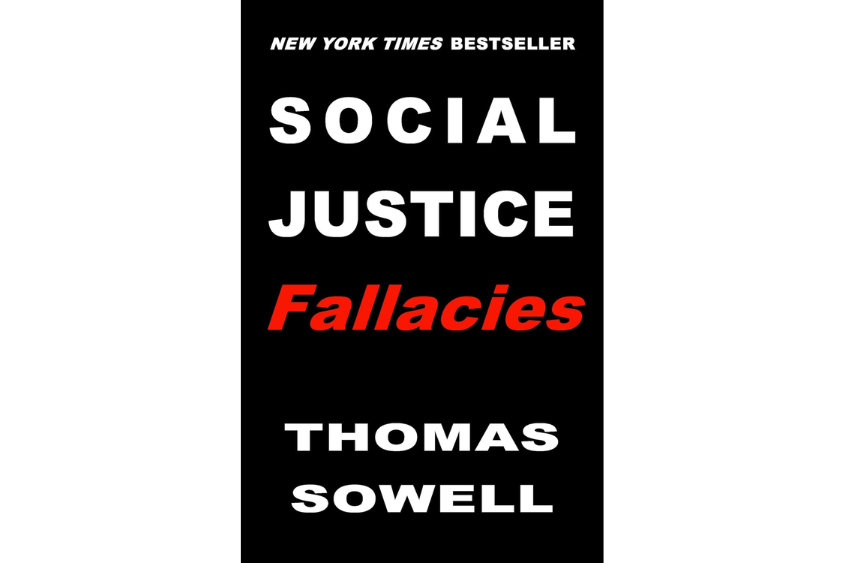
Thomas Sowell does not begin Social Justice Fallacies by arguing that life is fair. He starts with a different question. What should we conclude when people or groups end up with different results?
Published in 2023, the book challenges common ideas about equality, discrimination, expert knowledge, and public policy. This Social Justice Fallacies summary explains seven of Sowell’s main ideas. Plus, we’re going to look at real examples and where critics push back.
JUMP TO:
What Does Sowell Mean by Social Justice Fallacies?
The social justice fallacies meaning becomes clearer once you see how Sowell uses the word fallacy.
He is not saying every concern about inequality or discrimination is false. Instead, he questions assumptions that can lead people to name a cause too quickly. He also asks what happens after a policy changes the rules.
The book looks at equal chances, racial disparities, people treated like chess pieces, limits of knowledge, and the gap between good intentions and real results.
Sowell keeps returning to one basic question. Before we design a solution, how sure are we that we understand the problem?
7 Key Ideas in Social Justice Fallacies
1. Equal Opportunity Does Not Guarantee Equal Results
Sowell argues that equal rules do not lead to equal group results by default. People differ in age, family background, location, education, culture, skills, interests, and life choices. Those differences can shape later outcomes.
He warns against treating a gap as if it already explains itself.
Even more dangerous than ignorance, however, is a fallacious certitude, which can afflict people at all educational levels and all IQ levels.
Thomas Sowell, Social Justice Fallacies
A gap in income, graduation rates, jobs, or test scores raises a question, but it does not prove a cause. This does not mean discrimination never plays a role. Sowell’s point is narrower. If several causes are possible, we should test them before settling on one.
His wider views on the subject also appear in our collection of Thomas Sowell quotes on social justice.
2. Disparities Do Not Explain Themselves
Sowell spends much of the book challenging one-cause explanations for racial, ethnic, and economic gaps.
Take two cities with very different household incomes. The gap might reflect age, education, local industries, housing costs, migration, family structure, discrimination, or several factors at once.
Seeing the number does not tell us which cause carries the most weight. This is also where critics challenge Sowell. Kirkus argues that some of his conclusions overlook other variables that could support different explanations.
The useful point is methodological. A confident explanation is not the same as a proven one.
3. People Are Not Chess Pieces
One of the book’s clearest ideas is what Sowell calls the Chess Pieces Fallacy.
Policy plans can assume that people will stay in place after the rules change. Real people rarely behave that neatly.
Raise a tax and some businesses may change hiring or investment. Cap rents and some landlords may sell, convert units, cut maintenance, or leave the market. Change college admissions rules and students may apply somewhere else.
The policy changes. Then people respond.
Interior decorators arrange. Governments compel.
Thomas Sowell, Social Justice Fallacies
The point is not that every regulation fails. Good analysis still has to account for human response.
If a forecast ignores incentives, it may describe a world that disappears as soon as the policy begins.
4. Good Intentions Do Not Predict Good Results
Sowell asks readers to judge policies by what they do, not only by what they promise.
A government can pursue a humane goal and still create costs it did not expect. The reverse can happen too. A policy that sounds harsh may produce benefits its critics did not predict.
Housing offers an easy example. A city may cap rents to protect tenants. The next questions should look at housing supply, repairs, new construction, and how property owners respond.
The goal may be compassionate, but the result still needs evidence.
Sowell is not arguing that governments should do nothing. His argument asks us to follow a policy beyond its first intended effect and examine what happens next. Cato’s review highlights this focus on incentives and unintended consequences throughout the book.
Intentions tell us what policymakers hoped to achieve. Results tell us whether they did.
5. Knowledge Is More Scattered Than It Looks
Sowell’s Knowledge Fallacies focus on a simple problem. Useful information is spread across many people.
A hospital administrator may know budgets, staffing levels, regulations, and system-wide trends. A nurse on one ward knows which patients are getting worse, where delays keep happening, and which written procedure fails in practice.
Neither person sees the whole picture.
In an interview about the book, Sowell put the danger more sharply.
A high IQ and low information is a very dangerous combination.
Thomas Sowell, Hoover Institution interview
Expertise matters, but expertise also has limits.
A national policymaker may see patterns that one shop owner cannot. The shop owner may understand local costs, staffing problems, and customer habits that never appear in a national dataset.
The hard part is not choosing experts over ordinary people. It is building decisions that can use both kinds of knowledge.
6. Equality and Freedom Can Pull in Different Directions
Sowell draws a sharp line between equal treatment and policies designed to produce equal group results.
People make different choices about work, education, family, location, and risk. Those choices can lead to different outcomes. Sowell argues that a government trying to equalize results may need to limit some of those choices.
His broader argument traces a shift from equal opportunity for individuals toward efforts to secure more equal outcomes among groups.
Critics challenge this view.
They argue that formal freedom may offer less in practice when people start with very different access to education, wealth, health care, safety, or political influence. From that perspective, some intervention can expand practical freedom rather than reduce it.
This makes the debate more useful than a simple choice between equality and freedom.
The harder question is what real freedom requires, and how far government should go to create fairer starting conditions.
7. Ask What Happens Next
The seven ideas lead back to one habit. Sowell wants readers to ask another question.
A gap appears. What else might explain it? A policy changes. How will people respond? When experts offer a plan, what information might they lack? If a program has a clear goal, what happens after it starts?
This approach pushes political debate away from slogans. It asks us to look at incentives, evidence, trade-offs, and results.
The standard should apply to everyone. Experts, politicians, critics, and Sowell himself still need evidence.
Social Justice Fallacies Examples in Current Policy Debates
The easiest way to understand Sowell’s framework is to apply it to familiar policy questions.
Start with an income gap between two groups. One social justice fallacies example would be jumping straight from the gap to one cause.
Sowell would first ask about age, occupation, education, location, work experience, family structure, discrimination, and other relevant factors. The presence of several possibilities does not tell us which one is correct. It tells us what still needs investigation.
Rent control shows the chess-pieces idea.
A city may want to protect tenants from sharp price rises. Sowell would ask what landlords and developers do next. Do they build fewer units? Sell? Cut repairs? Put their money somewhere else?
College admissions offers another example. Change the rules and students, schools, and families may change their choices too.
These social justice fallacies examples do not tell us which policy to support. They show the kind of questions Sowell thinks should come before certainty.
Where Critics Push Back
Social Justice Fallacies has drawn both praise and criticism.
Supporters value Sowell’s focus on incentives, alternative causes, and unintended effects. Cato’s review praises his challenge to explanations that move too quickly from group disparities to claims about what caused them.
Critics argue that Sowell can understate structural causes of inequality. Kirkus also questions whether some examples support his conclusions as strongly as he suggests.
There is a useful warning here for both sides. Showing that several causes are possible can weaken a simple explanation. It does not prove which alternative is correct.
The same standard works in reverse. A disparity alone does not prove discrimination caused it. But pointing to other variables does not rule discrimination out either.
The evidence still has to do the work.
How the Book Fits With Sowell’s Other Work
Longtime readers will recognize many of these ideas.
Discrimination and Disparities looks at why group differences can have many causes. Knowledge and Decisions studies how information moves through society. Basic Economics returns often to incentives and unintended effects.
Social Justice Fallacies brings several of those themes into a shorter discussion of equality, race, and public policy. Even a favorable Cato review notes that experienced Sowell readers will find much of the framework familiar.
New readers may see that as an advantage. The book offers a compact introduction to arguments Sowell developed over decades.
Is Social Justice Fallacies Worth Reading?
If you want a neutral guide to social justice theory, this is not it. Sowell takes a clear position and argues for it. The book can still be useful even if you disagree with him.
Its strongest sections ask readers to separate outcomes from causes, intentions from results, and expertise from complete knowledge.
The best way to read it may be to treat Sowell’s claims as questions to test, not answers to inherit.
The Question Sowell Leaves Us With
Social Justice Fallacies asks readers to slow down before turning unequal outcomes into confident explanations. Sowell may not persuade everyone, and his critics raise serious questions about parts of his case.
Yet his central challenge deserves attention.
When a statistic seems to confirm what we already believe, how often do we search for the evidence that might prove us wrong?
Leave a Reply