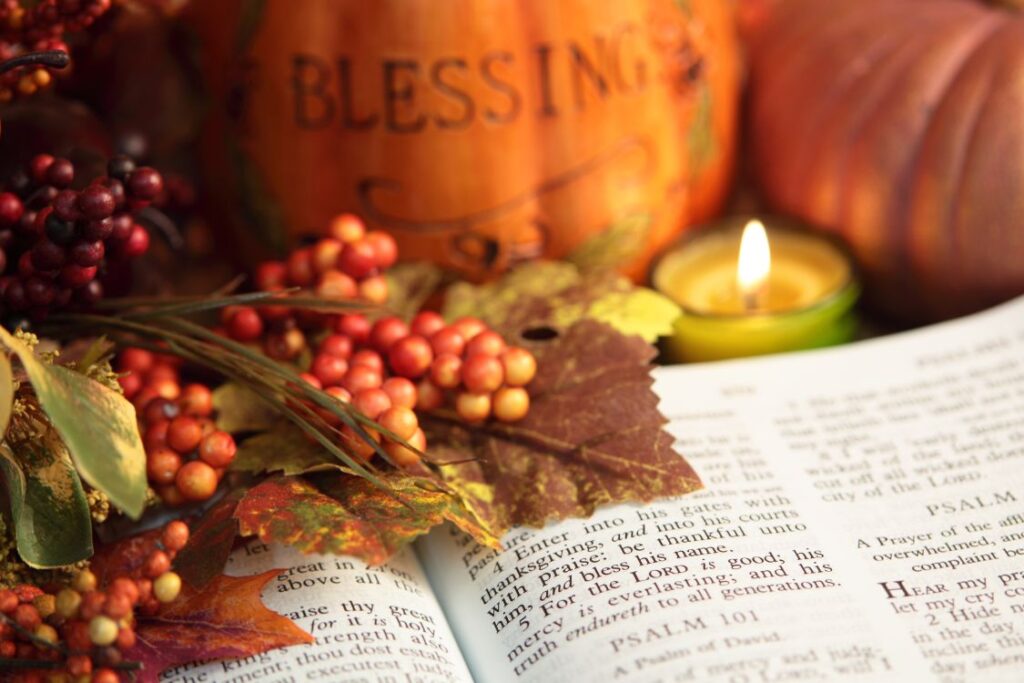
Thanksgiving Bible verses remind us that gratitude in Scripture is more than a response to an easy season. It appears in worship, prayer, hardship, shared meals, and ordinary acts of generosity.
The 35 passages below explore what the Bible says about giving thanks to God, recognizing his provision, and remaining grateful when life feels uncertain. Each verse is presented with enough context to show what it meant before applying it to Thanksgiving today.
Thanksgiving Bible Verses About Giving Thanks to God
These verses place thanksgiving where Scripture often begins it: with God’s character and what he has done.
1. His Love Endures
“Oh give thanks to the LORD, for he is good; for his steadfast love endures forever!”1 Chronicles 16:34 (ESV)
These words appear in the song David appointed after the Ark of the Covenant was brought to Jerusalem. Gratitude grows from two truths the singers repeat: that God is good, and his steadfast love does not expire when circumstances change.
That makes the verse especially fitting for Thanksgiving. The focus is not simply on what is on the table, but on the character of the one being thanked.
2. Remember His Deeds
“Give thanks to the LORD, call upon his name, make known his deeds among the peoples.”Isaiah 12:4 (ESV)
Isaiah 12 looks toward salvation and responds with praise. Thanksgiving leads naturally into remembrance and testimony.
One way to practice that today is to look back over the year and name where you saw help, provision, or unexpected grace instead of letting those moments disappear into routine.
3. Give Thanks Daily
“do everything in the name of the Lord Jesus, giving thanks to God the Father through him.”Colossians 3:17 (ESV)
Paul does not confine thanksgiving to worship or special occasions. In this verse, gratitude belongs within everyday Christian life.
Thanksgiving Day may focus our attention for a few hours, but Colossians points toward a wider habit: letting gratitude shape ordinary words and actions long after the leftovers are gone.
4. Thanksgiving as Worship
“giving thanks always and for everything to God the Father in the name of our Lord Jesus Christ”Ephesians 5:20 (ESV)
This verse appears within Paul’s description of a Spirit-filled life. Thanksgiving is part of worship rather than an occasional emotional response.
The wording can sound difficult during a painful year. Paul is not asking believers to call evil good. He is describing a life that continues to recognize God even when circumstances are not what we would have chosen.
5. An Inheritance in Light
“giving thanks to the Father, who has qualified you to share in the inheritance of the saints in light.”Colossians 1:12 (ESV)
The surrounding verses explain why Paul gives thanks: God has rescued believers from darkness and brought them into Christ’s kingdom.
The gratitude here is rooted in salvation rather than material comfort. That gives Thanksgiving a deeper center for readers whose year may not have felt especially abundant.
6. Victory Over Death
“But thanks be to God, who gives us the victory through our Lord Jesus Christ.”1 Corinthians 15:57 (ESV)
This verse is sometimes used as a general statement about success, but 1 Corinthians 15 is discussing resurrection. The victory Paul celebrates is victory over death through Christ.
For Christians, that context gives the verse more weight than a promise that every earthly plan will work out. Thanksgiving ultimately rests on a hope larger than the circumstances of one year.
7. Thanks in Ministry
“But thanks be to God, who in Christ always leads us in triumphal procession”2 Corinthians 2:14 (ESV)
Paul is reflecting on the spread of the gospel through his ministry. His image of a triumphal procession is not simply a promise of personal achievement.
The verse is better read as gratitude that God can work through human lives to make Christ known, even when the people involved feel weak or uncertain.
If you are looking for words beyond Scripture, our Thanksgiving quotes about gratitude, family, and gathering include reflections from literature, poetry, and classic writers.
Psalms for Thanksgiving and Praise
The Psalms repeatedly connect gratitude with remembering. They look back at God’s faithfulness so the present moment is not judged by feelings alone.
For readers who want to understand the book more broadly, BibleProject’s guide to Psalms explores how praise, lament, faith, and hope work together across the collection.
8. With My Whole Heart
“I will give thanks to the LORD with my whole heart; I will recount all of your wonderful deeds.”Psalm 9:1 (ESV)
David connects gratitude with memory. Giving thanks begins by recalling what God has done rather than assuming we will naturally remember it.
That makes the verse a simple Thanksgiving practice in itself: pause long enough to remember before moving on to the next concern.
9. Mourning Into Dancing
“You have turned for me my mourning into dancing”Psalm 30:11 (ESV)
Psalm 30 does not begin in celebration. The joy near its end comes after distress and a cry for help.
For someone reaching Thanksgiving after a hard season, the verse offers a different kind of gratitude. It is the relief of looking back and realizing that sorrow did not have the final word.
10. Morning and Night
“It is good to give thanks to the LORD”Psalm 92:1 (ESV)
Psalm 92 describes declaring God’s love in the morning and his faithfulness at night. Gratitude becomes a rhythm rather than a single event.
Thanksgiving Day can serve as a reminder of that rhythm, but the psalm quietly invites it into the rest of the year.
11. Enter With Thanksgiving
“Enter his gates with thanksgiving, and his courts with praise!”Psalm 100:4 (ESV)
Psalm 100 is one of Scripture’s clearest calls to thankful worship. The next verse explains why: the Lord is good, his love endures, and his faithfulness continues across generations.
The command to give thanks is therefore grounded in who God is, not in whether every part of life currently feels settled.
12. Remember His Benefits
“Bless the LORD, O my soul, and forget not all his benefits”Psalm 103:2 (ESV)
Psalm 103 goes on to remember forgiveness, mercy, healing, and redemption. David seems to know that forgetfulness is one of gratitude’s quiet enemies.
A Thanksgiving meal may be memorable, but this verse asks a deeper question: what goodness have we stopped noticing because it has become familiar?
13. His Steadfast Love
“Oh give thanks to the LORD, for he is good, for his steadfast love endures forever!”Psalm 107:1 (ESV)
Psalm 107 follows this familiar opening with stories of people in distress who cry to God and are delivered.
That context gives the refrain its force. God’s steadfast love is praised not from a life untouched by trouble, but by people who know what it is to need rescue.
14. Answered Prayer
“I give you thanks, O LORD, with my whole heart”Psalm 138:1 (ESV)
A few lines later, David remembers calling to God and receiving an answer. His gratitude has a history behind it.
Readers may recognize the same feeling when a prayer, concern, or long season looks different in hindsight than it did while they were living through it.
Bible Verses About Gratitude in Prayer and Daily Life
Biblical gratitude is not limited to thanking God for possessions. Several New Testament passages connect it with prayer, faith, community, and the people who enrich our lives.
15. Abounding in Thanksgiving
“rooted and built up in him and established in the faith, just as you were taught, abounding in thanksgiving.”Colossians 2:7 (ESV)
Paul describes gratitude as part of a life rooted in Christ. It is not an isolated mood but something that grows alongside faith.
The image of being rooted is helpful at Thanksgiving. Gratitude is strongest when it has somewhere deeper to draw from than whatever happened this week.
16. Thankfulness in Community
“And let the peace of Christ rule in your hearts, to which indeed you were called in one body. And be thankful.”Colossians 3:15 (ESV)
The surrounding passage speaks about peace, worship, teaching, and life together. Gratitude belongs within community.
For Thanksgiving, that may mean appreciating the people whose presence has shaped the year, including those whose care has become so dependable that it is easy to overlook.
17. Thankful Prayer
“Continue steadfastly in prayer, being watchful in it with thanksgiving.”Colossians 4:2 (ESV)
Paul joins persistence in prayer with attentiveness and gratitude. Thanksgiving does not replace asking God for help; it accompanies it.
That balance is useful when prayers remain unanswered. A person can keep asking while also remembering what has already been given.
18. Grace Produces Thanks
“as grace extends to more and more people it may increase thanksgiving, to the glory of God.”2 Corinthians 4:15 (ESV)
Paul writes this in a chapter marked by weakness and suffering. Yet he sees God’s grace spreading through that difficult ministry and producing thanksgiving.
The verse shifts gratitude away from self-focus. Sometimes what we are most thankful for is the good that reaches someone else.
19. Thankful for You
“I thank my God always when I remember you in my prayers”Philemon 4 (ESV)
Paul’s gratitude is directed toward a person whose faith and love have encouraged others.
This is a natural Thanksgiving verse for someone who wants to tell a friend or loved one what their presence has meant during the year. Gratitude often becomes more powerful once it is spoken.
To express your appreciation personally, explore our Thanksgiving messages for loved ones.
20. Faith Worth Thanking For
“We always thank God, the Father of our Lord Jesus Christ, when we pray for you,”Colossians 1:3 (ESV)
Paul’s thanksgiving for the Colossians grows from hearing about their faith and love. He is grateful not merely because they are part of his life, but because of the good he sees developing in theirs.
Thankfulness for another person can include noticing who they are becoming.
21. Remembered in Prayer
“I do not cease to give thanks for you, remembering you in my prayers”Ephesians 1:16 (ESV)
Paul again combines gratitude for people with prayer for them. He does not treat appreciation as a passing feeling.
At Thanksgiving, this verse can turn gratitude into action. The people we are thankful for can also become the people we intentionally pray for.
Thanksgiving Bible Verses for Difficult Seasons
Some of the Bible’s clearest passages about thanksgiving appear in uncomfortable settings. They do not deny grief or fear. Instead, they show gratitude continuing while hardship remains real.
Poetry also makes room for gratitude during difficult years, as these Thanksgiving poems about memory and loss beautifully illustrate.
22. In All Circumstances
“give thanks in all circumstances; for this is the will of God in Christ Jesus for you.”1 Thessalonians 5:18 (ESV)
This verse is often shortened to “give thanks for everything,” but Paul’s wording is important. He says to give thanks in all circumstances.
There is room here for grief, uncertainty, and unanswered questions. Gratitude does not require pretending the painful thing itself is good. It means hardship does not erase every reason to pray, hope, or recognize God’s presence.
23. Though the Fig Tree Fails
“yet I will rejoice in the LORD; I will take joy in the God of my salvation.”Habakkuk 3:18 (ESV)
The previous verse imagines severe agricultural loss. Crops fail, livestock disappear, and the normal sources of provision are gone.
Habakkuk’s joy therefore comes before circumstances improve. This is not gratitude because the harvest was plentiful. It is trust when there is almost nothing visible to celebrate.
For readers approaching Thanksgiving after financial loss or another painful disruption, the honesty of that setting can be comforting.
24. Thanks Before Deliverance
“he got down on his knees three times a day and prayed and gave thanks before his God”Daniel 6:10 (ESV)
Daniel knows that continuing to pray could cost him his life. He gives thanks anyway, following the same practice he had before the crisis.
His gratitude is not a celebration after escaping the lions’ den. It happens while danger is approaching, which makes the moment far more striking.
25. Thanksgiving From the Depths
“But I with the voice of thanksgiving will sacrifice to you”Jonah 2:9 (ESV)
Jonah prays these words from inside the fish. He is not safely back on dry land yet.
Thanksgiving appears in the middle of distress as Jonah recognizes his dependence on God. Sometimes gratitude begins before a situation is fully resolved.
26. Praise Before the Battle
“Give thanks to the LORD, for his steadfast love endures forever.”2 Chronicles 20:21 (ESV)
Jehoshaphat appoints singers to praise God as Judah moves toward an enemy army. The thanksgiving comes before the outcome is known.
The scene offers a powerful picture of trust: praise is not reserved only for the moment after everything works out.
27. At All Times
“I will bless the LORD at all times; his praise shall continually be in my mouth.”Psalm 34:1 (ESV)
The heading of Psalm 34 connects it with a dangerous episode in David’s life. His language of continual praise therefore does not come from uninterrupted comfort.
The verse offers a steady form of gratitude, one that can coexist with a season we would never have chosen.
28. Prayer With Thanksgiving
“in everything by prayer and supplication with thanksgiving let your requests be made known to God.”Philippians 4:6 (ESV)
Paul addresses anxiety by directing believers toward prayer, and thanksgiving is part of that response. He does not tell them to deny what concerns them.
For someone carrying worry into Thanksgiving, this passage offers a gentler approach: bring the concern to God while remembering that fear is not the only thing present.
Bible Verses About Food, Provision, and Generosity
Thanksgiving naturally draws attention to food, but Scripture often moves quickly from provision to remembrance and generosity. Receiving well and sharing well belong together.
29. Eat and Remember
“you shall eat and be full, and you shall bless the LORD your God”Deuteronomy 8:10 (ESV)
Moses warns Israel about a danger that comes with abundance: enjoying God’s gifts and then forgetting the giver.
That makes this one of the most natural verses for a Thanksgiving meal. A full table can become an invitation to remember rather than simply consume.
30. Receive With Thanksgiving
“everything created by God is good, and nothing is to be rejected if it is received with thanksgiving”1 Timothy 4:4 (ESV)
Paul is responding to false teaching that prohibited certain foods. His point is broader than saying grace before dinner, but the connection between food and gratitude is genuine.
Receiving a meal thankfully recognizes that provision should never be treated as automatic.
31. Jesus Gives Thanks
“when he had given thanks, he distributed them to those who were seated.”John 6:11 (ESV)
Before distributing the loaves in the feeding of the five thousand, Jesus gives thanks.
The scene is simple but fitting for Thanksgiving. Gratitude comes before the food is shared, turning provision into an occasion to recognize its source.
32. Thanks in the Storm
“giving thanks to God in the presence of all he broke it and began to eat.”Acts 27:35 (ESV)
Paul gives thanks for bread during a dangerous sea voyage. The people around him are exhausted and afraid, and the journey is far from over.
Even an ordinary meal can become meaningful when life feels unstable. Sometimes eating, praying, and continuing forward are acts of hope.
33. Glad and Generous Hearts
“they received their food with glad and generous hearts”Acts 2:46 (ESV)
The early believers regularly shared meals in their homes. Their table fellowship was marked by gladness and generosity.
Thanksgiving gatherings can reflect something similar when hospitality matters more than impressing anyone. A welcoming table does not have to be an elaborate one.
34. Ready to Share
“They are to do good, to be rich in good works, to be generous and ready to share”1 Timothy 6:18 (ESV)
A few words earlier, Paul describes God as the one who richly provides. He then turns immediately toward generosity.
Biblical abundance is not meant to stop with the person who receives it. Thanksgiving can therefore include asking who else might benefit from what we have been given.
35. Generosity Produces Thanksgiving
“you will be enriched in every way to be generous in every way”2 Corinthians 9:11 (ESV)
Paul is discussing practical help for believers in need. The generosity he describes does more than meet material needs; it also produces thanksgiving to God.
This brings the article full circle. Gratitude is not only something we feel after receiving. It can also grow through what we choose to give.
A Thanksgiving Prayer for the Year Behind Us
Thanksgiving arrives differently for everyone. Some people come to the day with obvious reasons to celebrate. Others carry a year they are relieved to have survived.
Scripture leaves room for both.
Biblical gratitude does not ask us to erase what hurt or pretend every prayer was answered the way we hoped. It teaches us to remember God’s faithfulness while bringing the rest of the story to him honestly.
So before the meal begins or the day grows busy, consider what you want to remember from the year behind you. Perhaps gratitude begins with one answered prayer, one person who stayed, or simply the grace that carried you farther than you thought you could go.
Whatever this Thanksgiving looks like, may your thanks come from somewhere real.
Leave a Reply